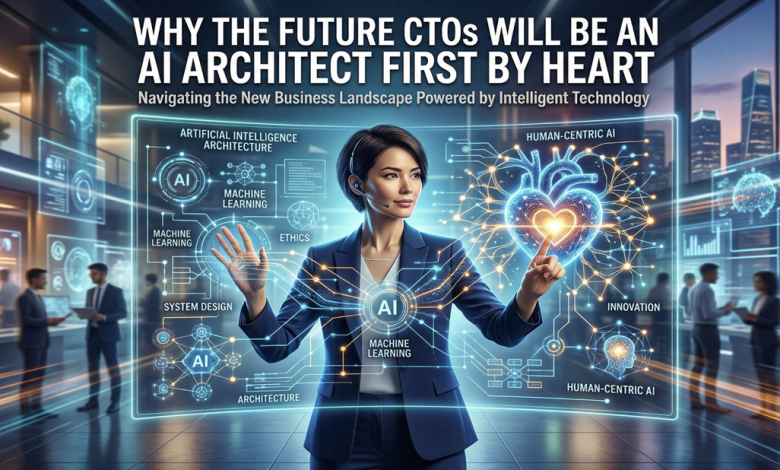
The definition of technology leadership has long been rooted in operational oversight managing engineering talent, optimizing infrastructure spend, and aligning delivery with broad corporate objectives. But as enterprise AI adoption matures, this foundation is fracturing. Data and technology leaders can no longer operate simply as resource managers or stewards of static infrastructure.
According to Deloitte’s State of AI report, organizations successfully scaling artificial intelligence are actively restructuring executive responsibilities, prioritizing holistic, system-wide integration over siloed technical expertise. The implication for data and technology executives is clear: the future belongs to leaders who approach the enterprise not as a collection of disjointed tools, but as an interconnected, intelligent ecosystem. To thrive, the modern tech executive must think like an AI architect first.
Infrastructure oversight to intelligence design:
In traditional enterprise environments, a technology leader’s success was measured by system uptime, software delivery velocity, and the robustness of the technology stack.
In an AI-driven paradigm, these responsibilities expand dramatically to ensuring reliable infrastructure, AI-native workflow design, Integrating models into decision-making systems and to ensuring AI systems’ scalability and governance.
With the evolution of AI and its ever-changing environment, CTOs need a fundamentally different mindset to treat AI as a core layer of the organization’s architecture, not just a tool. AI security architecture is a board-level concern. AI systems have taken on autonomous roles, and the risks associated with those roles have become more complex. Threats also include: Attacks on models, Data poisoning, and Unauthorized system behavior.
The National Institute of Standards and Technology (NIST) has emphasized the need for AI risk management “to improve the ability to incorporate trustworthiness considerations into the design, development, use, and evaluation of AI products, services, and systems.” For CTOs, they need to: Embed security into AI system design, ensure compliance and governance, and balance innovation with reduced risk.
Agentic AI and autonomous systems pose new challenges and are already being tested in different areas of organizational functions, including: Cybersecurity (threat detection and response), Workflow automation and operations and Customer interaction through adaptive systems.
For CTOs, this has expanded their responsibilities to include boundary-setting for autonomous decision-making, transparency and accountability, and ensuring that system behavior is aligned with organizational goals.
Mitigating the Fragility of Tightly Coupled AI Architectures:
A recent AI security issue disrupted airlines, financial services, and critical systems across many systems. Although it was initially thought to be caused by a cyberattack, it wasn’t. It was caused by a failure within a deeply rooted security infrastructure. The infrastructure operates at a scale where a single point of failure can spread globally within minutes. This incident exposed a clear problem. Modern enterprise systems are tightly coupled architectures and not loosely connected tools. Its failure modes are also amplified by design.
This incident provides a profound lesson for AI leaders : autonomous systems amplify failure modes by design . When agentic AI tools are integrated across multi-departmental workflows such as automated threat response, algorithmic operations, or customer-facing decision engines the blast radius of a system failure or data hallucination expands massively.
Fostering Accountability in Agentic Ecosystems:
The rise of Agentic AI systems capable of evaluating situations, making decisions, and executing multi-step workflows without constant human intervention demands a rewrite of organizational accountability. When an AI agent makes a costly operational error, responsibility cannot be deflected onto an algorithm. Data and technology leaders are responsible for defining the strict boundaries of autonomous decision-making. This requires a deliberate organizational readiness strategy:
- Human-in-the-Loop (HITL) Triggers: Designing systems where high-risk or high-financial-impact decisions require explicit human sign-off.
- Auditability by Design: Ensuring every autonomous decision path is logged, transparent, and completely reversible.
- Cross-Functional Readiness: Aligning legal, compliance, data engineering, and business units so that the operational boundaries of AI systems match corporate risk tolerance.
AI infrastructure is no longer an operational layer supporting the business. It now serves as a strategic lever that directly shapes outcomes. CTOs make decisions about cloud environments, model APIs, and data pipelines that influence crucial aspects of business success, such as cost efficiency, system scalability, and competitive advantage. Leading organizations are approaching AI infrastructure as a long-term investment that aligns their structural choices with business priorities from the start. Unlike industries that treat them as purely technical.
Conclusion:
Leaders nowadays should treat Data as an Active Supply Chain to ensure your data architecture supports real-time, context-aware retrieval rather than static storage, Design for Failure: Implement architectural circuit-breakers and canary deployments to insulate the enterprise from autonomous system drift and then Govern at the Architecture Layer: Embed compliance, data safety, and security directly into your core systems to handle the complex realities of AI scaling.
The CTO role is shifting structurally. AI systems are now more autonomous and embedded in the daily operations of many businesses, so leadership can no longer be limited to managing tools or oversight. What comes next will demand a direct approach to building AI- driven organizations.
The future will reward data and technology executives who can look at a complex matrix of models, data streams, and autonomous agents and accurately predict how they will behave operationally, financially, and ethically in the real world. By prioritizing robust data readiness, ironclad governance frameworks, and fail-safe architectural design, today’s leaders will build the resilient, intelligent organizations of tomorrow. It requires thinking like an AI architect first.