Every enterprise conversation about AI today circles the same question: how fast can we ship it? Far fewer are asking the harder one: who is accountable when it is wrong?
That gap is exactly why Quality Engineering (QE) remains critical as AI transforms software delivery. The question is no longer whether AI will change how software is built and tested. It is how QE must evolve to ensure that greater speed and autonomy do not come at the expense of quality, accountability and trust.
McKinsey’s 2025 research found that the highest-performing AI-driven software organisations achieved 31–45% improvements in software quality. The opportunity for Quality Engineering is to ensure those gains are repeatable, governed and sustained as AI-generated software scales
Why QE remains critical and how it must evolve
AI is easy to trust. The more convincing an AI system sounds, the less we tend to question it. That is the trap.
Agentic AI compounds it. Autonomous systems can introduce reasoning errors, bias and model drift that are difficult to detect. When an agent causes harm, the enterprise owns the outcome regardless of who, or what, wrote the code. Customers do not know an AI system failed; they simply know the product did. Unexplainable outputs can also make audit trails and compliance harder.
At the same time, AI has reduced the cost of producing code, allowing technical debt, redundant logic and subtle regressions to accumulate faster than conventional QE processes can absorb them. This makes QE more important, while exposing the limits of traditional approaches.
QE must therefore evolve from finding defects before release to becoming a quality custodian: ensuring AI-enabled systems behave as intended, remain explainable and controlled, and are trustworthy enough to operate in production.
AI can already generate test cases, scripts and data on demand. The value of QE consequently shifts from simply asking what to test to asking what should be tested, why it matters and how we know the result is trustworthy. The next evolution is towards QE that is increasingly diagnostic, predictive, observant, generative and prescriptive: identifying root causes faster, predicting what is likely to break, testing real user behaviour, generating test assets from requirements and determining which tests matter most for a particular change.
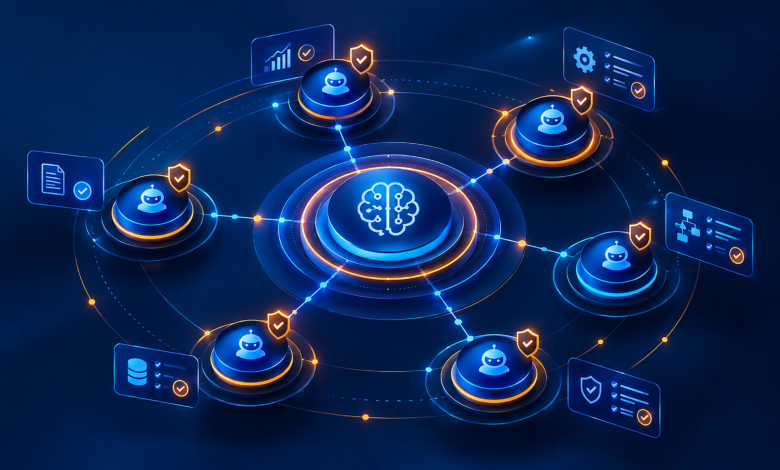
Anchoring these capabilities is what I would describe as agentic loop testing: verifying intent and outcomes at every decision point, engineered into the development lifecycle rather than bolted on afterwards.
The human role shifts accordingly. QE professionals move from operating test scripts to becoming custodians of autonomous quality systems, designing, governing and continuously improving them. Confidence scoring for AI-generated tests and human-in-the-loop checkpoints remain essential where the stakes are highest. The objective is not to remove human expertise from quality, but to place it where judgment matters most.
Scaling AI-led QE from pilot to enterprise
The challenge is scale.
Building an AI pilot is one thing. Making it work across a complex enterprise is another. Only 10–15% of AI pilots make it into long-term enterprise deployment, according to Forrester, while an MIT-backed study has found that nearly 95% of enterprise AI pilots fail to deliver measurable business impact. The gap is rarely AI itself.
A pilot succeeds in a controlled environment with a small team that understands its quirks. The enterprise is different: large numbers of connected applications, fragmented and inconsistent data, and CI/CD and ITSM tooling owned by different teams.
The same principle applies to AI-led QE. Scaling it requires more than introducing another AI tool into the testing lifecycle.
First, integration. Enterprises need an integrated approach spanning test design, execution, root-cause analysis and release decisions.
Second, talent and operating model. AI-led QE requires specialists who can orchestrate and govern AI workflows, not simply prompt them. Centers of excellence can help standardize practices, governance and guardrails across teams.
Third, processes designed for AI. Test planning should adapt in real time. Root-cause analysis should be driven by evidence rather than tribal memory. Release decisions should increasingly be informed by prediction than instincts.
The pragmatic path is to prove the model narrowly and then scale it: The practical approach is to validate the model in a focused environment, introduce predictive and diagnostic capabilities in high-risk areas, and then scale observability and autonomous quality practices across the enterprise while retaining human oversight where required.
The enterprises that succeed with AI-led Quality Engineering will not necessarily be the ones with the most advanced models. They will be the ones that recognize that as autonomy increases, the value of quality does not diminish. It increases.
QE is evolving from a function that validates software into a capability that helps enterprises determine whether autonomous systems can be trusted.
Because in enterprise AI, technology is rarely the ultimate constraint.
Trust is.