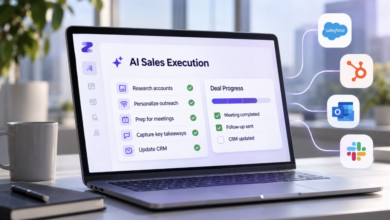

Databricks has built a multibillion-dollar business helping companies manage the data that informs their decisions. It now wants a larger role in putting those decisions into action, including work across applications sold by rival software companies. The expansion has substantial financial backing. In August, Databricks said its annual revenue run rate had surpassed $7 billion, up more than 80%. It also closed a $5 billion funding round at a $190 billion valuation, with Genie, its autonomous AI assistant for handling complex business tasks, among its investment priorities.
Recently, the company announced an upgraded Genie that no longer waits to be asked. Employees set a goal and boundaries, and the agent keeps working in the background, bringing open decisions to a priority inbox. Customers cannot switch that mode on yet. Genie and Genie Ontology are generally available, while the always-on mode is still headed for preview.
The launch comes amid growing competition. OpenAI introduced dots in September, and Google followed with its Gemini agent in October. Competition increasingly hinges on which vendor can give these assistants enough business context to make their work reliable.
For Patrick Wendell, Databricks’ co-founder and vice president of engineering, success depends on both the cost of running AI agents and how well they understand the business. Rolling out a frontier model to roughly 3,500 engineers increased Databricks’ spending by about 60%, according to its internal account. He claims that rival agents may retrieve a revenue figure without knowing whether it answers the business question. Before returning that number, an agent needs to establish how the requesting team defines and calculates revenue.
“Genie has an Agentic Ontology. Most other agents have a few limited MCP connections to data and try to figure out the business from there. Genie uses its Ontology to connect deeply to the authoritative business, product, sales, and support data you use to run the business, and deeply understands that data,” he tells me. “So when Genie runs a job, it’s working from numbers the business already trusts, not guessing numbers from documents and emails.”
Rival AI Agents Lack Business Context
Wendell explained that companies today have access to the same AI models, which are generally capable of handling tasks such as document generation and email drafting. However, much of the complex work within enterprises revolves around data, which captures how businesses operate. “We call this business DNA horizontal context, and it’s a company’s most valuable IP. Databricks is where some of the most valuable context (how your data connects to your business) naturally accumulates.”
Genie Ontology extracts knowledge from the analytical work companies already perform. External business intelligence tools, including Power BI, contribute business logic. A Workday directory connection supplies reporting relationships, while activity signals help Genie identify who actually works together. Moreover, teams establish authoritative definitions in Unity Catalog, Databricks’ governance system. Its OntoRank algorithm gives those definitions precedence over knowledge agents infer.
The arrangement gives companies a way to distinguish accepted business rules from patterns an agent merely observes and the context supports ongoing assignments. Likewise, Genie can monitor customer usage and flag meaningful changes, or investigate campaign underperformance and propose budget adjustments. Genie can suggest automating recurring work and respond to triggers, including when more than 10 customers request the same feature.
Databricks says thousands of customers already use Genie in production, including Zillow and Unilever. Those deployments establish a customer base for the expansion, although they do not demonstrate adoption of the new autonomous mode.
The Competition Over Data Behind AI Agents
Microsoft and Salesforce enter this contest through applications employees already use. Snowflake approaches it from the data platform, having announced background CoWork and CoCo bots on Nov. 3. Its planned private preview, alongside a Business Ontology and governance tools, shows how closely the competitors’ ambitions overlap.
Wendell pushed back against the idea that owning the application necessarily gives its agent the better position. “Knowing the data is what makes a workflow trustworthy. An agent that lives inside one app only sees one slice of the business,” he says. “What customers are asking for is a single agentic system of record and a single view of data across the business, so all agents are working from the same view of ground-truth data.”
His proposal gives Databricks a role inside employees’ preferred applications. Its lakehouse brings different kinds of data into a common platform, where customers can develop agents alongside the information they use. They can also retain their existing interfaces.
“Customers can curate that single agentic system of record in their Lakehouse because it’s easy to converge all their legacy systems into one open, central repository. If it makes sense to keep agents or users in the tools they know, that’s fine, too. Connect any AI tool to Databricks via Genie MCP, or call Genie right from inside your existing tools,” Wendell says. “But the future is clear: running the business from 12 disparate systems, each with its own view of the world, just doesn’t make sense. One open agentic system of record does.”
The argument positions Databricks against agents confined to individual applications. Snowflake presents a closer comparison because it also starts with governed data. The platform’s proposed advantage rests on how effectively its ontology learns from existing analytical work and makes that knowledge useful across other companies’ AI tools. Moreover, Databricks offers more than 100 connectors. Customers can ingest data or index it where it lives, while the Model Context Protocol, or MCP, enables live queries and permitted actions across applications.
Plugins bring that context into ChatGPT and Claude. Databricks can therefore gain influence over enterprise work without winning every employee’s choice of assistant. The competitive advantage, however, depends on whether its shared understanding proves valuable enough for customers to keep routing decisions through it.
Better AI Accuracy Still Leaves Humans Accountable
Databricks tested Genie’s ability to interpret business data in a benchmark developed with Turing. The test simulates a fictional British energy supplier, Calderwick Energy, with hundreds of data tables and older analytical files that could lead an agent to the wrong answer.
One task asked agents to find the planning rate the company had used in an earlier financial year. The relevant table showed 0.31 pence per kilowatt-hour because it applied newer planning assumptions to historical records. However, the notebook that generated the table documented the original rate of 0.52 pence. Genie found that explanation and answered correctly in all five attempts. The competing agents missed it.
Across the benchmark, Genie answered correctly in 91% of test runs, compared with 45% and 58% for two unnamed frontier AI agents. It also used less than half as many tokens and completed tasks roughly three to four times faster, according to Databricks. The testing setup matters. Genie ran directly within Databricks, while the competing agents used a toolset that excluded access to Genie through MCP. Databricks also acknowledges that its advantage may narrow in newer environments with less accumulated business knowledge.
The benchmark measures how accurately agents answer analytical questions. It leaves open how reliably they can manage longer projects without continuous supervision. Wendell described ongoing work on memory that agents can share and ways to request clarification without requiring users to monitor an entire task. However, he did not provide a failure rate for extended autonomous workflows. Genie’s permissions determine what it can access, but an agent can still make a poor decision within those limits.
“Genie’s access is always fully governed by Unity Catalog and Unity Gateway, but what it does with those permissions is something we design carefully. Genie is designed to clarify before taking actions and uses an independent AI classifier that evaluates whether a tool call is safe to auto-approve autonomously. This is layered on top of the customizable guardrails that customers can create in Unity Gateway,” Wendell explained.
On accountability, he says, “Genie is ultimately given authority by a human user either as an extension of that user when working as a personal assistant, or as a standalone agent explicitly provisioned for a specific task.” He adds, “Detailed tracing and auditing in Unity Gateway helps enterprises make sure they have visibility on all actions.”
Administrators decide which tools it can use and when it must seek approval, while users choose how independently it operates within those boundaries. The user remains responsible even as the agent handles more steps without individual approval.
Measuring Agent ROI Beyond Computing Costs
Databricks has already used Genie to identify and reduce unnecessary spending in its own AI systems. “We learned this one firsthand. If you don’t have cost controls from day one, spend gets away from you fast. That’s why we built Unity Gateway,” Wendell says. “We’ve even pointed Genie at its own usage, which found wasted tokens from expensive tool calls and recommended fixes. With Unity Gateway and Genie, we eliminated $1.2 million in annual token waste in one hour.”
The $1.2 million represents annualized savings from those changes. Databricks also reports cutting unit costs by as much as 90%, while token spending per employee remained roughly steady and output nearly doubled. Genie uses usage-based pricing, with administrators setting budgets and spending limits.
“We really don’t think the work that Genie does is comparable to traditional automation. The type of things Genie is capable of just weren’t automatable in the past. We think it’s approaching the point where it is more appropriate to compare it to the work teams are doing manually,” he says. “I think this forces enterprises to go back to first principles when it comes to evaluating ROI instead of just asking: do the outcome and the time saved justify the cost? We know there is a bit of a chicken and egg thing with this type of rollout, so we’ve made Genie free through the end of January 2027 so enterprises can start this evaluation without worrying about token costs.”
CEO Ali Ghodsi envisions employees becoming managers of AI systems, which means the time they spend supervising agents also matters.
“This is an area of very active innovation for us and for the industry at large. It’s also why we put so much thought into the escalation design and inbox feature instead of just copying popular modalities already out there. Our goal isn’t for people to watch Genie work. It’s for Genie to bring them only the decisions that matter,” Wendell says.
THE CONTROL LAYER VERDICT
Databricks wants Genie to manage the work employees now coordinate across separate business applications. Its value will depend on whether people can delegate those tasks without repeatedly clarifying instructions or correcting mistakes. When billing begins, customers should count the time spent supervising Genie alongside its usage charges. Otherwise, they risk paying for an AI coworker that gives its human colleagues more work to do.