When AI systems fail, the model is often blamed first. In production, however, reliability usually breaks earlier and deeper: in the GPU layer, the interconnect, the data pipeline, the retrieval stack, and the operational controls that surround the model.
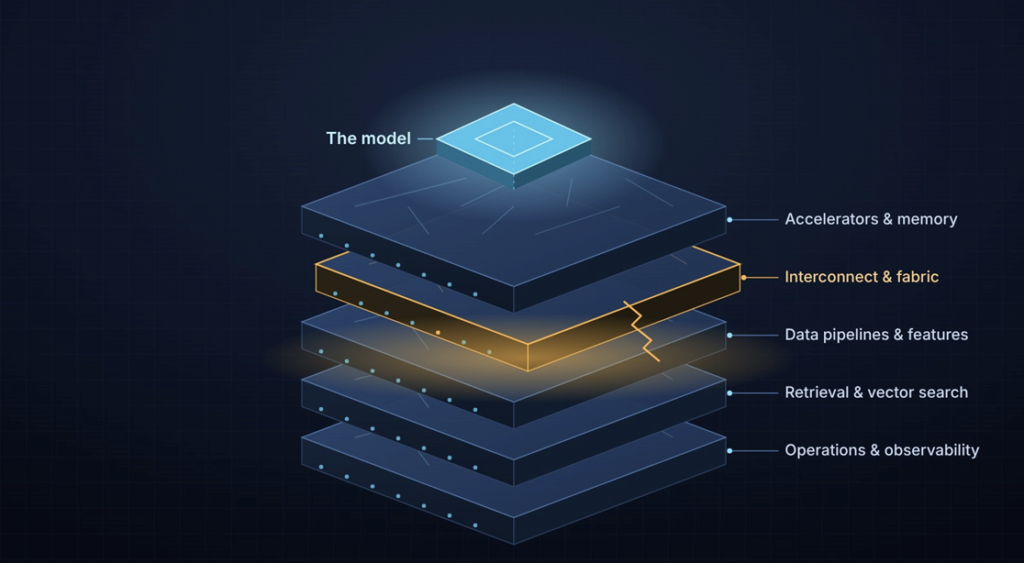
The model sits on top, but reliability is decided in the layers beneath it.
The conversation around AI performance is still dominated by models. Teams debate architectures, prompts, training data, and fine-tuning strategies as if capability and reliability are primarily model-layer concerns. In practice, they are not.
Production AI systems succeed or fail as end-to-end systems. The model matters, but so do the layers beneath and around it: accelerators, memory, interconnects, storage, orchestration, retrieval, observability, and feedback loops. When any of those layers degrade, the result is rarely an obvious outage. More often, it is a system that still responds while becoming slower, less current, or less trustworthy.
That is what makes AI infrastructure different from ordinary infrastructure hygiene. In conventional software, weak infrastructure usually makes the application slow or unavailable. In AI systems, it can also distort the context, throughput, or runtime conditions on which the model depends.
AI quality, in other words, is not only a modeling problem. It is also a systems engineering problem.
Reliability Starts in the GPU Layer
Most users encounter AI at inference time, but reliability is shaped earlier, in the compute layer itself. Modern training and serving systems are constrained not just by raw FLOPS, but by memory capacity, memory bandwidth, fabric health, device thermals, power behavior, and topology.
This is why accelerator health has to be treated as a first-class production concern. Fleet-management tools such as NVIDIA’s Data Center GPU Manager (DCGM) and AMD SMI show what operators actually watch in the field: memory error events, page retirements, hardware faults, thermal and power excursions, PCIe replay events, and fabric link errors. These are not theoretical edge cases; they determine whether an AI workload is merely running or running in a healthy state.
Three accelerator-side bottlenecks show up repeatedly across the sector:
The first bottleneck is a memory reliability and memory pressure. At training time, memory faults can force restarts or invalidate a run. At inference time, memory pressure often becomes the limiting factor before compute does. The PagedAttention research behind vLLM shows that large language model serving is frequently bottlenecked by KV-cache management, with fragmentation and over-reservation wasting substantial GPU memory.
That waste directly constrains batch size, concurrency, and context length.
The second, thermal and power behavior. Health monitoring tools track thermal violations, power violations, and clock slowdowns tied to board and reliability limits. A cluster can look nominal at the scheduler layer while one or more GPUs are throttling below their intended clocks. In distributed jobs, a single throttled worker becomes a straggler, and the rest of the job waits.
Lastly, interconnect and topology health. Distributed AI depends on collective communication, as the PyTorch distributed communication guide and collective libraries such as NCCL and RCCL make clear. If NVLink, Infinity Fabric, PCIe, InfiniBand, or RoCE paths are congested or unhealthy, synchronization overhead rises and the slowest path defines the job. This is why monitoring tools expose link-level counters for replay, CRC, and recovery errors.
Utilization Is Too Blunt a Signal
Many teams still use aggregate GPU utilization as a proxy for health. That is too blunt. Profiling metrics can distinguish compute activity, memory activity, tensor-core activity, PCIe throughput, and inter-GPU link throughput. A GPU can appear heavily utilized while the workload is actually memory-bound, link-bound, or stalled behind synchronization.
Topology and placement matter too. The same model can behave differently depending on CPU affinity, NUMA locality, PCIe path quality, and whether peer-to-peer traffic flows across the intended links. Serving guides such as TensorRT-LLM’s CPU affinity guidance are a reminder that performance stability is shaped by system layout, not just accelerator count.
Data Freshness Is an Accuracy Requirement
A model can be statistically sound and still produce the wrong answer if its inputs are stale.
This matters most in systems that rely on live context: fraud detection, demand forecasting, logistics, cyber defense, operational copilots, and knowledge-grounded assistants. In those environments, the common failure mode is often delayed or mismatched data rather than corrupted data.
If events arrive late, features are materialized too slowly, or embeddings are generated from yesterday’s documents instead of today’s, the model reasons over a version of reality that no longer exists.
That is why AI infrastructure teams focus so heavily on streaming, feature freshness, and end-to-end latency budgets. Common open-source building blocks include Apache Flink for stateful stream processing, Feast for consistent online and offline feature serving, workflow systems such as Airflow and Dagster, and messaging layers such as Kafka or Pulsar. Freshness has to be engineered, measured, and protected like any other service-level requirement.
In Retrieval Systems, Infrastructure Becomes the Accuracy Engine
This is even more visible in retrieval-augmented generation (RAG). Once an AI system depends on external knowledge retrieval, answer quality is no longer defined by the language model alone. It is shaped just as much by the retrieval stack.
If chunking is poor, indexing is inconsistent, embeddings are outdated, or approximate nearest-neighbor settings are badly tuned, the model receives weak context. At that point, even a strong model is forced to interpolate, guess, or overstate confidence. The issue is not necessarily the model; it is the quality of the context pipeline feeding it.
Tooling in this space spans libraries and databases alike. FAISS, Milvus, Weaviate, Qdrant, pgvector, OpenSearch, and Elasticsearch are all common choices. Whichever is used, teams still have to balance recall, latency, cost, update frequency, and operational simplicity.
Serving Configuration Shapes Answer Quality
Serving infrastructure adds another layer of complexity. To improve throughput and control cost, organizations use quantization, dynamic batching, request scheduling, and optimized inference runtimes. These are sensible techniques, but they need careful validation against quality benchmarks, not just throughput targets.
Inference engine documentation, such as the vLLM docs and the TensorRT-LLM quantization guide, shows how much serving quality depends on runtime configuration, memory strategy, batching behavior, and supported kernels. Retrieval and serving systems do not simply support the model. They redefine where answer quality comes from.
Day-2 Operations Determine Whether Trust Holds
Deployment is not the finish line for AI reliability. It is the point at which real reliability work begins.
Once a model is live, the environment around it keeps changing. User behavior shifts, source content evolves, business policy changes, and traffic patterns move. A system that performed well during validation can degrade gradually in production without ever triggering a conventional incident.
That is why AI observability has to go beyond uptime and API error rates. Teams need visibility into drift, retrieval quality, feature freshness, latency percentiles, cache behavior, grounding success, and human feedback loops. OpenTelemetry provides a vendor-neutral foundation for traces, metrics, and logs, with open-source tools such as Prometheus, Grafana, MLflow, and Langfuse, as well as internal evaluation harnesses, often sitting on top.
For data and model drift, the Evidently guide to data drift is a useful reference because it distinguishes drift, data quality issues, and training-serving skew.
The goal is not to monitor everything. It is to monitor the signals that distinguish “the service is responding” from “the service remains trustworthy.” Those are not the same condition.
Strong Day-2 operations also require rollback discipline, versioned data and prompts, reproducible pipelines, and regular evaluation against realistic workloads. Distributed frameworks such as Ray Train, cluster schedulers such as Kubernetes and Slurm, and experiment-tracking systems such as MLflow or Kubeflow matter because they help teams reproduce failures and recover safely.
The Strategic Lesson: Treat Infrastructure as Part of the Product
The key infrastructure question in AI is not, “How fast can we run the model?” It is, “What conditions must hold for this system to remain trustworthy under real load?”
That framing leads to better decisions. It pushes organizations to invest in resilient data movement, healthy accelerator fleets, well-instrumented retrieval, predictable serving, and operational feedback loops. It also encourages a healthier instinct: when AI quality drops, do not assume the model is the only suspect.
The organizations that build dependable AI will not necessarily be the ones with the most impressive demos. They will be the ones that treat infrastructure as part of the product rather than plumbing behind it.
Because in production AI, infrastructure does more than keep the system running. It determines whether the system deserves to be trusted.