An AI pilot often has a champion. Someone organizes demonstrations, shares useful prompts, and helps colleagues try a new tool. That energy matters, but it does not answer what happens when an agent becomes part of a real business process.
Imagine an agent that reads incoming customer requests, retrieves approved guidance, and drafts a response for an employee to review. Who decides which requests it may handle? Who checks whether its answers remain accurate after a policy change? Who has the authority to pause the workflow when exceptions rise?
If those questions have no named answer, the organization has enthusiasm for AI but no clear owner for the work it is changing. Agentic AI adoption needs both champions who help people begin and workflow owners who remain accountable for what happens next.
An agent changes a process
A conventional assistant may help a person draft or summarize. An agent can connect steps: classify a request, retrieve information, call a tool, prepare an action, and hand work to a person or another system. Even when a human approves the final step, the agent may alter the sequence and timing of the work.
That means the unit of adoption is the workflow, not the seat. A team can report frequent use while employees quietly redo inaccurate drafts, work around brittle handoffs, or catch errors too late. A workflow owner has to see the whole path from the initial request to the final outcome, including exceptions.
The NIST AI Risk Management Framework treats governance, mapping, measurement, and management as continuing activities. Its AI RMF Playbook also emphasizes defined roles and responsibilities. For agentic workflows, those principles become practical only when someone can make decisions about the business process itself.
What a workflow owner does
The workflow owner is accountable for the result of a defined process, not for building the model. That person might lead operations, customer support, finance, or another function, depending on where the work lives. They need enough authority to set the workflow’s purpose, review its performance, resolve cross-team issues, and decide when its use should expand or stop.
Technical teams still own technical controls. They manage access, integrations, testing, logging, and system reliability. Security, privacy, and legal partners advise on their respective requirements. The workflow owner brings these perspectives together around the decisions that affect the people and outcomes of the process.
Define the result before counting use
The owner starts with a specific job and a baseline. For a customer-request workflow, the desired result might be accurate first responses within a defined time, with appropriate escalation for complex cases. The baseline should include the current time to respond, quality or correction rate, and volume of exceptions.
Logins and agent runs can show that the workflow is being used. They cannot show whether customer experience improved or whether employees are absorbing hidden rework. The owner should choose a few outcome measures that make those tradeoffs visible and state how each will be checked.
Set authority and handoffs
The owner specifies what the agent may read, draft, recommend, or change. They identify which decisions require a human and where the work moves between teams. An agent may draft a reply, for example, while only an authorized employee can send it or approve an exception to policy.
These boundaries must be enforced in the system. OWASP’s guidance on excessive agency identifies excess functionality, permissions, and autonomy as sources of potentially harmful actions. A workflow owner cannot replace technical safeguards, but can make the intended authority and business consequences clear enough for technical teams to implement them.
Own quality and exceptions
The owner defines what a good result looks like for this task. That may include factual accuracy, source support, completeness, tone, timeliness, and the rate at which reviewers accept or substantially rewrite drafts. The right measures depend on the workflow and the cost of getting it wrong.
Exceptions deserve equal attention. If the agent cannot find approved guidance, receives conflicting information, or encounters a request outside its scope, the workflow needs a visible fallback. The owner decides who receives that work, how quickly it must be handled, and when repeated exceptions signal a need to change the workflow.
Keep the workflow current
Business processes change. A new policy, product, form, or approval rule can make yesterday’s answer wrong even if the model and its infrastructure are working as designed. The owner needs a route for those changes to reach the agent’s sources, instructions, tests, and employee guidance.
This is an operating responsibility, not a one-time launch task. The owner should review samples and exception patterns regularly, with technical partners, and decide whether to adjust, pause, or retire the workflow. The OECD AI Principles call for accountability and traceability across an AI system’s lifecycle; a named workflow owner gives those ideas a place in day-to-day operations.
A hypothetical customer-support example
Consider an agent that sorts incoming support requests, retrieves approved help content, and drafts replies for employees. An AI champion introduces the tool, collects examples of useful prompts, and helps peers learn the interface. Those contributions can increase confidence and surface valuable feedback.
The support workflow owner makes different decisions. They define which request types are eligible, when an employee must take over, what evidence a reviewer needs, and how to measure response quality. They also set the process for updating source content when a policy changes.
Suppose a new return policy takes effect, but the agent continues to draft responses from older guidance. The champion may be the first to hear that something feels wrong. The owner has to coordinate the correction, identify affected requests, determine whether work should pause, and verify that the updated workflow performs as intended before it resumes.
This example is hypothetical. It shows why feedback and accountability need to connect: the champion helps reveal the problem; the owner has the authority to resolve it across the process.
Give ownership a simple operating record
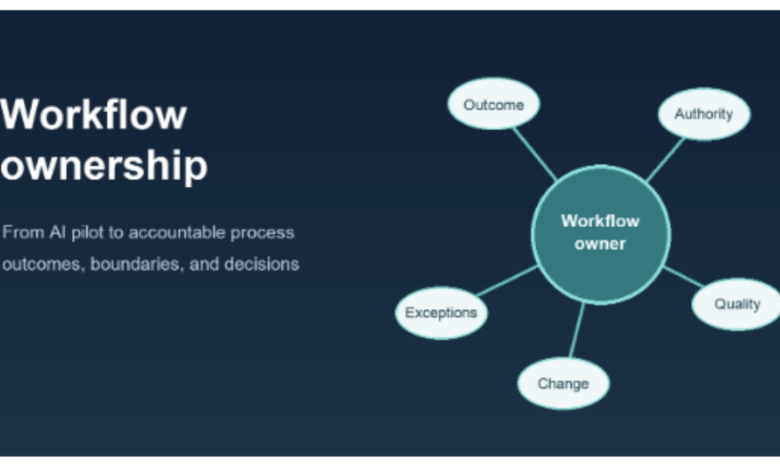
Before a pilot becomes routine work, record six decisions in one place:
- Owner and purpose: Who owns this workflow, and what outcome should improve?
- Scope and authority: Which requests qualify, and what may the agent read, draft, recommend, or execute?
- Review: What must a person check, and which actions require approval?
- Quality: Which outcome, error, and rework measures will be reviewed?
- Exceptions: Who handles failures, unexpected actions, and requests outside scope?
- Change: Who updates sources and tests when the business process changes, and who can pause the workflow?
This record should be short enough to use and specific enough to guide a decision. It is not a substitute for technical documentation or policy. It is the agreement that lets business and technical teams see whether they are operating the same workflow.
Keep champions close to the work
Champions remain valuable after a workflow owner is named. They help colleagues discover appropriate uses, share practical examples, and surface friction that dashboards miss. They can also tell the owner when employees are bypassing a step, correcting the same error repeatedly, or losing confidence in the result.
The owner should give champions a clear route for that feedback and close the loop on what changes. Champions should not be asked to carry accountability; they do not have the authority or time to exercise. Advocacy works best when it is connected to a process that someone can actually improve.
Start with one workflow. Name its owner, define the intended result and permitted actions, test the exception path, and review the first weeks of real use. Expand only when the owner can explain what improved, what still fails, and who will act when the process changes.
Agentic AI becomes part of an organization when it changes how work gets done. That change needs people who make adoption possible and people who own the outcome. AI champions can create momentum; workflow owners make that momentum accountable.