
Promising agent prototypes often collapse under real business conditions. By 2026, what separates a working pilot from something that actually holds up in production usually isn’t prompt quality. It’s the workflow architecture underneath it. The organizations pulling ahead have figured this out already, treating agentic AI as a design problem first, rather than something to keep tinkering with indefinitely.
Early agentic experiments delivered quick wins through clever prompting. Scaling exposed the cracks fast. Legacy systems, shifting data, and multi-step coordination tend to break ad-hoc instructions the moment things get complicated. The teams making real progress shifted focus toward mapping logic before writing code, and it shows in the results.
The Scaling Reality Behind Agentic Ambitions
A recent State of AI survey from McKinsey found 62% of organizations experimenting with AI agents, yet only 23% have scaled that work anywhere, usually within a single function rather than across the business. One line from the research stands out: intentional workflow redesign carries one of the strongest links to real business impact.
The adoption curve tells a similar story from a different angle. Task-specific AI agents are expected to appear in 40% of enterprise applications by the end of 2026, up from less than 5% in 2025, according to Gartner, with potential to drive close to 30% of enterprise software revenue by 2035.
Yet the same firm forecasts something less encouraging: more than 40% of agentic AI projects will be canceled by 2027, largely over costs, unclear returns, and thin risk controls. The advice coming out of that research is blunt: rethinking workflows with agentic AI from the ground up is “the ideal path,” not an optional extra.
None of this means agentic AI is overhyped. It means reliable systems need more than polished instructions. They need intentional design around how agents plan, remember, coordinate, and recover.
Mapping Logic Before Code Prevents Costly Rework
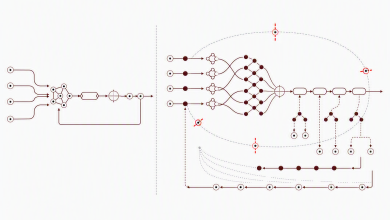
A clear Flowchart lays out decision paths, recovery routes, oversight checkpoints, and data exchanges before any code gets written. Most teams skip this step, and it shows.
Build agents around open-ended prompts alone, and everything looks fine in testing. Production tends to expose what testing never caught: unexpected branches, lost context, cascading failures.
Visual mapping catches these problems early. Teams can spot loops forming, or one component’s output quietly breaking the next step, long before it turns into an expensive surprise. There’s a useful way to think about this in a piece on seizing the agentic AI advantage by McKinsey, which describes agents breaking the so-called “GenAI paradox” through autonomy, planning, memory, and integration, things static prompting rarely delivers on its own.
This clarity also supports multi-agent setups well, where specialized agents handle distinct responsibilities while an orchestration layer manages state, routing, and escalation.
What Effective Workflow Design Looks Like in Practice
Organizations that get agentic systems into production, and keep them there, tend to share a few habits:
- Defined role boundaries keep each agent within a clear scope.
- Persistent memory keeps context flowing across steps, so nothing resets and starts from zero halfway through.
- Built-in decision gates step in too, giving humans a chance to review things right when it matters most.
- Explicit recovery paths anticipate common failure modes.
- Measurable success criteria get set upfront, before the project even starts.
Put together, agentic AI stops being a set of clever responses and starts acting like dependable infrastructure. That argument gets reinforced in research on reimagining tech infrastructure for agentic AI, which points out that systems meant to orchestrate and scale this work need infrastructure built for it from the start, not bolted on later.
Practitioner Views on Why Architecture Matters More Than Prompts
Builders working at the infrastructure level tend to agree on this point. Speaking on Sequoia Capital’s Training Data podcast, LangChain’s Harrison Chase argues the real value sits in the orchestration layer, somewhere between rigid chains and full autonomy. His case for “constrained, domain-specific cognitive architectures” over unconstrained prompting has become something of a rallying point among builders.
A related point came up in a separate Sequoia conversation, where Vercel CEO Guillermo Rauch called for agents to be treated as “first-class users” of software. That means redesigning APIs and interaction patterns for complex, multi-step workflows, rather than assuming agents will adapt to interfaces built for humans.
Deloitte weighs in with a number worth remembering, from its research on AI agent orchestration: better orchestration could unlock 15% to 30% more market value compared to poorly coordinated multi-agent setups. Weak orchestration, that report notes, caps potential before it even starts.
Moving From Promising Pilots to Dependable Systems
Worth asking here: how much of your current AI work still leans on ad-hoc prompting versus workflows built on clear process logic? The same acceleration shows up in the 2026 AI Index Report out of Stanford, alongside a widening gap between organizations that scale and those that stall.
The teams seeing stronger returns treat workflow design as core engineering, not a polish step tacked on before launch. As explored in this coverage of agentic AI and the reinvention of enterprise decision-making, the shift toward orchestration-focused approaches is becoming less of a nice-to-have and more of a practical requirement for anyone hoping to deploy sustainably.
If your teams are still iterating mainly through prompts, setting aside time to visualize and pressure-test the underlying flows can help. The gap between a working prototype and something production-ready tends to show up in those diagrams long before it shows up in the performance numbers.