

Why Individual Productivity Gains Aren’t Translating into Business Impact
By Andrew Murphy, CSO and Co-Founder of jaam automation
Businesses are seeing the benefits of AI at an individual level, but turning those gains into measurable improvements across the wider organisation is proving more difficult. As investment accelerates, the question is no longer simply what AI can do, but whether businesses are changing how they operate to get the most from it.
UK Government research published in 20261 highlights the disconnect. Three-quarters of businesses using AI reported improved workforce productivity, yet 77% had not seen a change in revenue since adopting it. Meanwhile, Accenture research found that only one in ten2 UK organisations had successfully scaled AI or embedded it into core operations.
These findings point to a challenge that extends beyond the technology itself. When AI improves individual tasks without changing the processes connecting them, its impact remains fragmented. Employees may work faster, but the organisation as a whole does not necessarily work smarter.
With the UK Budget approaching and productivity high on the economic agenda, businesses need to look beyond AI adoption figures and consider how the technology can deliver tangible operational and commercial value.
From AI assistants to connected workflows
The first wave of enterprise AI focused on experimentation, giving employees access to tools was a sensible starting point, but it only goes so far.
An employee might use AI to produce a report in half the time, but if the information still needs to be copied manually into another system, an approval chased by email or the same work repeated by another team, the wider process remains unchanged.
AI agents offer a more significant opportunity. Rather than simply responding to prompts, they can carry out defined tasks, monitor progress and help coordinate what happens next. But their potential depends on how effectively they connect to the wider business.
Adding agents to disconnected processes risks creating another layer of technology without addressing the underlying problem.
Connecting people, agents and business systems
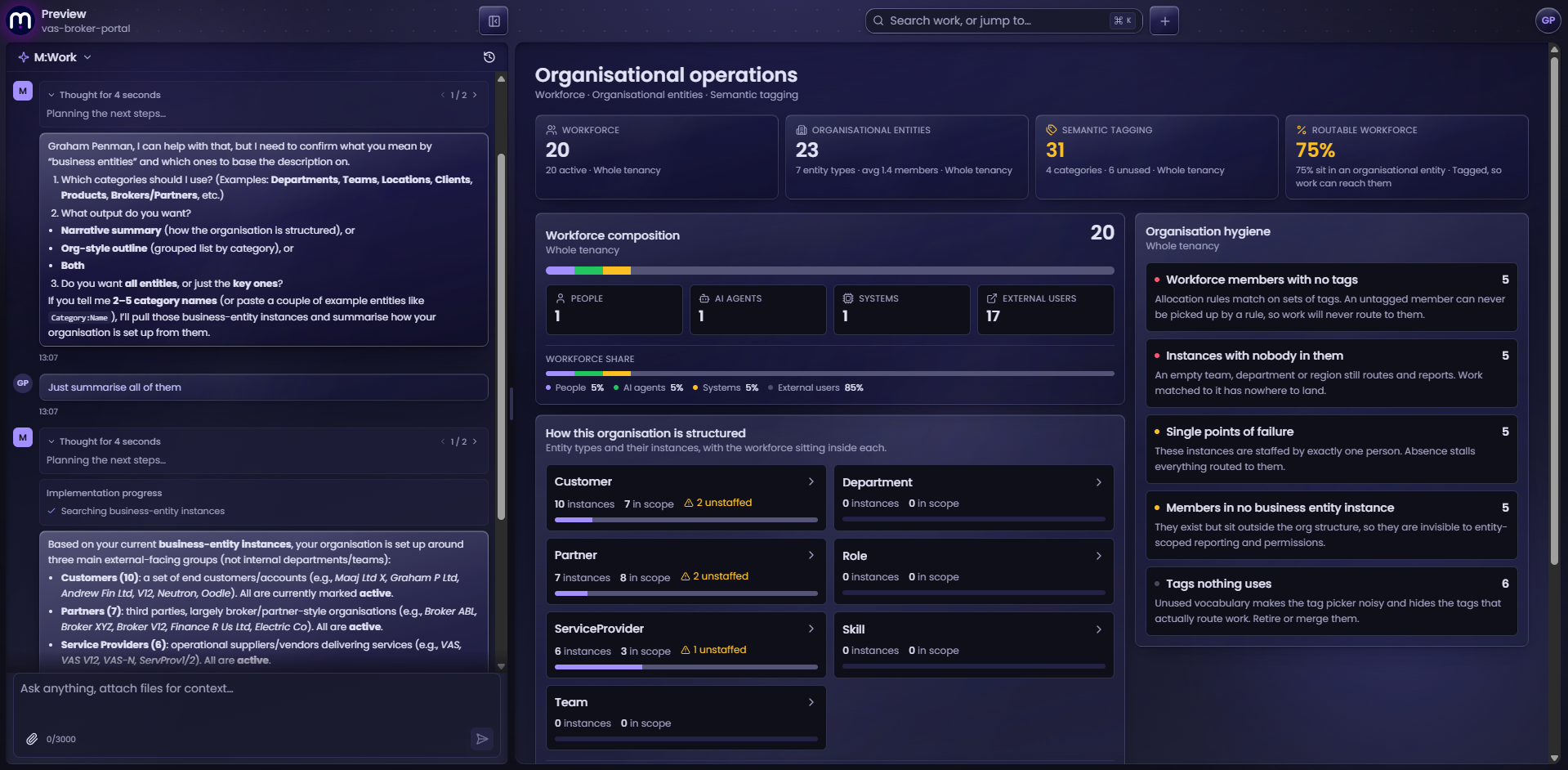
Agentic Work Management brings people, AI agents and existing systems together around the work that needs to be done.
Consider customer onboarding. Sales, finance, IT and customer success may each manage different stages using separate applications. Information becomes fragmented, handovers create delays and employees spend valuable time coordinating activity.
A more connected approach enables people and agents to collaborate across the process: gathering information, completing checks, updating records, monitoring deadlines and escalating exceptions when human judgement is needed.
The aim is not just to automate more tasks, but to coordinate the entire process more effectively, while retaining human visibility and accountability.
Why organisational context matters
Even a highly capable AI model can struggle to act effectively without understanding the business environment in which it operates.
Knowing how to draft an email is different from knowing which customer should receive it, what contractual obligations apply, which system holds the relevant information and whether approval is required before it is sent.
That understanding comes from organisational context: business data, processes, policies, permissions, systems and the relationships between them.
Without it, an agent might complete a task correctly in isolation but still make the wrong contribution to the wider process. Businesses need to ensure agents have the right information, at the right time, with clearly defined boundaries around what they can access and do.
Rethink the process, not just the technology
Many business processes were designed around human handovers, manual checks and the limitations of traditional software. Automating individual steps may improve efficiency, but it will not necessarily remove unnecessary complexity.
Businesses need to examine workflows from beginning to end. Which activities genuinely require human involvement? Which can be handled by agents? Where are decisions made, how does information move between systems and what happens when something falls outside the expected process?
This does not mean replacing established CRM, ERP, finance or collaboration platforms. The opportunity is to connect them more intelligently, enabling AI to coordinate work across existing technology rather than creating another isolated destination for employees.
For businesses facing pressure to demonstrate a return on their AI investment, redesigning how existing systems work together could be more valuable than simply adding another tool.
Autonomy needs accountability
As agents take on more responsibility, governance becomes increasingly important. Routine, low-risk activities may be suitable for greater autonomy, while decisions involving financial commitments, regulatory obligations or reputational risk may require human approval.
Organisations need clear permissions, visibility into agent activity and mechanisms for escalating exceptions. They must be able to understand what an agent has done, why it acted and when a person needs to intervene.
This isn’t about slowing adoption, it’s about building the trust and operational control needed to expand AI safely. Businesses can start with well-defined tasks, assess performance and reliability and increase autonomy as confidence grows.
Turning AI investment into economic value
AI has considerable potential to improve productivity, but that potential will not be realised through technology investment alone. If the UK is to capture the economic benefits of AI, businesses need to move beyond isolated efficiency gains and embed the technology into the way work gets done.
That means connecting people, processes, systems and organisational knowledge so AI can contribute to business outcomes, rather than just making individual tasks faster.
The organisations that make this shift will be better positioned to translate AI capability into operational value. Those that don’t risk accumulating pockets of productivity while the processes connecting them remain slow, fragmented and difficult to scale.
The next AI advantage won’t come from giving employees more tools, it’ll come from redesigning work so people and AI can deliver better results together.

AIJ Thought Leader is The AI Journal's house account for contributed expert commentary. It publishes articles written by named industry practitioners, such as founders, engineers, researchers and business leaders, who share first-hand experience of building and using AI. Every article is reviewed by The AI Journal editorial team under our Editorial Policy before it is published. Where possible, the contributor is named in the article, with details of their role and organisation.
More from AIJ Thought Leader
See all AI & Technology
Your Underwriting Agent is Ready to Act, Your Risk Architecture Isn’t
 AI & Technology
The next AI frontier in insurance is not automation – it is orchestration
 Data
The commercial cost of AI skills gaps: UK business leaders report lost opportunities
 AI & Technology
AI could move healthcare from reacting to disease to preventing it
Recommended for you
More stories AI Business Strategy
How Recognition Patterns Can Warn You About Flight Risks Early and Encourage Managers to Use New AI HR Tools
 AI Business Strategy
11 AdTech CEOs We’re Looking At
 AI Business Strategy
The EU AI Act is forcing businesses to get serious about AI accountability
 AI Business Strategy
How MYbank Is Rebuilding Itself Around AI Agents to Serve 42 Million Small-Business Owners
 AI Business Strategy
Helping the Next Generation of Investors Understand Market Information
 AI Business Strategy