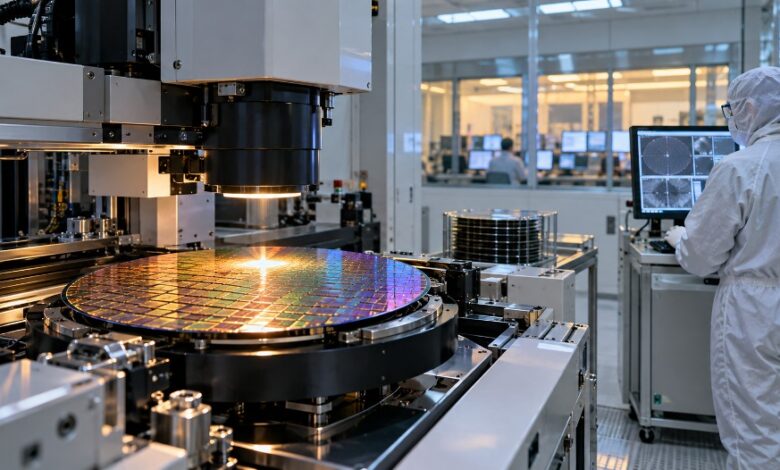
Everyone is watching AI write code, answer questions, and generate images. Loud work. The louder those demos get, the more a quieter and frankly more consequential kind of AI gets overlooked, the kind that never trends. In semiconductor manufacturing, the consequential work is exactly that quiet kind: catching a process deviation early enough for an engineer to stop it before it becomes a yield problem.
Here is what makes that hard. A chip moves through hundreds of tightly linked steps, and a signal from one tool means almost nothing on its own. It matters only when you read it alongside the wafer, the recipe, the process stage, and the conditions around it. So the real challenge is not a smarter prediction. Not even close. It is turning that prediction into a decision someone standing on the floor, mid-shift, with a lot on the line, can actually trust and act on before the window to prevent the problem quietly closes.
That is the shift the industry is quietly making: from AI pilots to manufacturing intelligence. Pilots impress. Loops deliver. The teams that win will not have the flashiest model. They will be the ones who connect sensing, prediction, engineering judgment, and bounded action into a single operating loop.
The Burning Platform: Data Is Growing Faster Than Decisions Can Keep Up
The pressure is real, and it is growing. Global semiconductor sales reached $791.7 billion in 2025, and the Semiconductor Industry Association projects roughly $1 trillion for 2026. More demand means more pressure to lift output and quality without losing control of processes that are already near the edge of complexity. And here is the tension that defines the moment: the data a fab produces is growing far faster than the decisions anyone can make from it. Sensors multiply, capture rates climb, storage swells. The volume of signal races ahead while the rate of good, timely decisions crawls. Closing that gap, not collecting more data, is the real work.
And these processes are unforgiving. Micron describes memory manufacturing as up to 1,500 steps that can span months. Think about what that means for a defect: by the time it shows up at final test, the root cause may have quietly touched many wafers already. Late is expensive. Very expensive.
There is also a subtler tax. A 2025 NIST workshop report notes that manufacturers have reported data preparation alone can eat as much as 70% of the total cost of a single AI application. Data gathered for one model often cannot be reused for the next, because each team prepared it a little differently. So the prediction is not usually the bottleneck. The decision is. Getting a trustworthy prediction into an engineer’s hands, in context, early enough to matter, is where the data-to-decision gap is won or lost.
What Changes When You Design for the Decision
Start with context, because a raw sensor value is close to meaningless alone. The system has to know which tool produced the reading, what process was running, which wafer or batch was involved, and whether the measurement is even complete. Context is everything here. It is what separates a genuine warning that deserves an engineer dropping what they are doing from the ordinary, harmless variation that a fab produces all day long without incident.
Then comes trust. This is where most pilots quietly die. An engineer will ignore an alert they cannot investigate. So the system has to show its work: which factors drove the prediction, how confident it is, and what similar past events looked like. Confidence thresholds, traceable inputs, and known failure modes are not nice-to-haves. They are the difference between an alert that gets acted on and one that gets muted.
Finally, match the action to the risk. Early on, the model should recommend an inspection, rank likely causes, or ask for a second measurement. Nothing more. Full stop. Automated action earns its place only where the response is bounded, reversible, and validated, and a human stays in the loop for anything that could change a recipe, halt production, or ripple into downstream lots. Here is the counterintuitive part: more data does not automatically mean better AI. A NIST semiconductor benchmark found that consistently processed data from multiple machines cut false positive rates by 30% to 50% while holding an acceptable true positive rate. The win came from qualification and consistent context, not from a bigger model.
Anatomy of One Decision Loop
Make it concrete. Picture a single recurring problem: a subtle drift in a deposition step that, left alone, shows up as a thickness failure three stages later. The pilot version of AI here is a model that flags the drift with 92% accuracy and emails a dashboard link. Impressive in a demo. Useless at 2 a.m., because the engineer who gets the alert cannot tell whether this is the real thing or the fourth false alarm that shift.
Now picture the loop version. The same prediction arrives, but it carries its context with it: the tool ID, the recipe running, the specific wafers at risk, the three signals that moved, and how this pattern compares to the last time it preceded a real excursion. The engineer sees not just “drift detected” but “here is why, here is how sure, here is what it looked like last time.” They confirm in ninety seconds, request a second measurement, and the step gets corrected before a single wafer reaches the failing stage. Same model. Completely different outcome. The difference was never the accuracy number. It was everything wrapped around the number.
That gap between the two versions is the whole game, and it is worth naming what separates them:
- A pilot optimizes a metric. A loop optimizes a decision.
- A pilot ships a prediction. A loop ships a prediction plus its evidence, its confidence, and a bounded action.
- A pilot is measured in accuracy. A loop is measured in decisions made sooner, false alarms avoided, and excursions prevented.
- A pilot ends when the model works. A loop is never done, because it learns from every investigation an engineer closes.
None of this requires a more powerful model than the pilot had. It requires wrapping the model in the operational scaffolding that lets a human trust it under pressure. That scaffolding is unglamorous, and it is exactly what most pilots skip.
Evidence From the Floor
Micron offers the large-scale picture. The company reports applying AI across manufacturing data from more than 590,000 sources, processing 100 million wafer images and 436 million control points each week. Drawing on its internal data from 2016 through 2025, Micron reports 4% higher tool availability, a million work hours in annual productivity gains, and a 50% reduction in product scrap, alongside faster time to market. Those are company-reported figures, so read them in that light. The operating lesson holds regardless: value shows up when analysis is embedded in routine production work, not run off to the side as an experiment. Micron’s account spans visual inspection, equipment monitoring, and yield analytics.
A NIST-supported study using publicly reported Seagate data makes the complementary point. Researchers combined qualified etch-machine data into roughly 100,000 batch runs and tested a wafer-flatness model across machines. Broader, consistently described coverage produced 30% to 50% lower false positive rates than models trained on siloed data. Coverage helped. But only because the teams first did the unglamorous work of agreeing on how to describe and qualify everything they were feeding the model.
Close the Loop, or the Model Goes Stale
There is one more piece, and skipping it is why some production models quietly rot. Every investigation an engineer completes is a labeled data point: was the alert useful, what did they find, what did they do. Capture that, and the model improves, the operating thresholds sharpen, and drift in the tools themselves becomes visible over time. Skip it, and you are running last quarter’s diagnosis engine against this quarter’s process, slowly losing accuracy while nobody notices. A fab changes constantly: new materials, requalified tools, seasonal shifts. A model that cannot learn from the floor it lives on is depreciating from the day it ships. The loop is not a nice-to-have at the end. It is the thing that keeps the whole system honest.
Where to Start
You do not need a platform program to begin. You need one decision.
- Pick a single recurring call an engineer already makes by hand, one with a clear owner and a bounded response. Not the hardest problem. The most repetitive one.
- Wrap the prediction in its evidence before you tune its accuracy. Tool, recipe, wafers at risk, the signals that moved, the last time this pattern showed up. If an engineer cannot investigate the alert in ninety seconds, it will get muted, and accuracy will not save it.
- Keep the first action bounded and reversible: recommend, rank, or ask for a second measurement. Earn automation later, on the actions where a wrong call is cheap to undo.
Ship that one loop, measure whether it makes the decision sooner, and let the result tell you what to build next.
The AI That Earns a Place on the Floor
Models will keep getting better. That is the easy part, and it is the part everyone is already working on. The harder part, the one that decides whether any of it reaches the floor, is the discipline wrapped around the model: whether the people on the line can read the evidence, trust the limits, and act before the window closes.
That lesson is not new. Semiconductor manufacturing spent decades learning that quality comes from disciplined process control, not from any single clever instrument. The same rule now holds for AI. The fab of the future will not be run by a model alone. It will be run by a disciplined partnership between data, AI, and engineering judgment, because in a factory, intelligence only counts when it improves the next decision.