Most corporate AI pilots can survive a wrong answer. A clumsy summary gets rewritten; a weak first draft gets binned. An assistant that sits beside a client’s open positions on leveraged products has no such cushion: a confident mistake there has a price, in the account’s own currency.
That is the setting for the assistant JAFX builds into its trading terminal, JAFX AI. Its design choices read like a checklist for any business putting AI near a money decision.
Ground it in the customer’s data, and show the sources
A general-purpose model answering from memory knows nothing about the customer in front of it. JAFX AI starts from the customer’s own data instead. In chat it knows the current price, the chart, the news and the calendar for every market on JAFX, and it reads the client’s balance, open positions and orders. Ask it to review open positions and it takes fresh figures from the account first.
Just as important, it shows what it read. Under every answer sit its sources: the live quote, chart, calendar or news. That turns “trust me” into “check me”, which is the only footing on which a customer should act.
A related lesson: let arithmetic do arithmetic. When JAFX AI drafts a trade, the size is worked out from the client’s balance and the risk they choose. Some tools leave the model out entirely. AI Scan’s overbought and oversold flags are calculated from the candles, and market alerts are detected by maths on the price; the AI is called in only to explain what happened.
Put the warning where the decision is
Every AI product carries a disclaimer, and almost nobody reads them. JAFX has its standing line (“JAFX AI gives general market information, not financial advice”), but the warnings that do the work are built into the moment of decision.
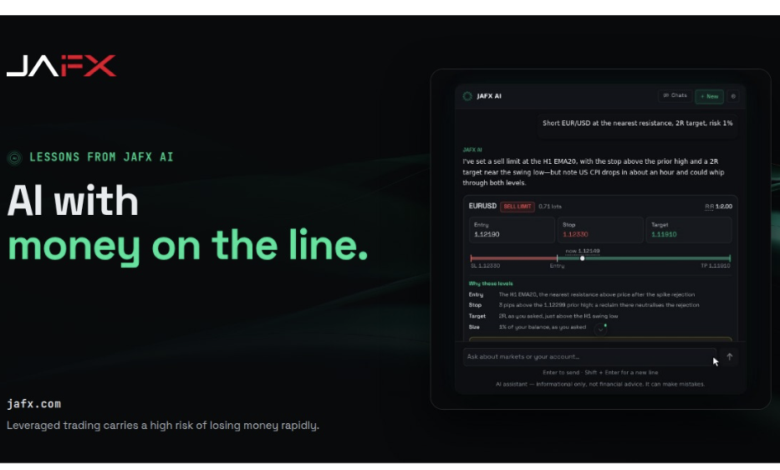
A trade the AI drafts arrives as a card showing what it would lose if its stop loss were hit, in the account’s currency and as a percentage of the balance, before the client presses Confirm. Nothing is placed until they do. Thirty minutes before a high-impact release on the market being traded, a red warning appears at the top of the order ticket and stays until the release. Risk information placed on the button gets read; the same text in the terms and conditions does not.
Treat timing as part of accuracy
In markets, a correct read that arrives late is worse than useless, and most AI deployments face a milder version of the same problem. JAFX’s tools run to a clock. AI Live Scan updates its chart reads as each candle closes. Unusual moves are flagged within minutes. Session briefings land at the Asia, London and New York opens every weekday, with figures checked against the text before they go out.
Stale output also has to expire. A drafted trade card lasts 10 minutes, after which it is gone. A suggestion built on prices that have since moved is no longer the same suggestion, and a system that lets it linger invites someone to act on it anyway.
None of this makes the AI right. Its market reads are sometimes wrong, which is exactly why the sources, the visible risk and the confirm step matter.
Don’t make the safety rail a premium feature
The commercial choice may be the most transferable. JAFX AI is included in every account, within fair-use limits, rather than sold as an upgrade. If an assistant’s job includes showing customers the risk they are about to take, putting it behind a paywall means the customers who most need that view are the least likely to have it. Fair use limits how much it is used, not who gets it.
For a closer look at the individual tools, from Market Pulse to Analyse Order, the JAFX AI page sets them out, along with a worked example of one real market move.
The broader point holds well beyond trading. When AI sits next to someone’s money, grounding, visible risk, timing and access are not features to add later. They decide whether the product can be trusted at all.
JAFX (PTY) LTD is an authorised Financial Services Provider (FSP No. 52058) regulated by the FSCA. Trading leveraged derivatives carries a high risk of losing money rapidly and is not suitable for everyone.