AI conversations in the restaurant industry have largely focused on what happens after a customer decides where to eat – automated ordering, chatbots, scheduling, kitchen efficiency and other operational use cases. However, one of the more interesting shifts is happening before any of that, at the point of discovery.
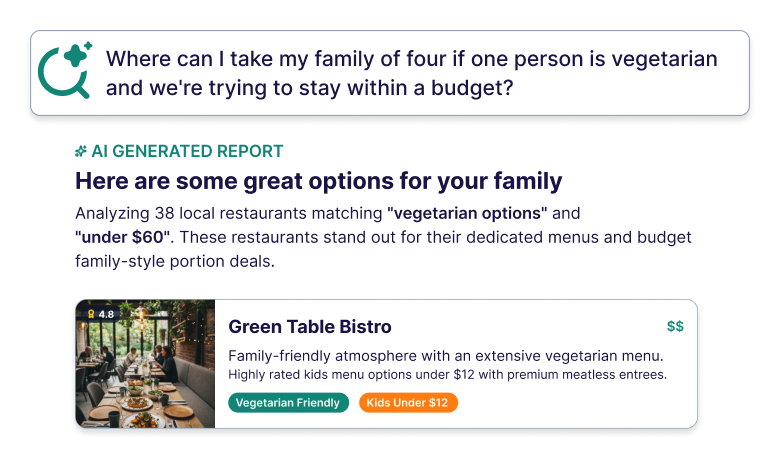
Consumers can ask AI much more specific questions than they typically would in a traditional search. Instead of typing “pizza near me,” someone might ask, “Where can I take my family of four if one person is vegetarian and we’re trying to stay within a budget?”
That changes what restaurants need to think about when it comes to online information. AI is becoming a bigger part of how people find places to eat, and eventually how they place orders, so restaurants need to make sure their businesses can be understood by the technology helping customers make those decisions.
For independent operators, that doesn’t necessarily mean becoming an AI genius. It means making sure the basics are there: accurate information, a strong digital presence and a clear picture of what makes the restaurant worth choosing in the first place. Recent data found that 59% of customers have decided not to order from a restaurant because they couldn’t find basic information online, showing just how important it is.
AI is changing what it means to be discoverable
Traditional restaurant search tends to start with broad criteria like cuisine, location or proximity, and AI gives consumers room to be much more specific. A diner may not know that they are looking for Mediterranean food or even start by naming a cuisine. They might be looking for a restaurant that works for their gluten-free child or an adventurous eater in a particular part of town. AI can take all of those details into account and potentially surface a restaurant that person would never have thought to search for directly.
That creates an opportunity for independent restaurants, but only if enough useful information about the business exists online. Operators should think about the questions a potential guest may have before choosing them like – what makes the restaurant different from others nearby? Are the menu and ingredients clearly described? Are the hours, location and ordering options accurate?
These may sound like basic details, but they matter more when technology is trying to make sense of a restaurant on someone else’s behalf. If the information isn’t there, the restaurant may never make it into the consideration set.
Better discovery can lead to better customers
For a long time, digital marketing has focused on driving as much traffic as possible. But more traffic is not always the same thing as better business. A customer who finds a restaurant that really fits what they are looking for – and then comes back every week – can be more valuable than several customers who try it once and never return.
That is where AI could become especially useful for independent restaurants. Its ability to understand context can help connect people with businesses that line up with their specific preferences, even when they were not originally searching for that restaurant or cuisine. For the restaurant, the opportunity is not simply to appear in more searches. It is to be discovered by people who are more likely to appreciate what the business already does well.
Of course, discovery only gets someone through the digital front door. From there, the restaurant still has to deliver. The menu should be easy to understand, ordering should be straightforward and the experience should give customers a reason to come back. The goal shouldn’t be to get recommended to everybody. It should be to reach more of the people who are likely to become real fans of the restaurant.
Build for machines without making hospitality robotic
The wrong response to all of this would be asking independent restaurant owners to learn a new set of technical skills every time technology changes because most operators already have more than enough to manage. They did not get into the restaurant business to become experts in AI, search technology or digital marketing. Good technology should take that complexity off their plate, not add another job to it. That will become even more important as AI moves beyond restaurant recommendations.
Today, someone may ask an AI assistant where to eat – but in the near future, that same person could ask it to find the restaurant, identify a meal that meets certain preferences and even finalize and place the order. The technology behind restaurants will need to be ready for more of those interactions to happen between systems, rather than directly between a person and a website.
Restaurants do not need to prepare for that future by chasing every new, shiny AI tool. They can start with the fundamentals by keeping information accurate, explaining clearly what makes the business different, making it easy for customers to order and making sure the technology behind the experience can evolve without creating more work for the operator. AI should make the restaurant easier to find and easier to do business with. It should not make the restaurant itself feel less human.
The restaurants with the most AI won’t necessarily win
Independent restaurants do not need to reinvent themselves because AI is changing how people search. In fact, many of the things that could matter most in this new environment are things great independent restaurants already have: a clear identity, strong hospitality, loyal customers and something they do particularly well in their local market. The challenge is making sure those qualities are visible online in a way that both people and technology can understand.
AI has the potential to connect a customer with a restaurant that fits what they actually want, rather than simply showing them the most obvious result. Over time, it may also remove more of the steps between finding that restaurant and placing an order.
The operator’s job is to make sure the restaurant is represented accurately, the ordering experience works well and the hospitality is still there when the customer arrives. The best restaurant technology should fade into the background. What the guest remembers should still be the restaurant.