Running an online business involves much more than listing products and processing orders. Business owners must answer customer questions, recommend products, recover abandoned carts, monitor sales, and manage daily operations. As customer expectations grow, handling all these responsibilities manually can become difficult and time-consuming.
Artificial intelligence (AI) is giving online businesses new ways to manage their daily operations. Traditional automation handles predefined tasks, but intelligent systems can understand goals, analyze information, and decide what actions to take. With AI Agents in Ecommerce, retailers can connect different business activities, reduce manual work, and make their operations more efficient.
Moving Beyond Traditional Business Automation
Traditional automation is useful for repetitive tasks, but it usually follows fixed rules. For example, an automated system might send an order confirmation email whenever a customer makes a purchase. It completes the assigned task but cannot independently decide what should happen next.
AI agents work differently. They can understand information, identify a goal, and choose suitable actions based on the situation.
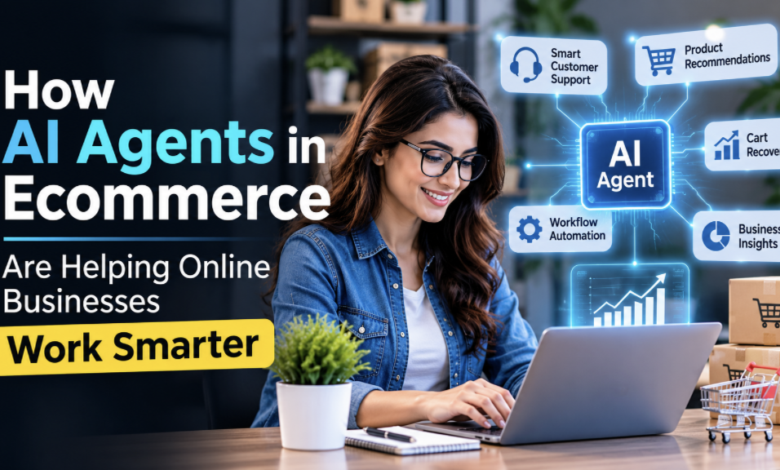
Imagine a customer comparing two products in an online store. An AI agent can answer questions, explain product differences, and suggest a suitable option. If the customer leaves without completing the purchase, the system may also help with cart recovery.
This ability to connect different activities makes AI agents more useful than basic automation tools.
Connecting Different Ecommerce Workflows
Online businesses often use separate tools for customer support, product recommendations, marketing, and cart recovery. Managing these systems independently can create gaps in the shopping experience.
AI agents can help bring these activities together.
For example, when a shopper visits an online store, an AI agent can identify their interests and suggest relevant products. If the customer has questions, it can provide useful answers. If they add an item to their cart but leave before checkout, the system can support a recovery process.
This connected approach helps businesses assist customers throughout their shopping journey, from their first visit to the final purchase.
Making Better Decisions With Business Data
Every online store collects useful information through product views, searches, customer questions, purchases, and abandoned carts. However, reviewing all this data manually takes time.
AI systems can analyze available information to identify patterns in customer behavior. For instance, if shoppers frequently ask about a product’s size or features, merchants may need to improve their product descriptions.
Similarly, if customers regularly explore related products, businesses can use this information to create better cross-selling opportunities.
These insights help merchants understand what customers need and where improvements are necessary. Instead of relying only on guesswork, they can make decisions based on actual shopping activity.
Improving Customer Support Without Increasing Workloads
Customer support is another area where AI agents can make a difference.
As an online store grows, questions about delivery, returns, product availability, and payment methods also increase. Answering every inquiry manually can put pressure on support teams.
AI agents can handle many routine questions using available store information. They can provide answers around the clock, guide shoppers through common issues, and identify situations that need human attention.
This does not mean replacing customer service teams. Complicated complaints and unusual requests still require human judgment. Instead, AI helps employees spend less time answering repetitive questions and more time solving important problems.
Learning From Customer Interactions
Customer conversations can provide valuable information about what shoppers expect from an online store.
Some customers may need clearer product comparisons, while others may want more detailed explanations before making a purchase. AI agents can analyze these interactions to identify common concerns and improve their responses.
With access to suitable feedback and interaction data, these systems can refine their recommendations and communication over time.
This creates opportunities for better customer experiences, more relevant suggestions, and smoother sales processes.
Meet Upsello Luna Agent: Taking Ecommerce Automation a Step Further
Businesses looking to move beyond basic chatbots can explore Upsello‘s Luna Agent, an AI-powered system designed to automate connected ecommerce activities.
Its approach focuses on four main capabilities. First, autonomous agents can work toward business goals, such as improving conversions, recovering lost sales, and supporting customer satisfaction. Second, end-to-end workflow automation connects different tasks instead of treating each activity separately.
Third, its AI-first architecture is built around AI-driven execution rather than simply adding AI features to traditional software. Finally, data-driven self-improvement allows the system to learn from customer interactions and refine its communication and sales strategies.
Together, these capabilities connect customer support, product recommendations, and cart recovery within a more coordinated system.
For merchants, this means less time spent on routine tasks and more opportunities to focus on business growth. They can also maintain control over important decisions and involve human employees whenever additional attention is needed.
Final Thoughts
AI agents are changing how online businesses manage their daily operations. Instead of depending entirely on separate tools and manual processes, companies can use intelligent systems to understand customer needs, connect workflows, and make better decisions.
The real value is not just answering questions faster. It is reducing unnecessary work, improving customer experiences, and making different business activities work together.
As ecommerce continues to grow, businesses that use AI agents thoughtfully can manage increasing demands more effectively while creating better experiences for their customers.