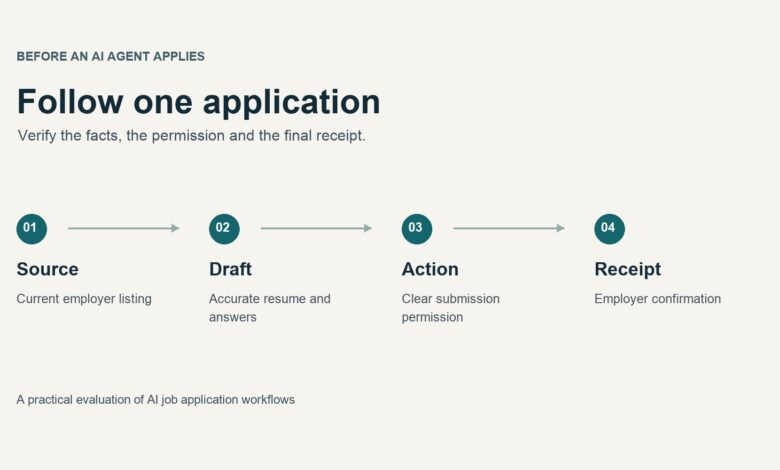
An AI job application agent can combine several tasks: finding vacancies, adapting a resume, filling employer forms and recording what happened. Each task needs a different kind of verification. A useful evaluation therefore follows one application from its source listing through to the employer confirmation, checking the evidence at every step.
For job seekers with a deadline, including international students and immigrants, mistakes can consume time that is difficult to recover. The practical question is whether the workflow preserves accurate facts, clear permissions and a reliable record of submission. Application volume alone cannot answer that question.
Start with a small test
Choose a few current roles that you would genuinely consider and can assess yourself. Include different form layouts, a role with screening questions and a listing you have already applied to. Review the employer pages before running the tool so you have a baseline for checking its decisions.
Separate the test into discovery, drafting, form completion and submission. A tool may perform one stage well while leaving another incomplete. If the product allows a draft or preview mode, use it first and inspect the exact resume version and answers that would be sent.
Keep a simple evaluation log with the source URL, role identifier, time checked, document version, answers needing correction and final status. Record manual interventions as well as successes. This makes the test repeatable and helps distinguish a product limitation from an outdated job listing.
Verify the job at its source
For each result, open the employer career page or the application portal linked from the employer website. Check the job identifier, location, seniority, deadline and whether the role remains open. A search result or cached description is a starting point, not proof that the employer is still accepting applications.
Ask how the tool handles listings that disappear, move or appear in multiple places. Duplicate detection should be evaluated against the employer and role identifier when available, rather than a title alone. Two similarly named vacancies can be different jobs, while one vacancy can have several copied descriptions.
Treat match scores as a prioritization aid. Ask what inputs affect them and compare the recommendation with the stated requirements. A score without understandable reasons does little to help a candidate decide where to spend limited attention.
Check that tailoring preserves facts
Resume tailoring should help present relevant experience clearly while preserving what the applicant actually did. Compare the generated document with the original employment dates, qualifications, skills and responsibilities. A stronger sentence is only useful if its meaning remains accurate.
For example, a candidate who supported a project should not become its manager because the vacancy mentions leadership. A tool can suggest emphasizing a genuine contribution or ask for missing detail. It should not fill that gap with an invented responsibility or achievement.
NIST identifies confidently presented false output as a generative AI risk and recommends reviewing sources and citations in generated content [1]. In an application workflow, that supports checking important statements against the candidate’s own records. This is an application of the framework, not a certification of any particular job search product.
Inspect the final file as well as the text preview. Check that contact details are readable, headings are intact and important content has not disappeared during export. Keep the version actually submitted so later interview preparation uses the same document.
Make permissions understandable
A resume upload, access to an employer portal and permission to submit an application are different actions. Evaluate whether the product explains what information it needs and what it will do with that access. Start with the smallest access needed for the task and check how to revoke it.
Look for a clear way to stop further applications and inspect completed actions. Check what happens to queued work when the user changes preferences or removes access. A pause control needs a defined effect, especially if some jobs are already being processed.
Job descriptions and external documents should be treated as source material rather than instructions that can override the applicant’s preferences. OWASP describes indirect prompt injection through external content and recommends least privilege and human approval for high-risk actions [2]. Ask the vendor how it limits the consequences of misleading instructions in a page, and request a demonstration rather than relying on a general assurance.
Review screening answers individually
Some fields can be filled from stable profile information, while others require a fresh decision. Salary expectations, willingness to relocate, availability and questions about work authorization should not be guessed from the resume. An unanswered question is a reason to request clarification, not permission to invent an answer.
Evaluate whether the system flags ambiguity and shows which answer it plans to use. Read the employer’s wording directly when a question is unclear. For questions requiring professional advice, the applicant should consult an appropriate qualified adviser rather than treat an automated answer as authoritative.
Test the failure path too. If a portal changes its form, requires an assessment or prevents automation, the product should report where it stopped. A blocked application should remain distinguishable from one submitted successfully.
Require evidence of completion
A completed form and an attempted click are not the same as a confirmed submission. Look for employer confirmation text, a receipt email or a status recorded in the employer portal. If the tool cannot obtain confirmation, it should label the outcome as uncertain.
The record should connect the confirmation with the correct role, employer, time and submitted materials. This helps prevent unnecessary retries when the outcome is unclear. It also gives the applicant a useful history if the employer later asks about a particular application.
Measure what the workflow actually changes: verified submissions, relevant roles pursued, errors corrected and time spent reviewing. Keep interviews and offers separate from these operational measures. They depend on hiring decisions beyond the application tool’s control, and a small personal test cannot establish a general performance claim.
An effective evaluation ends with a decision about the appropriate level of automation. Some applicants may use a tool for discovery and drafting while reviewing every submission; others may permit more activity within clearly defined preferences. The evidence should determine that boundary and make it easy to revisit when the product or the applicant’s circumstances change.
References
[1] NIST Generative Artificial Intelligence Profile. https://nvlpubs.nist.gov/nistpubs/ai/NIST.AI.600-1.pdf
[2] OWASP Prompt Injection. https://genai.owasp.org/llmrisk/llm01-prompt-injection/