Five years before generative AI captured mainstream attention, the deep learning researchers behind Maluuba had already deployed artificial intelligence across 100 million devices worldwide.
Following Maluuba’s $160 million acquisition by Microsoft in 2017, that founding team has reunited to tackle a far more complex technical challenge: engineering the first fully autonomous enterprise.
Their new research lab, Skyfall AI today emerged from stealth backed by an undisclosed funding round from Fidelity, Inovia Capital, Touring Capital, M13, NextView Ventures, and Garage Capital.
The neolab is focused on moving beyond the limitations of Large Language Models (LLMs) to create enterprise world models capable of long term strategic planning and execution.
To validate its research, Skyfall is bypassing closed simulations in favor of a real-world application: the company has opened a solicitation to acquire a small SaaS business for up to $1 million, which it plans to operate and scale entirely through its AI systems.
From Text Prediction to Enterprise World Models
The current generation of AI is largely driven by models optimized for text generation and sequential prediction. Skyfall argues that this architecture is insufficient for enterprise leadership, which requires causal reasoning and the ability to navigate deep uncertainty across long time horizons.
“The job of a CEO is to make hundreds of decisions every week with thousands of data points available to you,” said Sam Pasupalak, Co-founder and CEO of Skyfall. “To automate that, you need more than a chatbot, you need a comprehensive system that understands the fundamentals of a company: how marketing spend impacts sales, how HR shifts affect productivity, and how to plan across long horizons.”
To achieve this, Skyfall is developing “Enterprise World Models.” These systems rely on recursive simulation rather than step-wise text generation. By integrating financial data, operational APIs, and market variables, the models are designed to forecast the future state of an organization and weigh the multi-layered consequences of strategic actions before executing them.
“We invested in Skyfall because Sam has a track record of seeing the next frontier before it becomes consensus,” noted Morgan Blumberg, Partner at M13. “He recognized that LLMs would not be continual learners, so he built a research lab around a new world model architecture designed for true enterprise intelligence in ever-evolving reality.”
A Real-World Testing Environment: The $1M SaaS Acquisition
To stress-test its Enterprise World Models, Skyfall is initiating a highly unconventional experiment. The company is actively seeking to acquire a functioning SaaS startup to serve as a live test-bed. The primary objective is to double the acquired company’s revenue within six months with minimal human intervention.
Human oversight will be strictly limited to foundational administrative tasks: executing the acquisition documents, establishing bank accounts, filing regulatory and tax paperwork, and initializing the AI infrastructure. Operations, marketing, and strategic execution will be handed over to Skyfall’s systems.
The lab is currently soliciting bids on its website, and plans to operate this initiative transparently, publishing regular research updates on the system’s performance, execution, and failure scenarios.
Bridging Deep Research and Commercial Applications
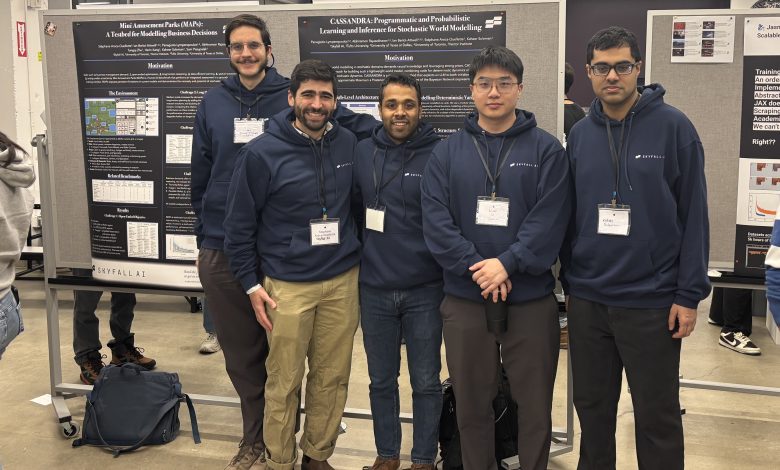
Skyfall’s leadership team includes Sam Pasupalak (CEO), Kaheer Suleman (CTO), and Sumit Pasupalak (CPO). Following their tenure building Microsoft AI in Canada, where they oversaw early AI development and global rollouts, the founders have assembled a 25-person research team drawing talent from Microsoft AI, MILA Quebec, and leading Canadian universities.
Alongside the acquisition initiative, Skyfall is beginning to commercialize its underlying infrastructure. The company recently introduced Morpheus, a Continual Reinforcement Learning platform built for AI researchers. Morpheus is designed to model complex, non-stationary systems, beginning with warehouse and logistics management, allowing AI agents to learn without explicit task labels or frequent environment resets. The platform utilizes persistent enterprise environments where strategic actions compound over time, mimicking real-world business dynamics.
Morpheus serves as both a commercial product and the internal infrastructure Skyfall is using to develop its autonomous enterprise models. In the coming months, the lab plans to expand its product roadmap by releasing an agentic suite aimed at automating complex operational tasks for founders and executives, taking the first practical steps toward full enterprise autonomy.
Researchers and companies can learn more at https://skyfall.ai/.