For those who have been event planning since spreadsheets were innovative technology, the sudden onset of AI everywhere can be quite the culture shock. Digital tools can now be seemingly used to complete any task, small or large, and their role in the event planning process is already firmly embedded.
There is a risk that overzealous usage could risk ousting the very people who’ve built event logistics into the successful industry it is today – with their knowledge, experience and (most importantly) human touch being eradicated from the process.
But there is a very clear middle ground here: a compromise between ignoring these tools altogether, and dismissing decades of expertise in favour of machine-led planning. Here are five practical ways to integrate AI into the process, in the pursuit of efficiency rather than people replacement:
Logistics and transport planning
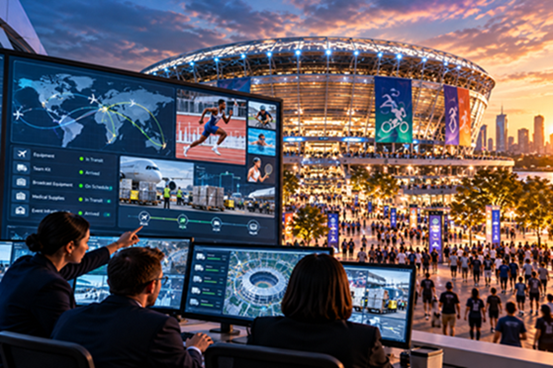
The use of AI tools to optimise routes, analyse traffic patterns and co-ordinate the journeys of thousands – sometimes millions – of people and pieces of equipment gives planners a wealth of live data that would otherwise take an inordinate amount of time to pull together.
Whether it’s calculating travel times to ensure athletes arrive at stadiums on time for their starring performance, or identifying potential traffic bottlenecks to enable alternative plans to be made, it’s undeniable that efficient scheduling is helped enormously by collating all the data, and updating it in real time, round the clock.
Predicting potential problems
Logistics experts can leverage historical event data to identify where delays or other operational challenges may arise. But again, AI tools can do this much more quickly, bringing together a wealth of information including traffic data, weather forecasts and even predictive modelling to support the development of contingency plans – with each scenario analysed to predict its likelihood and consequences.
Proactive planning is a huge advantage, saving time and money compared to dealing with problems when they occur – another example of how technology can support planners to work strategically rather than reactively.
The caveat is, of course, that AI cannot be relied upon to predict every unexpected event. But it can identify patterns, assess scenarios and help teams prepare for the most likely scenarios. And that’s potentially why Cvent and Northstar research found that 65% of event planners were using generative AI, and 16% cited ‘significant’ improvements as a result.
Streamlining supply chains
The number of suppliers who can be involved in staging a single event, especially one as complex and large-scale as the Olympics, is staggering; there were 1,605 direct suppliers contracted for the London 2012 Games, for example, with thousands of additional subcontractors.
Selecting, budgeting for, and keeping track of every single team involved before, during and after an event represents a mammoth task in itself – and that’s where AI can be utilised as a vital resource. Whether it’s analysing supplier proposals, flagging inconsistencies, or streamlining communications, technology helps navigate the complexity, leaving the experts more time to focus on high-value tasks.
The 2026 Global Planner Sourcing Report suggests AI tools specifically designed to support supplier co-ordination are becoming widespread: used by 75% of planners during the venue sourcing process, and 40% when comparing bids and proposals.
Workforce planning
Alongside the wealth of suppliers involved, the staffing and resources allocated to larger events can run into thousands of people. Operational staff, security personnel, technical teams, contractors and volunteers must all be in the right place at the right time, and this can present a significant logistical challenge without the support of digital tools.
AI can help organisers by forecasting staffing requirements, creating the most efficient rotas, distributing resources, and highlighting last minute changes such as the requirement for additional resources or itinerary alterations. This digital workforce scheduling has already been established by planners, with a study published in the European Journal of Operational Research highlighting the use of ‘optimisation techniques’ to balance staffing requirements, employee preferences and operational constraints.
Measuring sustainability effectively
Sustainability is a critical concern across the events industry, with accurate measurement methods necessary if planners are to make positive steps towards reducing their environmental impact. Manual calculations of factors such as emissions and waste production represent an inordinate time pressure for planners, but this is considerably lessened by the introduction of AI.
Tools can identify opportunities to reduce unnecessary vehicle journeys, help forecast demand to limit over-ordering, analyse energy consumption patterns, and collate emissions data from suppliers – all while ensuring delivery requirements, costs and reliability are balanced against sustainability efforts.
AI can also support future strategies, by highlighting which specific aspects of the event have the largest impact; for example, FIFA revealed the Men’s Football World Cup in Qatar had resulted in 3.8m tonnes of carbon dioxide emissions, with travel, construction and accommodation accounting for 94.7% of the total amount.
As with all of the other practical implementations, AI isn’t going to replace the long-established planning process, or override the need for experts who can display professional judgement, take accountability and provide specialist oversight.
But in an era where there are so many AI tools designed to support the completion of many of the tasks involved in the planning process, it’s becoming increasingly hard to justify ignoring them entirely. By allocating repetitive, time-consuming tasks which require extensive data collection and monitoring to AI, this frees up valuable human resources for the more complex elements of pulling together a large-scale event.
Those who benefit most from AI will be those who understand exactly where it can make the biggest difference, use it intelligently and selectively, and recognise even the smartest systems are there to support rather than replace experienced people making informed decisions.