
In the space of three July weeks, the machine that reads the internet acquired a price list at both ends. On 1 July 2026, Cloudflare announced that from 15 September, its network will block by default, across new and free-tier sites, any crawler that mixes search with AI training or agent use on pages that carry advertising, and that its Pay Per Crawl experiment is growing into Pay Per Use. This system pays publishers when their content actually surfaces inside an AI answer. Three weeks later, OpenAI opened Advertise in ChatGPT to businesses of any size: labeled sponsored slots beneath the chatbot’s answers, sold through a self-serve dashboard. Reading the web now carries an invoice; appearing beside its answers now carries a rate card.
Squeezed between the paid door and the paid slot sits the one channel neither invoice covers: being quoted inside the answer itself, because the machine judged your material worth citing. That channel is earned media re-engineered for a reader that never sleeps and never clicks, and it is the part of this shift my profession has been slowest to claim. I run a PR agency, ExpertizeMe International, and for the past year, the very description of what we do has been rewriting itself right under our feet. The tools were the easy bit. It is the questions that matter: who reads what we produce now, and who answers for it when it is wrong.
Take the invoice apart line by line, and the new economics of attention becomes legible.
The first line is the door fee. Cloudflare’s Pay Per Use is a small technical change with a loud implication: payment now attaches to the moment a page is actually used inside an AI answer; a fetch by a bot, on its own, earns nothing. Presence in the answer has a market price, set by a third party and cleared through infrastructure. Whatever a communications team used to think about AI visibility as a concept, it is now a line item, and the old hygiene advice to publish where crawlers are welcome has become a commercial negotiation about who may read you and at what rate.
The second line is the slot fee, and it arrives with a confession attached. To sell advertising alongside its answers, OpenAI has to promise that the answers themselves are not for sale: its launch page insists the ads are “clearly labeled” and kept separate from what the model says, and its documentation tells advertisers they cannot shape the generated response. Read commercially, that is the seller of paid placement certifying that the organic citation is the part that users actually trust, which is as clean an endorsement of earned media as a competitor will ever write. The advertisers arrived anyway, and the skeptics greeted the launch by quoting the founder back at himself.
“Ads plus AI is sort of uniquely unsettling to me.” — Sam Altman, 2024
Both ends of the wire had automated long before the invoices arrived. On the PR side, the question is settled: 76% of professionals use generative AI by Muck Rack’s count in its State of AI in PR 2026 report, 91% by Cision’s in Inside PR 2026, and the curve has flattened. The newsroom side belongs in a table:
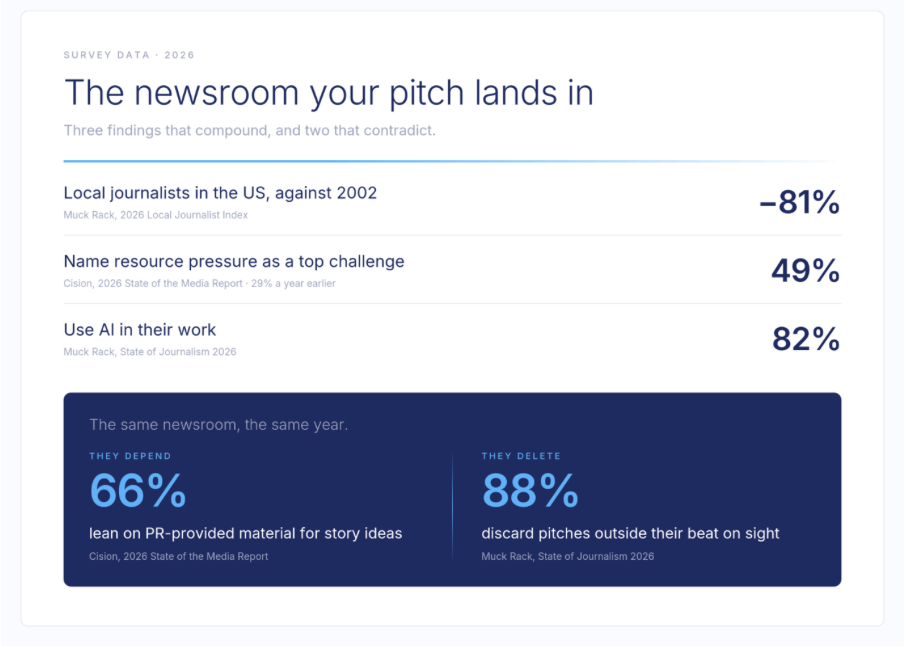
Read top to bottom, the table is a squeeze, and the paradox sits in its last two rows: in the same newsroom, two journalists in three lean on PR material for their story ideas, while nine in ten bin anything that misses their beat on sight. Our profession has never been more needed or easier to delete. AI escalated the standoff: sending a thousand personalised-looking pitches before lunch became possible, so everyone did it, and the only filter that survived is relevance. The machine sharpens aim for whoever researches one journalist deeply, and it industrializes rejection for whoever uses it to reach a thousand.
How the machine on the other end actually reads is a story with dates.
February 2024. Gartner predicts that traditional search volume will drop 25% by 2026 under pressure from AI chatbots. The industry files the number under distant threats and goes back to its dashboards.
August 2024. The paper that named the discipline reaches the KDD conference before most of the profession has noticed the problem it solves. “GEO: Generative Engine Optimization”, by researchers from Princeton and IIT Delhi, tests nine content strategies across 10,000 queries and moves a source’s visibility inside AI answers by as much as 40%. Generative engine optimisation, the practice of making a brand’s content visible, quotable and correctly attributed in AI-generated answers, turns out not to be guesswork. The winners are almost insultingly traditional: cited sources, quoted experts, concrete statistics, clean prose. The loser is my favorite finding in this young literature: keyword stuffing, on which an entire generation of search consultants made their living, scores 8% below doing nothing at all, and 10% below on Perplexity. A 2025 benchmark called C-SEO Bench later trims away the remaining hype, showing that conversational tricks generally change nothing while the quality and relevance of the source keep working.
July 2025. Pew Research Center, tracking the real browsing of 900 Americans through March of that year, measures what the shift feels like on a results page. When Google shows an AI summary, users click a traditional link in 8% of visits, compared with 15% without one, and click links within the summary just 1% of the time.
Two years on from Gartner’s prediction, the verdict is in: search volume held steady, and the behavior beneath it split. Google still handles roughly nine searches in ten, while billions of questions a month migrate to chatbots that answer in prose, cite a few sources, and send almost nobody anywhere.
The press release you publish today will be read in full by a handful of humans, and parsed and possibly quoted by systems serving millions.
At ExpertizeMe, we learned the paper’s lesson the practical way. When we rebuilt our editorial standards around machine readers, the recipe we arrived at would not have surprised an editor in 1975: exact figures with dates instead of adjectives, every claim pinned to a named source, definitions written so they can be lifted whole, and one canonical spelling of every name, our own included, everywhere it appears.
Everything so far has been about being read; the rest is about being believed, and here the clock runs backwards, because the decisive evidence arrived in 2023, when generated text was still a novelty. Two newsrooms ran that experiment on everyone’s behalf, and paid the bill themselves.
November 2023. The technology site Futurism discovers that Sports Illustrated has been publishing product reviews under authors who do not exist. One of them, “Drew Ortiz”, comes with a folksy biography about a love of the outdoors and a smiling headshot that turns out to be for sale on a marketplace of AI-generated faces; he has no publication history and no trace anywhere else on the internet. When reporters begin asking questions, the profiles quietly vanish from the site; the publisher blames a contractor named AdVon Commerce, the newsroom union declares itself horrified, and within weeks the chief executive, Ross Levinsohn, is gone, officially for unrelated reasons. The cheaper rehearsal had already run at CNET in January 2023: corrections to 41 of 77 finance explainers drafted by an internal AI engine, including one telling readers that a $10,000 deposit at 3% interest will earn them $10,300 in a year, where the correct figure is $300.
The lab keeps agreeing with the field. Labeling a text as AI-generated lowers its perceived accuracy and trustworthiness, even when the text is accurate and written by a human; Sacha Altay and Fabrizio Gilardi, in PNAS Nexus, trace the effect to a blunt assumption on the reader’s part that the label means the machine worked unsupervised. Benjamin Toff and Felix Simon, in the International Journal of Press/Politics, find the antidote: the trust penalty largely disappears when an article discloses the sources used to produce it. A 2026 study in Digital Journalism completes the picture, with readers rating news organizations markedly higher when humans visibly supervise the machine’s output. Readers will forgive a machine in the workflow and punish one in the byline.
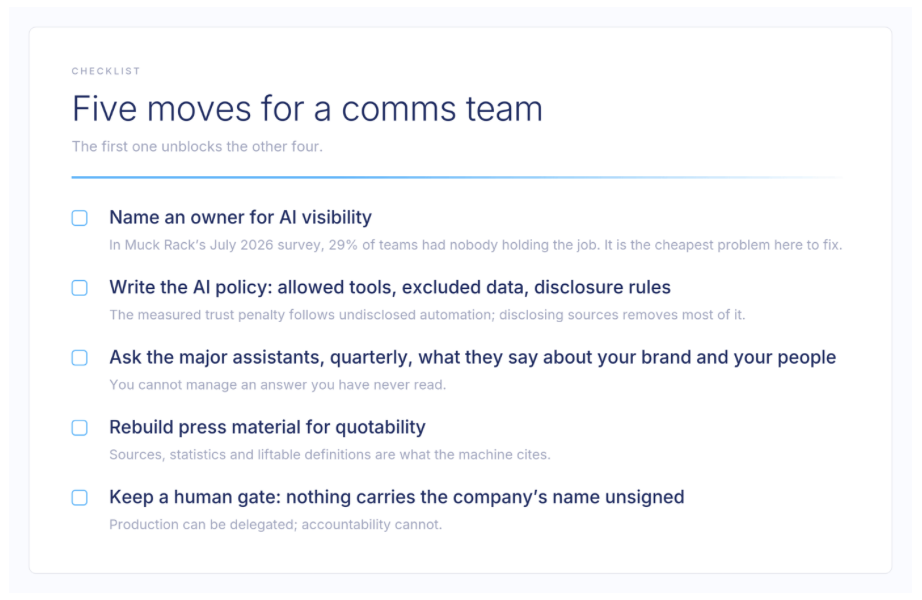
July 9, 2026. Between the two invoices, Muck Rack’s State of PR survey of more than 1,100 professionals catches the industry mid-step: 73% call generative engine optimization at least somewhat important to their strategy, 29% concede that no one in their organization owns it, and 39% are not measuring it at all. The market has priced the machine reader; most org charts have not. That gap can be filled by one short table:
Machines will keep writing, and machines will keep reading. Between the invoice at the door and the rate card at the slot, the signature remains the one part of this profession that was never automatable to begin with.