AI image and video generation has changed the way creators produce visual content. With modern generative AI models, users can create realistic characters, environments, products, and cinematic scenes simply by entering a text prompt or providing an image. However, one major challenge remains: consistency.
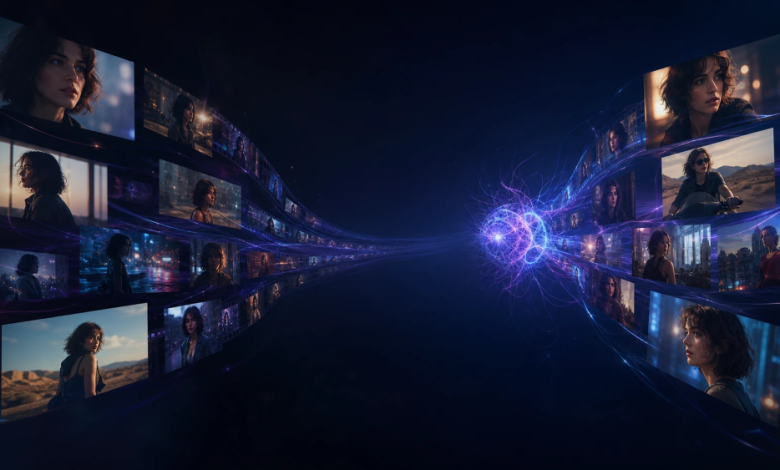
A model may generate an impressive character in one image but produce a noticeably different face, hairstyle, clothing style, or visual identity in the next generation. This becomes a serious problem for creators working on stories, digital characters, marketing campaigns, games, and AI-generated videos. This is where LoRA training is becoming an important part of personalized AI generation.
The Challenge of Identity Consistency in AI Generation
Generative AI models are trained on enormous datasets containing millions of images. This allows them to understand concepts such as people, objects, clothing, environments, poses, and artistic styles. However, these models do not automatically know the specific identity a creator wants to maintain across multiple generations.
For example, imagine creating an AI character for a short film. The first prompt might produce a character with the desired face and appearance. When the creator generates another scene, the character could have different facial features or proportions.
Even small differences can make the character look like an entirely different person. Prompt engineering can help, but prompts alone often cannot provide the level of consistency required for professional projects.
This creates a gap between general AI image generation and personalized generation.
Personalized Generation With LoRA
LoRA, or Low-Rank Adaptation, provides a practical way to customize an existing AI model without completely retraining the model from scratch.
Instead of teaching an AI model everything again, LoRA focuses on learning specific characteristics from a smaller dataset. Depending on the training objective, those characteristics might include a person’s appearance, a fictional character, a product, a visual style, clothing, or other recognizable features.
Once trained, a LoRA can be used alongside a compatible generative model to influence future outputs.
This makes LoRA particularly useful for creators who want greater control over the visual identity of their generated content. Rather than repeatedly trying to recreate the same appearance through prompts, they can use a trained LoRA as a reusable component.
Why an Online LoRA Trainer Can Be Useful
Training a LoRA traditionally requires some technical knowledge. Users may need to prepare datasets, configure training parameters, install software, manage hardware resources, and troubleshoot errors.
For creators who primarily want to focus on visual production rather than machine learning infrastructure, this can create an unnecessary barrier.
An online LoRA trainer can simplify the process by providing a more accessible environment for preparing and training personalized LoRA models. Instead of building a complete local training setup, creators can use an online workflow to move from their training images toward a usable LoRA model.
A typical workflow may include selecting suitable images, preparing the dataset, configuring training settings, starting the training process, and testing the resulting LoRA with an AI generation model.
The quality of the training data remains extremely important. Clear and varied images can help the model learn the intended identity more effectively.
From Image Generation to AI Video
The consistency challenge becomes even more important when moving from still images to AI video.
AI video models can generate impressive motion from an image or prompt, but maintaining the same character across different scenes is not always straightforward. Changes in facial structure, clothing, hairstyle, body proportions, or other visual characteristics can become more noticeable when multiple frames and scenes are involved.
For creators producing an AI short film, advertisement, music video, or social media series, character consistency can therefore become one of the biggest production challenges.
LoRA training offers a potential solution by creating a reusable representation of a specific visual identity.
How Wan 2.2 LoRA Training Can Help
Wan 2.2 can generate impressive image-to-video results, but maintaining a consistent character across different scenes can still be challenging. A character may look correct in one sequence but appear noticeably different when placed in another environment or pose.
Wan 2.2 LoRA training provides one way to create a reusable visual identity that can be applied across multiple generations.
Instead of relying entirely on prompts to describe the same character repeatedly, creators can train a LoRA around the desired identity and then incorporate it into compatible generation workflows.
A Wan 2.2 Video LoRA Trainer Online can make this process more accessible for users who want to experiment with personalized AI video without managing a complex local training environment.
The broader benefit is workflow consistency. Once a suitable LoRA has been trained, creators can potentially use the learned identity across different scenes, prompts, and generations while maintaining greater visual continuity.
Building a Better LoRA Training Workflow
A successful LoRA workflow starts before the actual training process.
The first step is selecting a high-quality dataset. Images should clearly represent the subject and provide enough variation to help the model understand the identity rather than memorizing a single pose or background.
The next step is configuring appropriate training parameters. These settings can affect how strongly the LoRA learns the subject and how it behaves during generation.
After training, creators should test the LoRA with different prompts and situations. Testing can reveal whether the identity remains recognizable across poses, lighting conditions, environments, and compositions.
For video applications, additional testing may be necessary because consistency needs to remain stable across moving frames and different scenes.
LoRA as a Missing Layer in AI Creativity
Modern AI models are already powerful at generating visual content. The next stage of AI creativity is increasingly about control and personalization rather than simply generating more images.
LoRA sits between a general-purpose AI model and a creator’s specific visual requirements. It can provide a bridge between what a model knows generally and what a creator wants it to reproduce consistently.
This is why LoRA training is becoming an important part of AI image and video workflows. It allows creators to build reusable visual identities instead of starting from scratch every time they generate new content.
Platforms such as LoRAAI.me are part of this growing ecosystem, helping make LoRA training workflows more approachable for creators interested in personalized AI generation.
The Future of Personalized AI Generation
As AI image and video generation continues to improve, consistency will become increasingly important. Businesses will want recognizable brand characters, filmmakers will need recurring digital actors, artists may develop personalized styles, and content creators will want characters that remain visually stable across entire series.
LoRA training can help address this need by giving creators a way to personalize existing AI generation models.
The future of generative AI is therefore not only about creating realistic images or videos. It is also about giving creators the ability to decide who or what appears in those generations and how consistently that identity can be maintained.
For anyone exploring personalized AI image generation, learning how LoRA training works can be an important step toward gaining more control over the creative process. As online training tools continue to evolve, the technology is becoming easier to integrate into everyday creative workflows.