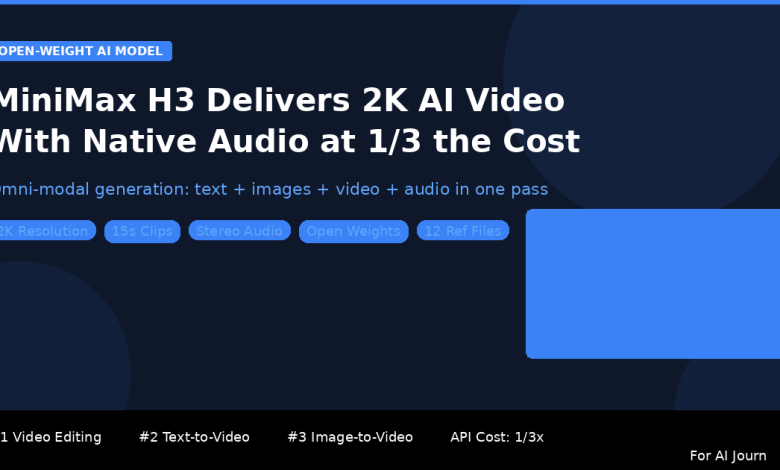
The AI video generation market entered 2026 with a clear hierarchy: closed-source Western models from OpenAI, Google, and Runway sat at the top of quality benchmarks, while open-weight alternatives lagged behind in fidelity and commercial readiness. MiniMax H3, launched on July 31, 2026, at the World Artificial Intelligence Conference in Shanghai, has disrupted that order. On the independent Artificial Analysis leaderboards, H3 holds the global first-place ranking for video editing capability, second place in text-to-video, and third in image-to-video — a combination no other open-weight model has achieved.
MiniMax, the Hong Kong–listed company (0100.HK) behind the Hailuo AI platform, designed H3 for commercial content teams, advertising agencies, filmmakers, and developers who need production-quality video without the per-clip costs that closed-source models demand. The company released the model weights on Hugging Face days after the conference debut, signaling a strategic bet that open ecosystems can outcompete walled gardens in AI video the same way they already have in large language models.
Why the Editing Benchmark Matters More Than Text-to-Video Rankings
Most coverage of AI video models fixates on text-to-video quality — how well a model turns a written prompt into footage. That metric matters, but it misrepresents how professional teams actually use these tools. In production environments, the majority of work involves editing, compositing, and iterating on existing material rather than generating from scratch. A model that excels at editing — applying motion transfer, swapping elements, adjusting camera angles, maintaining character consistency across revisions — saves more real-world hours than one that produces slightly prettier first drafts.
H3’s first-place editing score reflects a structural advantage in its architecture. Unlike competing models that treat editing as a secondary mode bolted onto a generation pipeline, MiniMax trained H3 from the ground up to understand the relationships between reference inputs and target outputs. The model’s Contextual Omni Representation system describes not just what the output should look like, but how each input asset relates to the generation — which reference supplies the character, which supplies the camera motion, which supplies the audio tone. This relational understanding is what makes the editing capability work at a level competitors have not matched.
For teams evaluating minimax h3 against Veo 3.1 or Runway Gen-4.5, the editing benchmark provides a clearer signal than raw text-to-video scores about which tool will reduce production time in practice.
The Architecture That Enables Cross-Modal Editing
H3 accepts up to twelve reference files per generation — nine images, three video clips, and three audio files — through what MiniMax calls an “@-reference system.” Users tag each asset in their text prompt with an @ mention and describe in natural language what role it should play. The model interprets these instructions and synthesizes a coherent output that respects all references simultaneously.
This is not a parameter panel with sliders and dropdown menus. It is a conversational interface to a multi-modal generation engine. A prompt might read: “Use @image1 as the character’s face, apply the dolly-in from @video2, and match the vocal register from @audio3.” The model resolves these instructions into a single 2K video clip with synchronized stereo audio.
Four subsystems handle the workload. H3-Context-IR compresses approximately 100,000 tokens of source material into around 4,000 tokens of relational context, preserving the semantic connections between inputs while dramatically reducing compute requirements. H3-VAE provides a temporally causal video autoencoder with 16× spatial compression and 4× temporal compression across 24 latent channels. The H3-Omni Transformer unifies all modalities into a single packed sequence processed with Rotary Position Embedding. H3-Regenerate-2K handles final upscaling from the 768p base resolution to full 2K output.
The result is 15-second clips at 2K resolution and 24 frames per second, with native 32 kHz stereo audio, across six aspect ratios from 21:9 to 9:16.
How H3 Pricing Reshapes the Cost Equation
The commercial implications of H3 extend beyond benchmark scores. At 2K resolution, H3’s per-second API price is less than one-third of mainstream closed-source models. At 768p, it is less than half the price of competitors’ 720p output. For context, OpenAI’s Sora 2 Pro lists at $0.30 per second for 720p and $0.70 per second for 1080p. Veo 3.1 starts at approximately $0.05 per second on the Lite tier but scales steeply for higher quality settings.
This pricing difference compounds at production scale. A marketing team generating fifty 10-second ad variants per campaign might spend several hundred dollars on Sora 2 or Veo 3.1 for a single batch. The same output through H3 costs a fraction of that amount.
For individuals and small teams, MiniMax offers subscription tiers starting at $21 per month for 180 credits (approximately 11 videos) and scaling to $90 per month for 1,300 credits with priority queue and batch processing. The full breakdown of plans, credit allocations, and feature differences is available on the minimax h3 pricing page.
The Open-Weight Gambit
MiniMax’s decision to publish H3’s weights on Hugging Face is the most strategically significant aspect of the launch. The model is released as two task-specific checkpoints — H3-Base and H3-Regenerate-2K — each bundled with the Omni Transformer, processor, tokenizer, text encoder, Visual VAE, and standalone Audio VAE. The H3-Context-IR preprocessing system remains API-only, though MiniMax provides documentation for building custom preprocessing pipelines.
Local deployment is resource-intensive. The BF16 base model requires approximately 134 GiB of weights for a single task partition before activation memory and runtime overhead. This puts self-hosting within reach of enterprise GPU clusters and cloud deployments, but not consumer hardware. The model also ships under the MiniMax H3 Community License, which is not a permissive MIT or Apache license — commercial users need to review the terms carefully.
The open-weight strategy targets a specific competitive gap. Closed-source models from Google and OpenAI cannot be fine-tuned, customized, or deployed on private infrastructure. For enterprises with proprietary data, compliance requirements, or latency constraints, H3 is the first video model that offers top-tier quality with the flexibility of local deployment.
Where H3 Falls Short
No model dominates every dimension. In side-by-side testing by independent YouTube creators, H3 produced cleaner detail and more convincing character motion than Kling 3.0, but longer 15-second clips can still exhibit character drift and background inconsistency. Veo 3.1 retains the absolute quality crown at 4K with cinematic synchronization. Runway Gen-4.5 offers superior timeline-based editing tools for iterative workflows.
H3’s audio-as-input capability — where a sound file can influence the visual generation, not just accompany it — remains unique in the market. But the prompting patterns around H3 are still maturing. Veo 3.1 benefits from months of community-developed prompt engineering guides, while H3’s ecosystem is weeks old.
For teams choosing between models, the practical advice from independent testers is to avoid picking one model for everything. Run H3 for coverage and cost-sensitive production, Veo 3.1 for the hero shot that needs absolute cinematic polish, and Kling 3.0 when a reference performance must transfer onto a generated character.
Industry Positioning and Market Response
The market took notice. Following the pre-market announcement on August 3, MiniMax Group Inc. shares surged over 10 percent on the Hong Kong Stock Exchange to close at HKD $249.40. The stock movement reflects confidence not just in H3’s technical capabilities but in MiniMax’s broader product strategy — the company also develops the M-series large language models, Speech 2.8 for multilingual text-to-speech, and Music 3.0 for AI music generation.
MiniMax positions H3 for advertising, branding, e-commerce, product design, UI/UX, gaming, and film pre-visualization. Early adoption patterns confirm particular strength in ad variant generation at scale, product catalog video, and social media content production.
What Comes Next
H3 is the third generation in the Hailuo video model lineage. Hailuo 01 built the foundational architecture. Hailuo 02 improved component efficiency and data quality. H3 represents the convergence of those improvements into a unified omni-modal system — the first in the series designed to treat multi-source, multi-modal input as the default operating mode.
The model is accessible through the Hailuo AI web app, the MiniMax Hub desktop application, and the MiniMax Open Platform API. The API follows an asynchronous three-step workflow: create a task, poll the task ID, and download the content URL.
For the AI video market, H3’s launch marks a structural shift. The combination of top-tier benchmark performance, open weights, and aggressive pricing challenges the assumption that closed-source models will always lead on quality. Whether that lead holds through the next generation of updates from Google, Runway, and ByteDance remains an open question — but for the first time, the burden of proof has shifted to the incumbents.