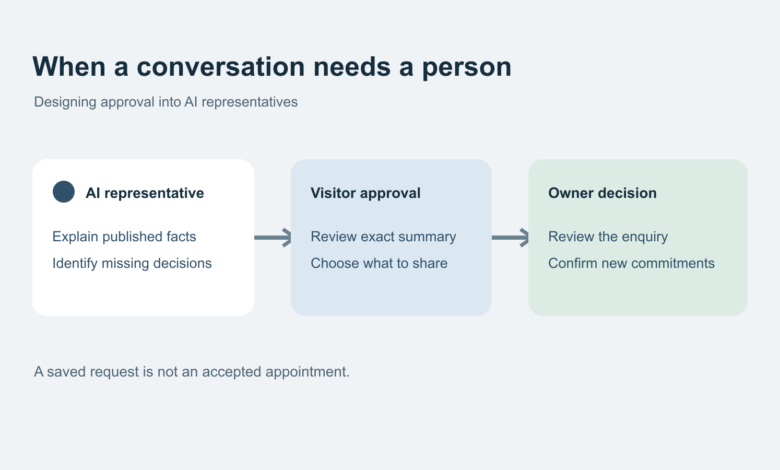
An AI representative for an independent professional can explain services while its owner is busy. The difficult part begins when a visitor asks for a discount, a delivery date or permission to share information. Those questions require a product to distinguish what it knows from what it may do. A useful design lets the representative answer established questions and gives people a clear approval step before a conversation becomes a commitment.
The examples below concern ordinary client enquiries, such as a designer discussing a website project. They are proposed design patterns, not measured claims about conversion rates or a guarantee that a particular model will behave safely. Each pattern can be evaluated through observable actions rather than the apparent confidence of an answer.
Separate published facts from new commitments
A designer might publish a portfolio, a description of services and a standard starting price. A representative can explain those facts, provided it can identify the relevant source and recognise when information is missing or stale. A request to deliver a larger project next Friday is different: neither a portfolio nor a starting price establishes current capacity. The response should identify the missing decision and offer a route to the owner.
Write this distinction into the service specification before choosing a conversational personality. Define which statements may be repeated, which require checking a current system and which require an owner decision. A cheerful tone cannot establish availability, and a confident answer cannot approve a new scope. If a current system is unavailable, the interface should preserve that uncertainty rather than filling the gap with an estimate presented as fact.
NIST published its Generative AI Profile in July 2024 as a companion to the AI Risk Management Framework.[1] Its discussion of confabulation is relevant to customer conversations because an answer can be plausible and still unsupported.[2] For a small business, a practical response is to make unverified dates and prices explicit in the wording and keep them out of any automatic commitment path.
Give each action a limited purpose
For a first version, an enquiry form often provides enough useful action. It can collect a proposed date and a short description for review, without granting the representative permission to alter the owner’s calendar or send a binding quotation. Give that action a narrow input format and make its result distinguish a received request from an accepted appointment. The person responsible for the work should still make the decision about availability.
OWASP identifies excessive agency as a risk arising from unnecessary functionality, permissions or autonomy in LLM systems.[3] Its guidance includes limiting tools and enforcing authorisation outside the model. Applied to a client representative, this means the service that saves an enquiry must check the relevant user and representative itself. A model’s claim that approval occurred is insufficient evidence for executing the action.
This division also helps product teams explain failures. A representative may have understood a request while the service failed to save it. Keep those events separate so the visitor sees a failure they can respond to, rather than a reassuring sentence about a booking that does not exist. A successful record identifier from the service is better evidence of a saved request than generated prose.
Make forwarding visible to the visitor
When a representative cannot answer, forwarding a question to its owner is a reasonable next step. The visitor should see the exact question being sent, the recipient and any contact details that will accompany it. They should be able to edit that summary or cancel. Approval of a short enquiry should not silently include the surrounding chat or attachments.
For example, a visitor might write about a confidential project while exploring possible services. A forwarding preview could contain only “Can you discuss a website redesign next week?” and the contact field the visitor chooses. The interface should explain what the owner receives before submission. This makes the boundary understandable without requiring the visitor to interpret technical permission settings.
Keep the preview and the submitted record consistent. If the summary changes after approval, show it again before sending. Handle a repeated click or a network retry without creating duplicate enquiries. These are ordinary interaction details, but they determine whether approval means what the visitor thought it meant.
Explain who pays before a conversation starts
A representative may use a subscription, prepaid credits or a budget sponsored by its owner. Whichever model a product chooses, a visitor should know whether their own balance is needed and what happens when a limit is reached. State the charging arrangement near the start action, where it can influence the decision to continue. A pricing page several navigation steps away is easy to miss.
If the owner sponsors a conversation and the allowance runs out, avoid silently switching the visitor to paid usage. Explain the interruption and offer a separate, explicit choice if another payment path exists. Teams should test this with an almost exhausted balance as well as a fully funded account. A fluent demo with ample credits tells little about the experience at the limit.
Test the boundary with specific requests
Create a small set of client questions before launch and record the expected outcome for each. Include an ordinary factual question, a request for an unpublished discount, a date that requires checking availability and an attempt to instruct the representative to ignore its rules. Check both the visible answer and the resulting records. A polite refusal is inadequate if a tool still executes the unwanted action.
Repeat the checks when prompts, knowledge, tools or models change. Test text and voice separately because a button used to approve a text summary may have no equivalent during a call. If a channel cannot support a reliable approval step, keep that action unavailable there and offer a supported route. Capability should follow the interaction the visitor can actually complete.
Measure useful handoffs as well as answers
Conversation counts alone cannot show whether a representative helps its owner. Review whether visitors received an accurate explanation, whether requests reached the right person and whether that person had enough information to respond. Track failed submissions, duplicate records and abandoned approval steps alongside completed enquiries. Use a limited pilot to identify confusing wording before expanding access.
A representative earns trust through a clear account of its authority. It can say what the owner has published, acknowledge what it cannot establish and offer a specific next action. The owner should be able to review the resulting request without wondering what was promised in their name. That is a concrete standard a product team can test even when a conversation sounds convincing.
References
[1] NIST, AI Risk Management Framework: https://www.nist.gov/itl/ai-risk-management-framework
[2] NIST, Artificial Intelligence Risk Management Framework Generative Artificial Intelligence Profile, NIST AI 600-1, July 2024: https://nvlpubs.nist.gov/nistpubs/ai/NIST.AI.600-1.pdf
[3] OWASP, LLM06 2025 Excessive Agency: https://genai.owasp.org/llmrisk/llm062025-excessive-agency/