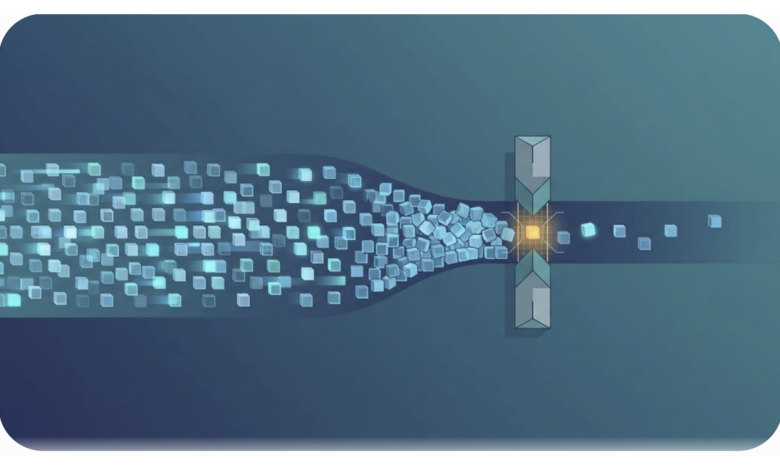
I watched a team double its output in a quarter and end the year moving at almost exactly the speed it started at.
The generation side of their work had transformed. Code, test scaffolding, first-draft documents, configuration — all of it arrived faster than anyone could have produced by hand. And yet the throughput of *shipped, trusted work* barely moved. The bottleneck had not disappeared. It had moved downstream, to the one place nobody had staffed for it: the point where a human being has to decide whether the machine’s output is actually right.
This is the pattern I now expect in almost every AI rollout, and it is the one most leaders are not budgeting for. The return on AI is not capped by how fast your models can generate. It is capped by how fast your people can trust what they generate. Most organizations are buying generation capacity and starving verification capacity, and that imbalance is why the second year of an adoption curve so often looks flatter than the first.
The bottleneck moved, and it moved to a place you can’t parallelize easily
Generation scales almost for free. You can double the volume of AI-produced output by changing a setting. Verification does not scale the same way. A reviewer reads at human speed, holds context in a human working memory, and gets tired. When you pour a larger volume of generated output into a review process that was sized for hand-crafted volume, a queue forms. Work-in-progress piles up in front of the reviewer, and the effective throughput of the whole system is now set by the slowest human station, not the fastest machine one.
What makes this worse than an ordinary queue is the *kind* of output AI produces. Traditional broken output tends to be obviously broken — it fails to compile, it throws, it looks wrong at a glance. AI output has a different failure mode: it is fluent, plausible, and confidently wrong. A subtly incorrect answer that reads as authoritative is far more expensive to catch than one that is visibly garbage, because the reviewer has to actually reason about it rather than reject it on sight. So not only is the queue longer, each item in it now costs more attention to clear.
The result is a system that feels faster at the input and is not meaningfully faster at the output. Leaders see the generation metrics — volume, velocity, adoption — and wonder why the delivery metrics are not following.
Trust debt compounds like technical debt
Teams under pressure resolve the queue in the obvious way: they let some of it through with a lighter look. Every piece of AI output that ships without genuine verification is not a time saving. It is a loan. You have borrowed against the possibility that the output was wrong, and the interest is paid later — in the incident, the rework, the customer-facing error that traces back to a plausible-looking artifact nobody fully checked.
I call this trust debt, and it behaves like technical debt with one nasty difference: it is invisible at the moment you take it on. Skipped verification leaves no failing test, no red mark, no artifact. It looks exactly like verified work until the day it doesn’t. An organization can run for months believing it has captured a productivity gain when what it has actually done is move risk off the balance sheet into a place where it will not be seen until it is expensive.
Building an oversight operating model
The fix is not to slow generation down. It is to treat verification as a first-class part of the system and engineer it deliberately. A few practices consistently move the ceiling:
Make AI output structured and self-describing, and route by risk. The single most useful change is to stop treating a model’s output as a flat blob a human must fully re-derive. Have the system emit structured output with an explicit, calibrated confidence signal, and route based on it — high-confidence, low-risk items get a light check, low-confidence or high-blast-radius items go to a full human review. The point is to spend scarce reviewer attention where it changes an outcome.
# Pseudocode — not production; illustrative of the routing idea
result = model.generate(task) # structured output, not a blob
if result.risk_tier == “high”:
queue_for_human_review(result) # blast radius too large to auto-clear
elif result.confidence < CALIBRATED_THRESHOLD:
queue_for_human_review(result) # model itself is unsure
else:
accept_with_audit_log(result) # cleared, but recorded and sampled
Never let a model’s boolean directly gate a release. A model returning “looks fine: true” is not a passing test; it is an opinion with a confidence interval. Treat it as a signal that feeds a decision, with thresholds you calibrated against known-good and known-bad examples, and with the low-confidence band always falling to a human. A judge that is itself uncertain must be allowed to say so.
Keep the verification path deterministic. If the same artifact can pass on Monday and fail on Thursday with nothing changed, your reviewers stop trusting the check and go back to reading everything by hand — and you are back at the ceiling. Determinism in the verification layer is what lets people trust it enough to lean on it.
Measure verification throughput, not just generation. If your dashboards only show how much AI produced, you are measuring the half of the system that was never the constraint. Track how fast trusted output leaves the building, and how much unreviewed output is accumulating. That second number is your trust debt, made visible.
What this means for the next budget cycle
The instinct, when AI gains stall, is to buy more or better generation. That is spending on the station that is already fast. The leverage is on the other side. Fund the verification tooling. Define, in advance and in concrete terms, what “acceptable” output looks like for each class of work, so review is a judgment against a standard rather than an open-ended read. Staff review as real, respected work rather than an afterthought squeezed between other duties. And when you evaluate an AI vendor, spend less time on how impressive the generation looks in the demo and more on one question: what does this give my people to help them trust the output — structured results, calibrated uncertainty, an audit trail — and what does it leave entirely on their shoulders?
The organizations that win the next phase of AI adoption will not be the ones that generate the fastest. That capacity is becoming a commodity. They will be the ones that can *verify* the fastest — that treat trust as the throughput metric it has quietly become. The ceiling is real, but it is not fixed. You raise it by engineering for the moment a human has to believe the machine.