The AI/Robotics Revolution has created a palpable fear that “the robots are coming to take our jobs!” Various studies conclude that roughly half of present jobs could be lost to automation — even professional work — possibly leading to mass unemployment and social upheavals.
My TechCast Project, which forecasts emerging technologies and social trends, surveyed international thought leaders to assess global unemployment across the occupational spectrum. Results are tabulated below and show that our experts believe a reasonable path can be found through this difficult transition.
They collectively judge the gains and losses in various job classes as the AI/Robotics transition reaches a more fully automated stage of development in about 2030. Routine work is likely to disappear, but market forces are likely to produce new creative jobs, and government support could limit job losses to tolerable levels.
What’s most intriguing is that robust gains in creative work could open a new frontier of vast possibilities in work requiring “subjective” thought and other forms of “higher” consciousness.
Expert survey results for OECD nations in 2030
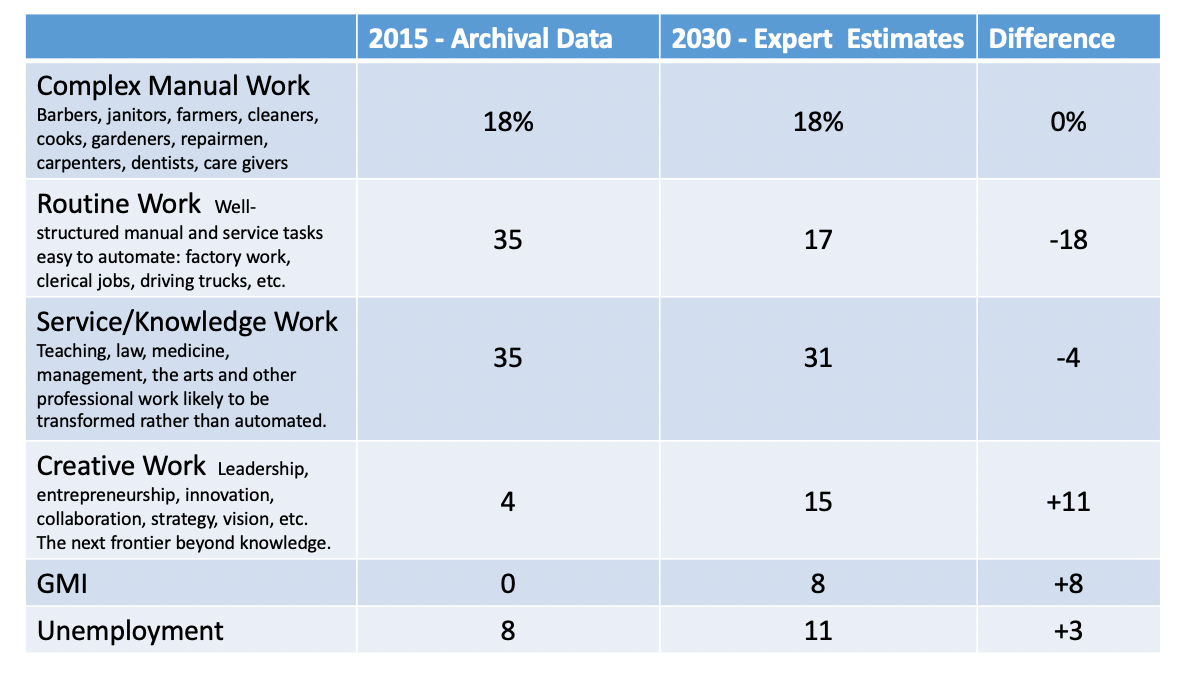
Automation is likely to eliminate about 18 percent of routine jobs, but only 4 percent of service/knowledge jobs, which will be largely upgraded as AI reduces “cognitive drudgery.” These losses are likely to be compensated by roughly 8 percent of workers gaining a guaranteed minimum income (GMI), and roughly 15 percent finding new jobs in “creative work.” Altogether, the changes are likely to raise unemployment by a modest 3 percent or so… bad, but not a major crisis.
The entire service, knowledge, and creative work sectors could grow to almost 50 percent of the entire labor force by 2030, almost 60 percent of employed workers.
Our most interesting finding is that innovative enterprise is likely to absorb the AI threat into a growing new domain of creative, subjective thought. Furthermore, the widespread use of AI should increase knowledge and intelligence to unprecedented levels, fostering a society of creative change and understanding.
While AI can automate routine knowledge work, there exists a huge unexplored economic domain beyond knowledge — creativity, entrepreneurship, vision, collaboration, diplomacy, marketing, supervision, and other higher-order functions that are uniquely human. Advanced AI may be able to solve tough problems, but it can’t provide vision, purpose, imagination, values, wisdom, and other capabilities that are essential for a complex world and tough choices.
Intelligent machines are likely to take over routine tasks, but the technology will remain limited, and people will always want a real person to provide human contact and handle tough issues. Staff is growing rapidly in universities, hospitals, research institutes, and other advanced settings for these reasons.
This trend follows a well-worn historic path. Automation replaced manual labor in farming, then in manufacturing, then services, and now it promises to automate knowledge work. We simply can’t yet see the opportunities beyond knowledge. Futurist Ray Kurzweil explained: “You can’t describe the new jobs because they’re in industries and concepts that don’t exist yet.”
Jack Ma, founder of China’s Alibaba, explained: “Technology will never replace humans. People will always surpass machines because people possess wisdom.” Philosopher Sean Kelly claims: “Nothing but another human being can properly be understood as a genuinely creative artist.”
Here are a few simple guides to living with AI and robots:
- Remember they’re just machines. No amount of talk about sentience or superintelligence can change the fact that AI and robots are tools. Don’t be taken in by their smooth-talking ways. You, the human, are in charge.
- Monitor and check. Our main task is to supervise these machines to ensure they’re not acting dangerously. Compare their results to other AIs, humans, and common sense, and be ready to correct them if needed.
- Rise to your talents. Smart machines free us from drudgery, so rise above them to find your unique talents and create innovations of utility and beauty. We could be amazed by our skills and create a far better world.
In the end, rather than diminishing people, the net effect of AI may be to enhance the value of these higher-order talents that are unique to humanity. As I highlight in my new book, One World? The Digital Revolution and the Rise of Global Consciousness, an abundance of evidence forecasts that today’s digital revolution is propelling us toward the next logical stage in our social evolution — a stage of mature consciousness. Key to this emerging era of human ingenuity is recognizing that the digital revolution is automating knowledge, driving attention up the hierarchy of thought into the subjective realm of emotion, values, and beliefs that form higher consciousness.
This outlook may seem contrary to many who are convinced that disaster looms ahead. We respectfully suggest that, yes, the robots are coming to take your jobs — but that will free us to do more creative work and foster a more innovative, prosperous, and thoughtful civilization. Learn more at billhalal.com.