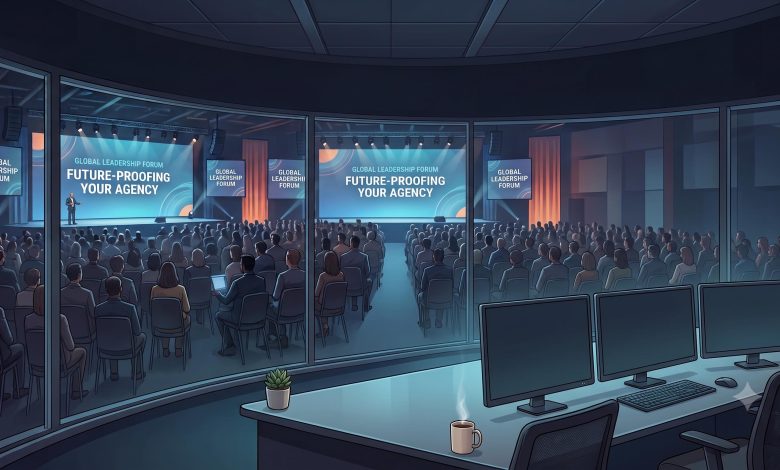
Most discussions about AI in the events industry tend to focus on what audiences are able to see – AI-generated content, synthetic presenters, personalised attendee experiences, automated marketing.
Coming into events after seven years in product and AI, that was where I was expecting the real transformation to happen. However, what surprised me is that the biggest shift of all seems to be operational.
Events agencies are not simply creative businesses. They are coordination systems disguised as creative businesses.
The visible output includes the stage, the experience, the content which all sits on top of a very dense operational layer involving suppliers, contractors, production timelines, catering logistics, compliance requirements, stakeholder management, and institutional knowledge accumulated across years of projects. This is also where AI becomes most interesting.
The operational shift behind the scenes
When the industry talks about “AI,” it often collapses very different technologies into one category. In practice, the systems reshaping agency work performs different functions.
Predictive systems have existed in events for years through attendee recommendations, matchmaking, and attendance forecasting. Generative AI is now entering workflows through drafting, summarisation, translation, and content production. Agentic systems are beginning to automate multi-step operational work by coordinating tools, retrieving information, and routing approvals across workflows.
Underpinning all of this are retrieval systems – AI grounded in organisational knowledge rather than the open internet. That distinction matters because events agencies run on lots of fragmented information.
The biggest surprise entering the industry was how much agency value sits in invisible coordination work. Most agencies operate through flexible networks of freelancers, specialist vendors, production crews, and trusted suppliers assembled differently for each project. The challenge is not simply hiring people…it is institutional memory.
Which supplier solved a similar production issue last year? Which freelancer performs well under compressed timelines? Which combinations of vendors consistently stay on budget? Which projects overran because briefing arrived too late?
Much of this knowledge currently lives in inboxes, spreadsheets, disconnected drives, and individual memory. And this is exactly where retrieval and predictive systems become operationally valuable.
The industry runs on knowledge
An effective retrieval layer can surface previous run sheets, supplier notes, production timelines, budgeting assumptions, and post-event lessons relevant to a live project. Predictive systems can identify resourcing pressure before bottlenecks emerge. Agentic workflows can automate onboarding, reconciliation, reporting, and approval routing that currently consume large amounts of operational time.
The same pattern appears in food and beverage operations, another area the industry rarely discusses publicly despite its scale.
At Nteractive, we have a dedicated in-house F&B function responsible for catering and food logistics across projects. That creates practical AI applications with measurable outcomes such as;attendance forecasting, feeding consumption forecasting, dietary preference analysis improving menu planning, supplier sustainability profiling, and real-time waste monitoring.
The most useful AI applications are often the least glamorous. They involve systems surfacing relevant context for a producer preparing a brief late at night. They involve automating reconciliation workflows after an event closes. They involve reducing operational friction inside agencies rather than producing visible audience-facing novelty.
The audience however never sees these systems directly – they simply experience events that run more effectively and seamlessly.
Trust is becoming operational
The industry is also approaching governance questions it still underestimates. Synthetic content and AI-generated presenters are becoming increasingly convincing, raising difficult questionsaround authenticity and disclosure. Shadow AI is already widespread inside agencies, with staff using tools like ChatGPT, Copilot, and Otter outside formal governance structures. Client restrictions are also becoming more specific, particularly in regulated industries where AI policies now appear directly in procurement and RFP processes.
At the same time, regulatory pressure is increasing. Predictive matchmaking, attendee profiling, and personalisation systems all involve personal data processing under GDPR and emerging AI regulation.
Infrastructure comes first
The strategic question for agencies is no longer whether to adopt AI. It is how to sequence adoption.
My view is that agencies should approach AI in three layers – starting with retrieval first, generative second, and predictive third.
An agency’s real advantage is accumulated operational knowledge: past projects, supplier relationships, delivery lessons, production documentation, and institutional experience. Without retrieval infrastructure, generative systems remain unreliable because they cannot access trusted organisational context.
Once retrieval exists, generative systems become significantly more useful for drafting, reporting, multilingual content generation, and internal copilots grounded in real operational data. Predictive systems become most valuable later, once organisations have mature data flows and operational visibility.
This approach is slower than deploying off-the-shelf AI tools immediately. It is also less visually impressive in the short term. But agencies that invest in operational knowledge infrastructure now are likely to build more defensible long term capability than agencies relying entirely on generic external systems.
AI in events is often discussed as a creative revolution – but in reality, the deeper shift is operational. The most consequential changes are happening inside the invisible systems agencies rely on to coordinate people, suppliers, logistics, and knowledge at scale.
That is where AI becomes genuinely transformative. And for the events industry, it is probably the layer that matters most.