For years, AI sat on the sidelines of video strategy, showing up as a set of useful extras but rarely treated as something the operation depended on. In a remarkably short span, models have gone from answering questions to executing work: chaining multiple tasks together, calling tools reliably, and increasingly building the tools they need to reach a goal. Once AI can carry a multi-step job from intent to result, it stops being a collection of features bolted onto the edges of a workflow and becomes something the workflow can actually run on. For video, where the operation is already one of the primary ways organisations communicate, build audiences and generate revenue, that shift is what turns agentic workflows from an idea into something you can put into production.
From features to outcomes
For most of the past two decades, business software has come in three shapes. UI-led platforms hand customers a set of screens and buttons. Headless platforms expose the same capabilities as APIs and let customers build on top. Hybrids do both. AI does something different to each. A purely UI-led product starts to feel like a constraint: you are limited to the use cases someone anticipated when they designed the buttons, at the pace clicking through them allows. Headless products get enhanced, because agents let anyone build on top of your APIs far faster than before. But the hybrids benefit most—they get the headless upside and they also get their existing UI-led workflows turned into something an agent can run, with the customer stepping back into the role of checking the work rather than doing every step of it.
The real shift is that customers can now ask software for outcomes directly. Not “let me click through five tools to publish a localised highlight” but “publish this highlight in seven languages with the right metadata and the right ad markers.” The interface is intent rather than UI, and the work happens through agents that understand the customer’s goal and chain the right capabilities together to reach it.
What integrated AI looks like today
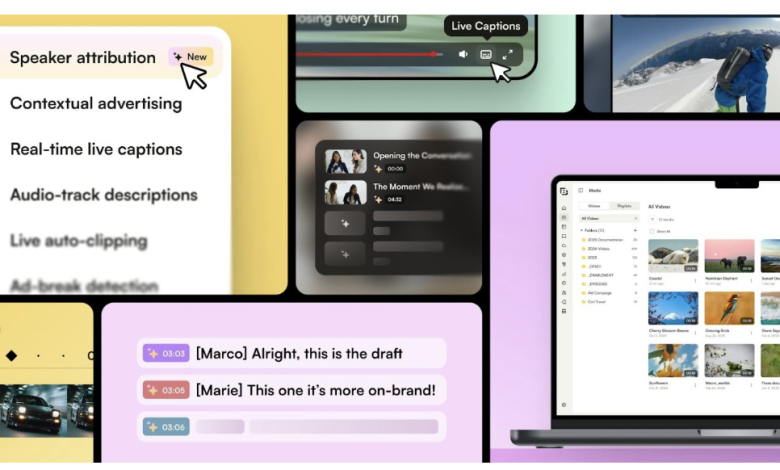
The clearest preview of where this is going is already running in production, and it is the mix of AI capabilities designed to work together.
Take sports leagues publishing AI-assisted highlight clips across global markets. Or enterprises localising leadership communications into multiple languages in a single session. Or broadcasters attaching scene-level metadata to their videos so ad sales, bidding and servicing can target the moment a Paris skyline appears on screen rather than just a video tagged “travel.”
The teams pulling ahead are the ones whose AI features are integrated tightly enough that the work moves through them as one workflow, shifting metrics like cost per minute of localised content and time to clip on live events.
This is what becomes possible when AI features are designed to connect. The next step, and the one that changes the competitive picture, is what becomes possible when an agent runs the workflow itself.
What platforms will compete on next
The shift in B2B software meets the operational reality of video. Two thirds of media buyers are now focused on agentic AI for ad buying and campaign execution, according to the IAB. Gartner projects that by 2028, at least 15 percent of day-to-day work decisions will be made autonomously through agentic AI, up from none in 2024. The Model Context Protocol, the open standard that makes platforms callable by AI agents, has gone from a research curiosity to the de facto interoperability layer in barely a year.
This changes the basis on which video platforms compete. For the last decade, the question was how many features does the platform have? The more useful question now is how much depth of workflow can the platform’s agents execute end to end? Breadth of features is still necessary; it just is not sufficient anymore. The customers asking the sharpest questions are asking for outcomes, and they want the platform to handle the work between the request and the result.
There is a second-order effect worth noting. In traditional B2B software, a new capability is not really shipped until there is a UI wrapped around it, and agents collapse that gap. A capability can reach customers as soon as the underlying functionality works, because the agent can navigate and chain the steps directly. The time between what a platform can do and what customers get value from shortens considerably.
The credible version of this
There is a version of the agentic AI conversation that is running ahead of where adoption actually is. “Autonomous AI employees” or “fully agentic enterprise” framing is often off-putting to serious buyers and does not reflect how adoption actually happens in B2B. In practice, trust is the first requirement, not autonomy. The market needs to see agents work on small, bounded tasks first and earn the right to expand into scheduled, more autonomous workflows over time. A content library quietly improving on its own as captioning, translation, metadata and SEO trigger each other on a schedule is the destination, not the starting point.
The credible version of this also leans on a more straightforward engineering principle: deterministic first, LLM second. The B2B AI market is currently full of products that wrap a language model around everything. The more robust version of enterprise AI uses LLMs where judgement is genuinely required, and deterministic code everywhere else. Agentic workflows that work in production look more like classical software with an LLM at the decision points than like a chatbot with extra steps.
The work, not the wow
Even Deloitte’s read on generative video, the technology that has dominated the headlines for two years, points in the same direction. In 2026, its real value to media will come less from replacing the production stack than from “eliminating costly micro tasks, compressing the time to create, and empowering smaller outfits to do more.”
So the question for next quarter is not which AI features to launch, but whether the platform could hand a real workflow to an agent and trust it to finish. Wherever that breaks down is the work worth doing, and it is the difference between competing on breadth and competing on depth.