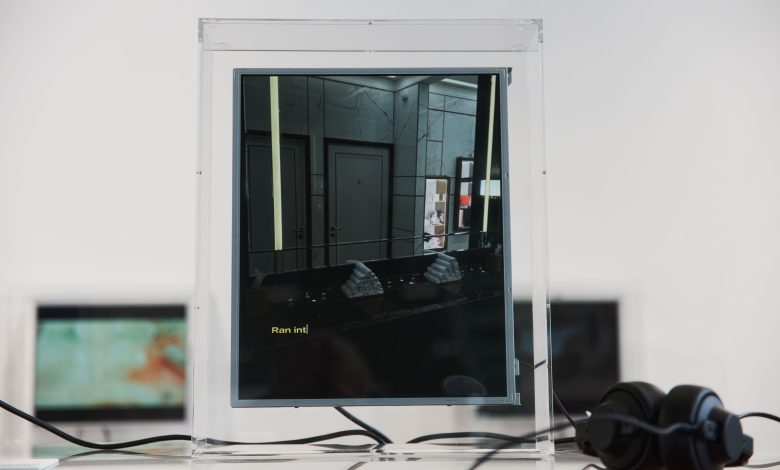
There is a structural problem at the centre of the media art world that rarely gets discussed outside of specialist circles. It is not about quality, or institutional recognition, or even money. It is about time.
Media art — video works, digital installations, generative pieces, screen-based practice — has a rich institutional history. It is shown at major biennials, acquired by serious museums, supported by dedicated foundations and festivals. The field has genuine cultural weight. But almost all of that presence is event-driven.
Works appear during a festival run, a residency, a temporary exhibition. When the event ends, the work disappears — back into an archive, a hard drive, an artist’s website. The infrastructure for continuous, contextualised presence simply does not exist at scale.
This is the problem CIFRA was built to solve.
An Ecosystem Without Permanent Walls
To understand what CIFRA is building, it helps to understand what the art system actually does.
Contemporary art operates as a complex ecosystem of reputations and institutional relationships. Galleries, curators, museums, dealers, and media all contribute to cultural legitimacy in different ways. Access to this system is governed not by open mechanisms, but by professional networks, recommendations, and accumulated institutional trust.
Media art has developed its own institutional history within this broader system. What has not developed — not at a meaningful scale — is infrastructure for permanent display outside the exhibition cycle. The gap between “shown at a major festival” and “visible, contextualised, accessible” remains wide.
This gap has real consequences. For artists, significant work disappears between events. For institutions, programmes are limited by physical and temporal boundaries. For commercial and cultural spaces that want to engage seriously with media art, there is no reliable system connecting them to the field with the curatorial rigour the work deserves.
What CIFRA Actually Builds
CIFRA’s proposition is to create that missing infrastructure — not as a streaming service, not as a marketplace, but as a curatorial platform enabling permanent, contextualised presence of media art beyond the exhibition cycle.
The platform connects multiple participants simultaneously: artists, curators, galleries, institutions, collectors, corporate spaces, and public audiences. CIFRA is designed to work with all of them within a single ecosystem — functioning as distribution infrastructure, archival environment, and community platform at once.
A particular focus is the extension of offline projects into lasting digital presence. A festival programme, an institutional exhibition, a gallery show — CIFRA turns them into something that continues: accessible, contextualised, connected to the broader field. The event becomes a starting point rather than the whole story.
The curatorial dimension is not incidental. CIFRA’s Artistic Vision Council — including Lev Manovich, Olga Shishko, Christiane Paul, Oliver Grau, and Martin Honzik — shapes the platform’s seasonal programming and editorial strategy. This is not a content recommendation algorithm. It is a professional curatorial structure applied to a digital environment.
The Commercial Dimension
For businesses and cultural venues, CIFRA’s model offers something not previously available in this form.
The commercial art display market has existing players focused on streaming art to screens in hotels, offices, and retail environments. What these platforms provide is essentially a content service: catalog access, managed delivery, ambient visual programming. The question of why a particular work is shown, what it means, who made it, and what institutional context surrounds it, tends not to be part of the proposition.
CIFRA’s model is different in kind. A commercial space working with CIFRA is not acquiring a content feed. It is connecting to a living field: a community of over 3,200 artists, a curatorial framework with genuine institutional weight, and a platform designed to make media art present in a way that reflects how it actually operates within the art world.
For businesses thinking seriously about what their physical environments communicate — luxury hospitality, corporate campuses, cultural venues, retail flagships — that distinction matters. The question is no longer “what do we put on our screens?” It is “what relationship do we want to have with contemporary culture?”
Why This Moment
The timing is not accidental. The art world is in the middle of a longer reckoning with digital presence — accelerated by the pandemic, complicated by the NFT cycle, and still unresolved. Institutions are looking for sustainable models for digital extension. Artists are looking for platforms that take the work seriously.
CIFRA is not the first platform to recognise that media art needs better infrastructure. It is the first to build that infrastructure around the full complexity of how the art world actually works — connecting artists, institutions, curators, and spaces within a single system designed for permanence, not just events.
The works were always there. What was missing was a place for them to live.