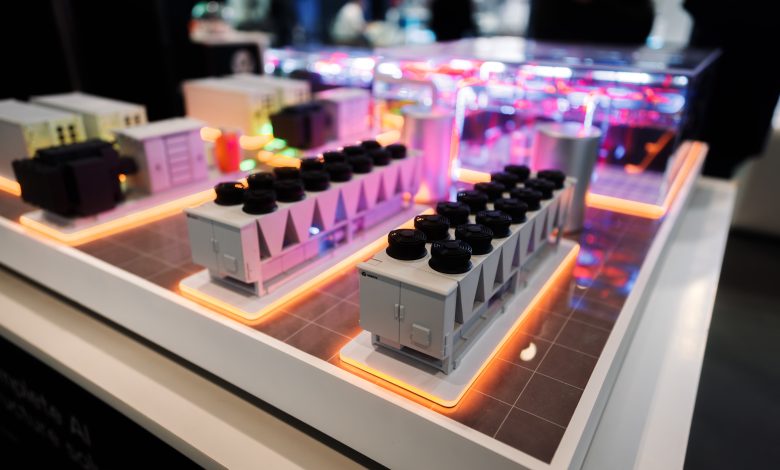
The rapid expansion of Large Language Models (LLMs) has created a significant disconnect between software capabilities and physical infrastructure. AI models continue to scale in complexity while the data centres required to house them are hitting fundamental limits in power density. This gap represents a critical challenge for the next generation of industrial AI applications. Overcoming this challenge requires a structural rethink of how we design and deploy high-performance computing operations.
The shift from general-purpose to AI-native design
Traditional data centres were designed for general-purpose cloud computing with predictable and low-density workloads. These facilities typically manage power loads of 5kW to 10kW per rack. Data Center Dynamics reports that as we move through 2026, high-density AI clusters are making these traditional methods obsolete. Modern AI-native infrastructure must now support densities exceeding 100kW per rack to remain viable.
This shift represents a foundational change in mechanical and electrical architecture. The physical footprint of an AI factory is defined by its ability to transfer heat away from high-value silicon. Standard air-cooling systems are reaching the limits of their efficiency as graphics processing unit (GPU) thermal design power continues to rise. Liquid cooling has moved from a niche requirement to a baseline necessity for AI workloads.
Solving the thermal density challenge
Managing the heat generated by dense AI clusters requires a transition to liquid-to-liquid or liquid-to-air cooling architectures. IEEE Spectrum notes that while average racks once sat at 8kW, AI is pushing that to 150kW per rack or more. This efficiency allows operators to pack more compute power into a smaller physical area. It also introduces new risks regarding fluid management and system pressure within the white space.
Engineers are now deploying Coolant Distribution Units (CDUs) to manage the interface between facility-side and rack-side cooling. These units act as the heart of the thermal management system. They enable coolant to be delivered at the precise temperature and flow rate required. A failure in this orchestration can lead to thermal throttling and significantly degrade the performance of expensive AI training runs.
Powering the next generation of compute
The growing electrical demand of AI factories is increasingly challenging local and national power grids. Facilities that once required 20MW of power are now requesting hundreds of megawatts for a single campus. In certain regions, this scale of demand often exceeds the capacity of existing utility infrastructure.
As a result, many operators are exploring alternative energy sources and on-site generation to supplement their requirements. JLL notes that energy challenges are driving up to $3 trillion investment cycle in infrastructure over the next five years. These systems allow data centres to act as prosumers and interact with the grid to manage peak loads. This integration of alternative and renewable energy sources is a primary focus for meeting sustainability targets.
Scaling infrastructure for the AI era
The demand for AI compute is moving faster than traditional brick-and-mortar construction cycles can support. Bloomberg reports that in the US, nearly half of all planned data centre projects for 2026 could be facing delays, reflecting broader constraints around grid access and the availability of critical equipment. This dynamic is driving greater focus across the industry on more standardised, scalable approaches to deploying power and cooling infrastructure, including industrialised, converged solutions.
Using industrialised methods and introducing digital twin designs can shave up to 85% off typical deployment times. These modular units are built and tested in a factory setup before being shipped to the site. This approach allows operators to scale their capacity in increments as their compute needs grow. It reduces the amount of high-risk electrical work that must be performed on-site.
Speed and collaboration: the foundations of AI infrastructure
A real enabler of speed is the early alignment on reference architectures and the continuous evolution of previously deployed designs. This requires excellent orchestration between highly competent technical teams and seasoned suppliers. It creates genuine cross-functional collaboration with no artificial barriers between organisations.
Traditional construction projects follow a very structured, hierarchical sequence where every discipline operates through its own contractual channel. That approach works in many cases, but it’s not well suited to the speed needed today. Instead, all parties should be brought together from day one – sitting around the table, workshopping solutions, and addressing infrastructure and IT stack requirements upfront. Everything then moves forward sequentially but in a highly collaborative, coordinated way rather than through a rigid, siloed hierarchy.
Automation and the role of AI in infrastructure management
As data centres become more complex, the role of human operators is changing. Managing liquid cooling loops and 100kW plus racks requires a level of precision that manual monitoring alone can struggle to provide. AI-driven management systems are now used to predict thermal dynamics and adjust cooling flow in real time. This proactive approach prevents hardware damage and optimises energy use.
These automated systems rely on a vast network of sensors embedded throughout the facility. They monitor everything from vibration in the pumps to the humidity levels in the air. By applying machine learning to this data, operators can identify potential points of failure before they occur. This predictive maintenance is essential for maintaining the high levels of uptime required for AI training clusters.
Looking ahead
AI deployment timelines are accelerating rapidly as organisations race to deliver tangible value from increasing compute investments. In this high-stakes scenario, thermal management has evolved from a supporting role into a foundational pillar of the AI infrastructure stack. Organisations that excel in adaptive liquid cooling, converged architectures, and cross-functional collaboration will be best equipped to build the reliable, high-performance systems powering tomorrow’s breakthroughs.
By integrating proven reference designs, industrialised solutions, and intelligent control systems, teams can dramatically shorten deployment cycles while enhancing reliability and efficiency. For those involved in AI data centre projects, the clearest imperative is to treat power and cooling as inseparable priorities from day one. That means engaging ecosystem partners early and embedding flexibility across every design layer.
As sovereign AI initiatives and industrial applications expand from large language models (LLMs) into robotics, autonomous agents, and edge deployments, the need for advanced thermal strategies will intensify. Success in this next chapter will depend on continuous learning, hands-on experimentation, and a mindset that breaks down traditional industry silos.