Have you ever heard of the Red Queen Effect? While fans of Alice in Wonderland will recognize the literary nod, the phrase has long been used in fields as diverse as evolutionary biology and business management to describe a frustrating paradox: sometimes, you have to run as fast as you can just to stay in the same place.
It describes a relentless loop where you must constantly adapt to outperform your competitors while they do the exact same to outperform you. In the end, everyone evolves, but nobody wins.
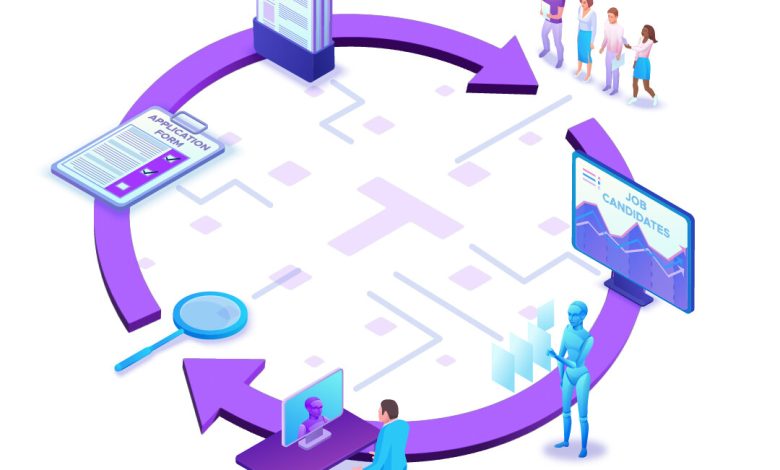
Today, this is the perfect metaphor for the silent arms race happening in HR. Candidates are using AI to polish their resumes and navigate assessments while employers do the same to screen applicants and detect the extent to which AI was used. It’s a loop where both sides are sprinting just to keep up.
Cheating or future-proofing?
Recent research from Talogy revealed that 65% of hiring managers are concerned about candidates using generative AI to cheat on recruitment assignments. However, only 22% of early career candidates admitted using it to complete a task.
This suggests a disconnect between hiring teams and job seekers that only feeds the so-called AI adversarial hiring loop, creating a cycle of escalating mistrust where both parties continuously refine their use of AI to outsmart each other.
Honesty contracts have proven to be helpful in reducing the inclination to cheat. We recently conducted a study that involved over 2000 assessment participants and found that, when an agreement not to use AI, search engines or other tools is introduced before the assignment, the number of candidates using some form of assistance dropped from 28% to just 13%.
However, while reinforcing transparency might be helpful, the pervasiveness of AI tools in most workplaces means that there is a pressing need to reframe its use throughout the recruitment process and break a cycle that ultimately benefits no one.
While using AI to polish a resume or complete an assignment has traditionally been seen as cheating, it could also be seen as a sign of resourcefulness, with candidates using all available tools and resources to do a good job. The real challenge, then, is not spotting whether candidates are using AI to put their best foot forward, but assessing the quality of the AI-human interaction in the context of the role they’re applying for.
Moving beyond AI fluency
In an AI-enabled work environment, penalizing candidates who use AI throughout the recruitment process might be counterproductive. Some organizations have already moved past this and are focusing on measuring AI literacy and familiarity with specific tools and platforms instead. However, this approach risks oversimplifying the challenges of AI adoption.
As AI evolves at an unprecedented pace, defining skills based on knowledge of specific tools and interfaces is problematic. What organizations really need to know is how effectively candidates interact with AI, using it to enhance performance without undermining the quality of their work.
It’s about assessing the distinctively human qualities that allow candidates to collaborate with AI effectively, such as learning agility, adaptability, the ability to critically evaluate AI outputs, and the level of comfort navigating ambiguity as systems change. Understanding an individual’s natural predisposition to effectively collaborate with AI means prioritizing capabilities that will remain relevant even as the technologies themselves inevitably change.
This shift mirrors the evolution of previous workplace technologies. Decades ago, proficiency in Microsoft Office or digital spreadsheets was a powerful differentiator. Today, those skills are baseline expectations that no longer set a candidate apart. Generative AI is rapidly following the same trajectory. As AI tools become deeply embedded in standard operating software, basic AI proficiency will stop being a competitive advantage.
The real shift happening in today’s workforce
Ultimately, we need to stop treating AI as an enemy and start viewing it as a permanent feature of most workplaces. The loop of catching ‘cheaters’ vs. optimizing applications is a distraction from the real shift happening in the modern workforce.
Moving forward, the defining question of recruitment won’t be: “Is this candidate using AI to complete their assessment?” or even “Can they use AI?” Instead, organizations will ask: “How effectively does this person perform within an AI-enabled workplace?”
Success will no longer be measured by whether a candidate can generate text or write code with or without a prompt, but by their ability to critically evaluate AI outputs, guide the technology with strategic thinking, and learn quickly and comfortably as tools evolve.
By shifting our focus from detection to collaboration, we can finally break the adversarial hiring loop. Employers can then stop running just to stay in the same place, and start hiring the agile, human-centric talent required to lead their businesses into an AI-driven future.