I spend a lot of time talking to AI founders. Most of them found a gap in the market first, then figured out how to fill it. Lakshmi Supriya Namana did it the other way around.
She is a Senior Cloud and DevOps Engineer. Her job, for years, has been making AI systems work reliably in production. the infrastructure layer, the deployment pipelines, the resilience engineering that determines whether intelligent systems hold up when they actually matter. That is what she knows deeply. And that is exactly what she used to build FlowOps.
Not a pivot. Not a side project that grew. A product that came directly from a decade of understanding where operational systems break.

She was already in the room
Before FlowOps, Lakshmi was showing up in places that most engineers at her level do not bother with.
In 2025, she spoke at an international AI transformation summit on chaos engineering in intelligent systems deliberately breaking AI infrastructure under controlled conditions to find failure points before users do. The lineup included professionals from Amazon and Warner Bros. She judged submissions at one of the world’s largest enterprise software hackathons, evaluating nearly 4,000 entries from developers building the next generation of tools. And she helped organise Women in Product India’s A Day with AI Demo Days over 110 founders, engineers, and product professionals in one room, including founders from Y Combinator-backed companies Clueso and Truffle AI.
She was not attending these things. She was contributing to them.
The gap she kept seeing
The more time she spent inside the AI community, the more clearly she could see what it was missing.
UK small service businesses consultants, training providers, field service teams are running their daily operations on spreadsheets, email threads, and WhatsApp groups. Bookings fall through. Follow ups get lost. Teams coordinate across five disconnected tools that nobody decided to connect.
The UK government’s SME Digital Adoption Taskforce, reporting in July 2025, put numbers to what she was seeing. With 5.5 million SMEs making up 99.8 percent of the UK’s entire business population, the Taskforce set a formal national ambition: make UK SMEs the most digitally capable and AI-confident in the G7 by 2035. Their own research estimated that small businesses could recover the equivalent of three and a half weeks of productive time annually just by adopting basic digital tools properly. Ten recommendations followed. The gap between where these businesses are and where that ambition points is wide.
Nobody was building for this specifically. So she did.
What FlowOps does
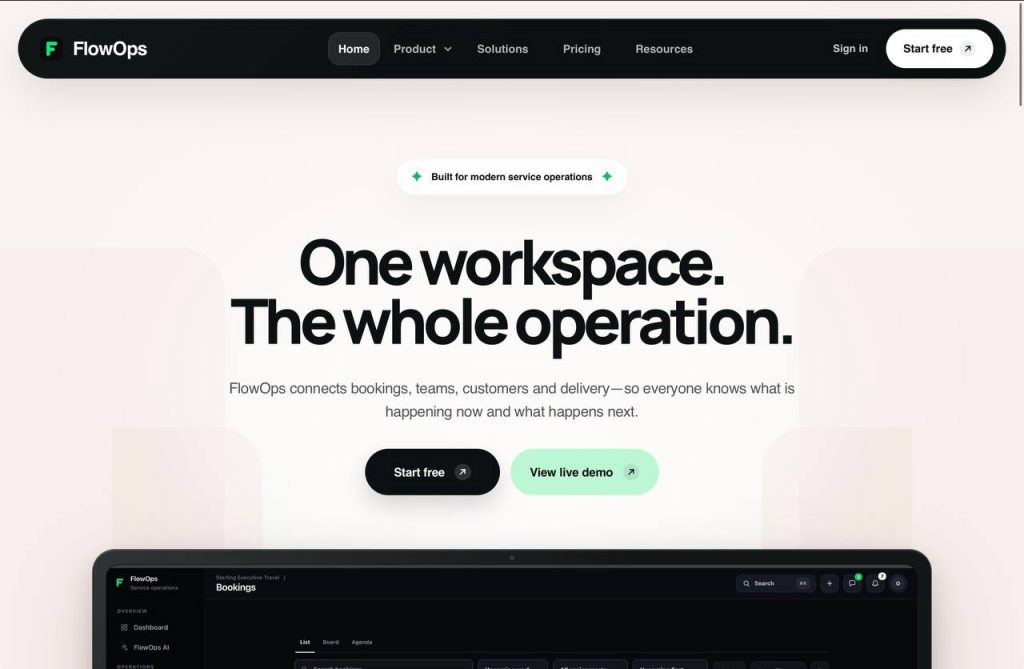
FlowOps is an AI powered operations platform for UK service businesses. Bookings, team dispatch, customer follow up, workflow automation, contract management, and an AI assistant in one connected workspace instead of five disconnected tools.
It is live at flowopsone.com. It has paying customers. One person built it, over approximately ten months, using a decade of infrastructure and AI systems expertise.
A few things about how it is built stand out. Jobs require manager sign-off before they can close enforced at the system level, not as a setting someone can ignore. Follow up work links automatically to its originating job, so a customer’s full history stays connected across multiple interactions. And the AI assistant filters what it sees by the user’s role before generating a response not after. Access boundaries are built into the architecture, not checked on the way out.
These are not feature decisions. They are the decisions of someone who has spent years watching where operational systems fail in practice.
This is not where it stops
FlowOps is the first product in a deliberately planned ecosystem. AutoSys workflow automation is in active development. SignalIQ, ClientPulse, and WorkspaceOS follow on the roadmap, each targeting a distinct operational gap that service businesses currently handle manually.
The pattern is deliberate. One engineer, one infrastructure, expanding outward from a proven first product into the full operational stack that small service businesses are missing.
For a market that the UK government has formally identified as a national productivity priority, the timing is not accidental. The expertise behind it was not assembled quickly. And FlowOps is, as its founder describes it, just the beginning.
flowopsone.com