I have covered a lot of hackathons. Most follow the same script: students show up, build something half-working, present to tired judges, and go home with a certificate that collects digital dust. Spark 9 was not that.
When HackIndia announced its latest Spark edition, powered by IdeaBoxAI, at St. Joseph Engineering College in Chennai on July 4 and 5, it was already being talked up as the best hackathon happening in India right now. It did not disappoint.
First, what is IdeaBoxAI?
Before getting into what happened at Spark 9, it is worth understanding who IdeaBoxAI actually is, because most people I spoke to had not heard of the company before this event.
IdeaBoxAI describes itself as a Persona AI company. The core idea is simple but genuinely different from how most enterprise AI is being built today. Instead of one generic assistant that every employee uses the same way, IdeaBoxAI builds role-specific AI agents, each with distinct capabilities, data access, and action surfaces tailored to a particular job function.
A Sales Engineer’s agent knows different things, sees different data, and can take different actions than a Finance Analyst’s agent. The platform lets companies configure these personas using a See / Know / Act model, defining what an agent can observe, what it knows, and what it can trigger or write.
The platform integrates directly with CRM, ERP, databases, and existing enterprise workflows, without asking companies to rebuild their tech stack. It ships with enterprise-grade security and role-based access controls from day one.
Think of it as the difference between hiring one generic employee for every department versus hiring specialists who deeply understand their role. That is the bet IdeaBoxAI is making on enterprise AI.
You can explore the platform at ideaboxai.com. There is a free trial at app.ideaboxai.com and full documentation at docs.ideaboxai.com. For the size and ambition of what they are building, the onboarding is surprisingly accessible.
What actually happened at Spark 9
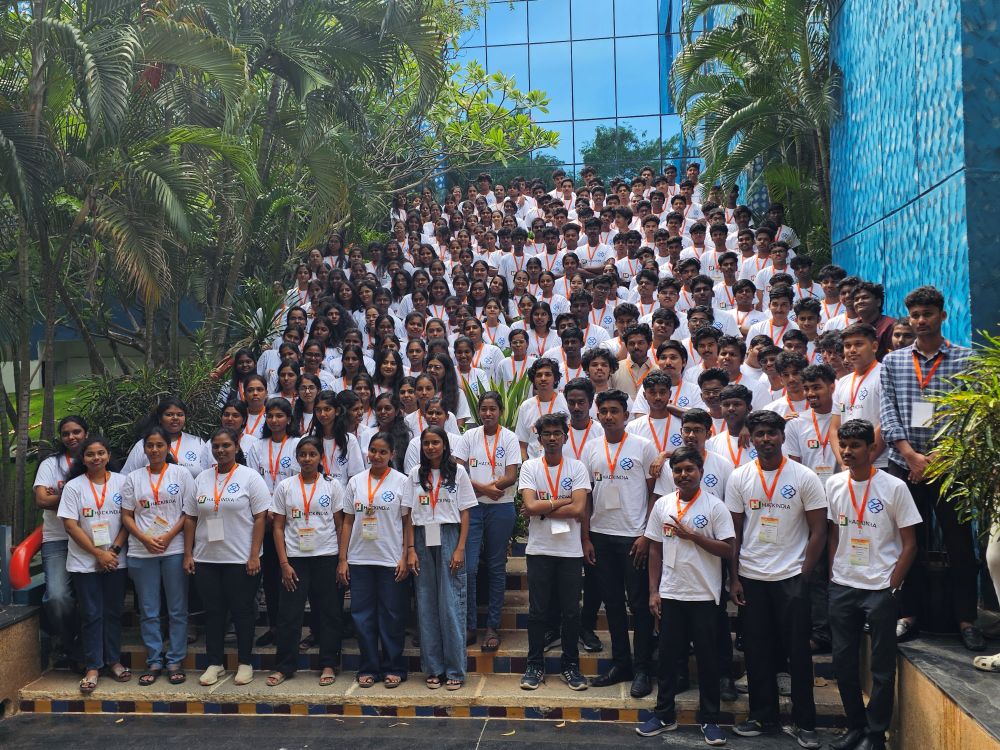
Three hundred students showed up to St. Joseph Engineering College on July 4. Thirty-six hours later, the room had produced working enterprise AI prototypes that I would not have been surprised to see demoed at a Series A pitch.
The difference, as far as I could tell, was IdeaBoxAI’s involvement at every level of the event.
Most hackathon sponsors write a cheque and disappear. The IdeaBoxAI team did the opposite. They ran a live onboarding session before the event, and their leadership showed up personally. Harish Govindaraju, Founder and Co-CEO, and Vithushan Sylvester, Co-Founder, spent time on a Google Meet with participants answering technical questions about the Persona Intelligence platform before a single line of code was written. By the time students walked into the venue, they had already been briefed on the stack they were building on.
That preparation showed in the submissions.
The tracks were genuinely hard
Four technical tracks and one wildcard marketing track. None of them were easy.
Track 01 — Enterprise Persona Intelligence
The flagship IdeaBoxAI track. Students picked any enterprise role and built an AI-powered co-pilot for it on the Persona Intelligence platform, wiring it to real data sources and demonstrating genuine agentic actions through a conversational interface. Not a prototype. Not a mockup. A working agent that remembers context and acts on it meaningfully across a multi-turn conversation.
Track 02 — Generative AI for Predictive Analysis
A conversational AI that writes and executes ML code on demand against any uploaded dataset, entirely on the fly. Regression, classification, clustering, time-series, all triggered by natural-language intent, with no manual code writing required from the end user.
Track 03 — Intelligent Model Routing for Cost Optimization
Build the routing layer that sends each node in an AI pipeline to the right LLM. Show the cost savings. Show the quality tradeoff. Make every decision observable and logged. This track attracted the most technically ambitious teams of the weekend.
Track 04 — Stateful AI Agents with Dynamic UI
The most visually impressive track. An AI agent that renders live, interactive CRUD interfaces mid-conversation. The user talks; the app updates in real time. No page refresh. No manual re-query. Just a stateful agent and a reactive interface that responds to natural language.
These are problems that senior engineers at well-funded AI startups are working on right now. Students were expected to make meaningful progress on them in 36 hours. Many did.
The marketing track was the surprise
The fifth track had nothing to do with code. IdeaBoxAI asked participants to understand its B2B, persona-driven product, research the competitive landscape independently, and create content that positioned the company clearly and accurately within the agentic AI category. Any format was fair game: demo video, comparison breakdown, thread, or review.
The best performers earn a fast-tracked interview for IdeaBoxAI’s marketing and community team.
A hackathon as a hiring audition. Genuinely clever, and a sign that IdeaBoxAI thinks about developer community not just as a marketing channel but as a talent pipeline.
Why this format works
The reason Spark 9 produced better outcomes than the average hackathon is not complicated. When a sponsor is embedded in the problem design, the judging, and the mentorship rather than just the branding, participants feel it. The stakes feel real because they are real.
IdeaBoxAI was not buying impressions. It was looking for people who could build with its platform and potentially join the team. That changes how seriously students take the 36 hours in front of them.
HackIndia has been running Spark editions across India for a while now, and the formula has clearly evolved. The NIT Delhi edition earlier this year drew more than 3,000 registrations. Spark 9 in Chennai drew 300 on-ground participants for an offline sprint, which is a different kind of commitment from a different kind of participant. The numbers are smaller, but the depth of engagement is not.
What IdeaBoxAI got out of it
Three hundred students in Chennai now know what persona-driven AI looks like in practice. Some of them built things this weekend that are better than what most early-stage startups ship in their first month.
For a company actively expanding its developer community and hunting for enterprise AI talent across India, that is a strong return on a single weekend partnership. Exposure to 300 pre-qualified, high-intent developers who spent 36 hours hands-on with the platform is worth far more than any passive brand campaign at that scale.
If you work in enterprise software, fintech, healthtech, supply chain, or any domain where role-specific intelligence matters, IdeaBoxAI is worth a serious look. The free trial at app.ideaboxai.com is a low-friction entry point, and the documentation at docs.ideaboxai.com is genuinely well-written for a platform at this stage.
The question after Spark 9 is whether they do it again. Based on what came out of those 36 hours, they should.
What comes next for HackIndia
The Spark series continues through the rest of 2026. Spark 10 heads to Uttarakhand, Spark 11 to Hyderabad, and Spark 12 to Jaipur, with more editions planned across India. Each one is a chance for a technology company to get in front of the most motivated segment of India’s developer community, in a format that actually produces results.
HackIndia Spark 9 set a high bar. The next editions will have to clear it.