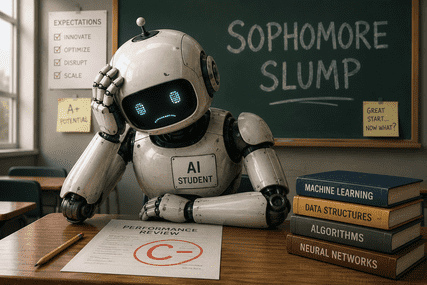
Every VH1 Behind the Music has the same scene. The band is trying to explain why the second album tanked. They almost never can. The first record worked on instinct, on feel, on some alchemy they couldn’t name, and when they went back to recreate it, they discovered they’d never actually known what made it good. They got lucky and called it craft. Most enterprises are in that scene right now with AI.
The pilots looked promising. The board got excited. Someone put a slide together with an upward-sloping line. Then the line stopped going up, and now the CIO is “still evaluating the landscape” while quietly hoping nobody asks a follow-up. The technology isn’t the problem. The problem is what AI exposed when it arrived.
Walk into a large enterprise and ask three questions in plain English: What problem do you actually solve for customers? Which work maps to that? Who owns it, and what does it cost? You’llget a deck three weeks later that contradicts last quarter’s deck, which contradicted the one before that. They’re not hiding anything. They genuinely don’t know. They’ve been shipping despite themselves for years, running on momentum and the low bar set by equally confused competitors.
AI doesn’t tolerate that ambiguity. It requires a clean input. You cannot point it at static and ask it to scale something. Here’s the part nobody wants to say out loud: the companies where AI is actually working are, suspiciously, the same ones that already had their act together. Clear positioning. Clean operations. Leaders who can name the key metric without opening a browser tab. They’re using AI as leverage on clarity that already existed.
For everyone else, the dynamic is more uncomfortable. AI doesn’t make a confused organization less confused. It makes it more confidently confused, faster. The wrong strategy now has charts. Unclear OKRs get summarized in three tidy bullets. The meeting that should never have happened gets turned into a perfectly written email routed to fourteen people who weren’t going to make the call anyway.
The early wins were real. They were also often just lucky, or just making busywork done fast. But luck doesn’t scale, and is a company very good at busywork something to be all that excited about? The organizations figuring this out in the next eighteen months aren’t asking “what can AI do for us?” They’re asking something harder: Are we the kind of company where AI can do anything at all?
That question requires an honest answer about strategy, ownership, and how success actually gets measured before anyone touches a model or stands up a pilot.
The sophomore slump isn’t actually an AI problem. It’s an operational clarity problem that AI finally made impossible to ignore. The second album was always going to tank. The bands who figured that out early enough wrote something worth recording. The rest are still blaming the label.