I don’t think John McCarthy (known as the “founder of AI”) and his mates, when they established Artificial Intelligence as an academic discipline in 1956, would have thought this theoretical concept would turn into a major area of investment 70 years later.
You don’t need a definition of what AI is from my end, to be very honest. You consume enough content throughout your daily doom scrolling time which is generated with the help of AI. Note that when I am talking about content and AI together, I am talking about generative AI in particular.
This post is a medium to share my opinions on what we expect from AI and what it is in reality, as of now. As these are my personal opinions, it may be wrong for some and right for some. In both cases, I openly respect your inputs, which you can share with me.
What We Expect From AI
A big part of how we picture AI today has been shaped not by research papers but by movies. From HAL 9000 to Jarvis to Skynet, we have been fed a version of AI that thinks, makes decisions, and in some cases, takes over the world. That is a tough image to shake off.
Then came the product launches. Every other week, a new tool is announced that will “revolutionize the way you work.” The results of some of them are impressive and the LinkedIn posts that follow are even more dramatic. Naturally, expectations go through the roof.
People expect AI to understand them. They expect it to be accurate, always. They expect it to think ahead and operate with some level of common sense. In a business context, many expect it to replace entire workflows or teams almost overnight.
And to be fair, some of that is not entirely unreasonable. The technology has moved fast. What felt like science fiction in 2020 is the first thing you and me open when we turn on our laptop in 2026. The pace of progress makes big expectations feel justified.
But there is a difference between progress and perfection. And right now, a lot of the frustration people have with AI comes from that gap as expectations are set too high, too early.
What AI Actually is Right Now
Strip away the marketing and the movie references and what you are left with is that AI is a very sophisticated prediction machine.
When you type a prompt and get a response, the model is not reasoning the way you and I reason. It is predicting what the most statistically likely next word or paragraph should be based on an enormous amount of text it was trained on.
It does this incredibly well. But “doing something incredibly well” and “understanding what you are doing” are two very different things.
Let’s suppose you have read enough recipes in your life; you can probably write a convincing one for a dish you have never cooked and never tasted. That is roughly what is happening here. The output looks right. It may even be right. But there is no lived experience behind it.
This is not me dismissing the technology. What these models can do at scale and speed is genuinely remarkable. Drafting, summarizing, translating, coding, answering questions, generating ideas; these are real capabilities that save real time. I use it myself.
But the moment you start treating it as a thinking partner with judgment and common sense, you are setting yourself up for a bad experience. It will confidently give you wrong information. It will occasionally produce something that sounds perfect and means nothing.
Because that is the nature of what this technology is, at least right now.
The Hype Problem
You know what I just did! Before this section, I wrote some good use cases where AI deliver meaningful results but then selected all the words and deleted them. I did not want to throw those words (predictive maintenance/demand, fraud detection) at you again.
Here is something worth asking. Who actually benefits when AI is painted as more capable than it is?
Not the businesses that deploy it expecting miracles and end up with a messy implementation and a frustrated team. Not the end users who trust an AI generated output that turns out to be wrong. Not the developers who then have to manage expectations they never set in the first place.
The people who benefit are the ones selling the dream. Investors need a narrative to justify valuations that, in many cases, have very little revenue underneath them. Technology vendors need to stand out in a crowded market where every product is claiming to be “AI powered.”
Media needs clicks, and “AI will change everything” gets more of them than “AI is a useful but limited tool that requires careful implementation.”
So the hype machine keeps running. Every product launch is a revolution. Every demo is a glimpse of the future. And somewhere between the launch event and the actual deployment, reality shows up.
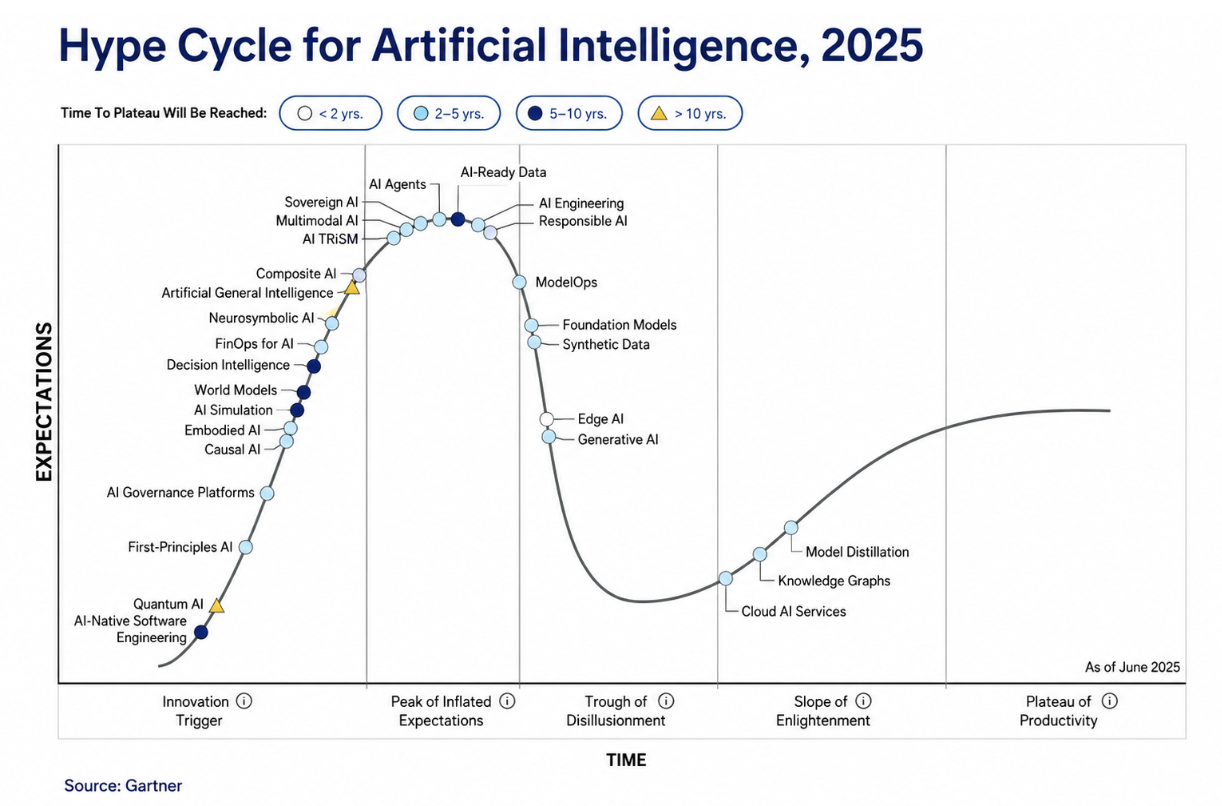
Image source: Gartner’s AI Hype Cycle 2025
I have seen this pattern before. It happened with blockchain. It happened with the metaverse. There is even a name for it, Gartner calls it the Hype Cycle. Technology arrives, expectations explode, reality disappoints, and then slowly, the technology finds its actual level and starts delivering genuine value in specific areas.
AI is going through that same cycle right now, except the stakes are higher and the money involved is larger than anything we have seen before. That does not make the technology fake.
The honest version of this story is that AI is a genuinely powerful set of tools that is still maturing. It will keep improving. Some of the bigger claims may even come true eventually.
But right now, in 2026, a lot of what is being sold as AI transformation is really just automation with a better marketing budget.
My Take
If you have read this far, you probably already have a sense of where I stand. But let me put it plainly.
AI is real. It is indeed useful and it is here to stay. Come on, you cannot ignore it. If you are a business that has not started exploring AI into your operations, you will have to justify this decision one day.
On a personal level I think the most important thing any of us can do right now is stay curious without losing our critical thinking. Use the tools. See what they can do. But do not outsource your judgment to them.
The moment you stop questioning the output is the moment the technology stops serving you and starts misleading you.
We are at an interesting point in history with this. To make the best out of this powerful technology you just need to pay close attention and stay honest about what they see.
That is all I am trying to do here. And if this piece sparked even one conversation worth having, it did its job.