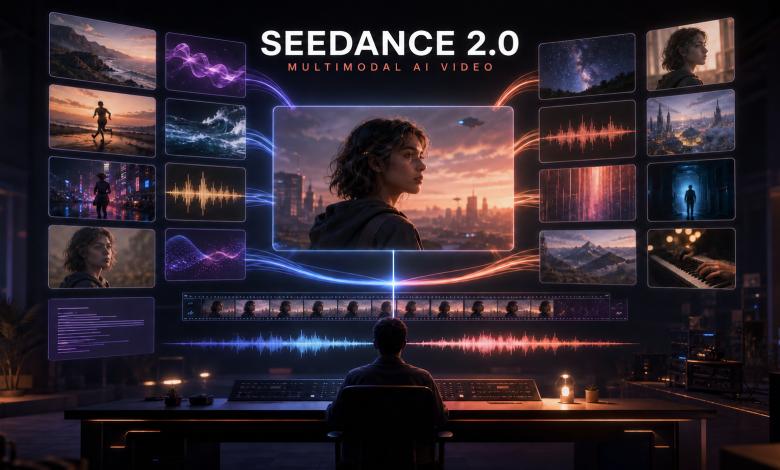
Most AI video generators still work like a slot machine: type a sentence, pull the lever, hope the output is usable. ByteDance’s rebuilt model accepts twelve assets at once — photos, footage, audio, and text — and returns a single clip where every element stays consistent and every sound lands on the right frame.
The Release and Its Context
ByteDance shipped Seedance 2.0 in mid-2026 as a complete architectural replacement for the earlier Seedance 1.5 Pro pipeline. The model runs on a new Dual Branch Diffusion Transformer that processes visual and audio signals in parallel branches, enabling a generation workflow that no prior consumer-facing video model has offered at this level of integration. Creators upload a combination of up to nine images, three video clips (totaling fifteen seconds), and three audio files alongside a text prompt, and the model produces a four-to-fifteen-second video with natively generated sound effects, dialogue lip-sync, and background music — all in a single pass.
The release targets a broad creator audience, but three groups stand to gain the most: e-commerce brands producing high volumes of product video ads, independent filmmakers prototyping scenes without a crew, and social media creators who need daily output at broadcast quality. The timing aligns with a clear market signal. According to industry tracking, global spending on AI-assisted video production crossed $2 billion in early 2026, driven largely by short-form content demand on TikTok, Instagram Reels, and YouTube Shorts. Creators are no longer asking whether AI can generate video; they are asking which tool gives them enough control to publish the output without manual correction. Seedance is ByteDance’s answer to that second question.
Where the Architecture Breaks From the Pack
The AI video generation field in 2026 includes serious competitors: OpenAI’s Sora 2 leads on physics simulation and cinematic realism for longer sequences; Google’s Veo 3 excels at photorealistic human motion; Kling 3.0 offers fast iteration at competitive pricing; Runway remains the go-to for motion designers who need granular stylistic control. Each tool has earned its position. What distinguishes Seedance 2.0 is not a single benchmark score but a structural decision about how creators interact with the model.
The @ Reference System: Directing Instead of Describing
Every competing model begins with a text box. Some allow a single reference image. Seedance 2.0 begins with a canvas that accepts twelve assets simultaneously and a natural-language tagging system that lets the creator assign each asset a role.
In practice, this means a creator can type: “@Image1 defines the character’s face. @Video1 provides the camera orbit pattern. @Audio1 sets the ambient soundtrack. Generate a ten-second product reveal with a slow push-in, then a quick cut to a hero shot.” The model reads each tag, understands the intended role, and composes the output accordingly.
This is a fundamentally different interaction model. Instead of describing what something should look like in words — a lossy translation that forces the creator to hope the model’s interpretation matches their mental image — the creator shows the model exactly what they mean by uploading the reference directly. The gap between intention and output narrows because the specification is visual and sonic, not purely linguistic.
For production teams that already have brand assets, product photography, mood boards, and reference reels, this eliminates the most frustrating step in AI video workflows: translating existing creative direction into prompt language. The assets themselves become the prompt.
Audio-Video Joint Generation Solves the Sync Problem
Until Seedance 2.0, the standard approach to AI-generated video with sound required two separate processes: generate the video, then generate or manually edit the audio track. The result was predictably uneven. Footsteps that land between frames. Lip movements that trail the dialogue by a quarter-second. Ambient sound that feels pasted on rather than recorded in the scene.
The Dual Branch architecture eliminates this by generating audio and video together. Dialogue lip-syncs to facial movements at the frame level. Sound effects — a door closing, a glass being set on a table, the rustle of fabric — arrive at the exact moment the visual action occurs. Background music responds to the emotional contour of the scene rather than playing on a fixed loop underneath it.
For any creator producing video with spoken dialogue — tutorial content, product demonstrations, short narrative — this removes an entire post-production step. The output does not need a sound editor because the sound was never separate from the picture.
The practical impact is most visible in multilingual content production. Seedance 2.0 supports lip-sync generation in multiple languages, meaning a brand can produce the same product video with dialogue in English, Korean, Japanese, or other supported languages, each with accurate mouth movements, without reshooting or manual dubbing.
Character Lock: Consistency That Survives Camera Changes
Identity drift has been the silent tax on every AI video tool. A character’s jawline shifts between cuts. A product’s label text warps when the camera angle changes. Clothing color drifts from navy to black across a five-second clip. These artifacts are invisible in demo reels but catastrophic in commercial use, where brand guidelines are measured in exact Pantone values and character models must match across an entire campaign.
Seedance 2.0 attacks this problem at the reference level. When a creator tags an image as a character reference, the model treats that image as an identity anchor. Facial features, hairstyle, body proportions, skin texture, clothing design, and accessories are locked across every frame of the output — including frames where the character is partially occluded, shot from behind, or moving through dramatic lighting transitions.
Early adopter results confirm the claim holds under stress. Community-generated clips on the platform’s prompt gallery show characters maintaining full visual consistency across multi-shot action sequences, wardrobe changes triggered by scene transitions, and extreme conditions like water splashes, dust clouds, and rapid motion blur. The same consistency applies to products: packaging text remains legible, label colors stay accurate, and physical proportions hold even when the camera moves from wide shot to extreme close-up.
Non-Destructive Editing: Iterate Instead of Regenerate
Previous-generation AI video models treated every output as a sealed artifact. If one element was wrong — the wrong expression on a character’s face, an awkward camera movement in the final second, a background detail that clashed with the brand palette — the creator’s only option was to regenerate the entire clip and hope the next attempt preserved everything that worked while fixing what did not.
Seedance 2.0 introduces targeted editing. Creators can replace a single character in a scene while preserving all original motion and camera work. They can modify a specific time segment — changing an action, removing an element, adding a visual effect — without touching the surrounding footage. They can extend a clip by additional seconds while the model maintains continuity in motion, style, and sound.
This shifts the AI video workflow from a generate-and-pray cycle to something that resembles conventional non-linear editing. Creators build incrementally, refining specific elements until the output meets their standard, rather than rolling the dice on each generation.
Seedance 2.5: Thirty Seconds and Fifty References
ByteDance followed the 2.0 release with Seedance 2.5 , announced in June 2026, which extends the model’s reach in three dimensions that matter for production-grade work.
Clip length doubles. Seedance 2.5 generates up to thirty seconds of continuous video in a single take. For short-form social content — TikToks, Reels, Shorts — thirty seconds is often the entire finished piece. A single generation can now deliver a complete publishable video without stitching.
Reference capacity expands dramatically. The model accepts up to fifty reference assets per generation, compared to twelve in version 2.0. This allows creators to define multiple distinct characters, each with their own visual identity, interacting in a shared scene with a fully specified environment, motion vocabulary, and audio atmosphere.
Local editing precision improves. Seedance 2.5 supports region-specific modifications — changing a background element, adjusting lighting on one character while leaving others untouched, swapping text on an in-scene sign — without affecting the broader composition. Combined with the longer clip length, this makes it feasible to generate and refine a complete narrative sequence within the model’s own editing environment.
The upgrade positions Seedance 2.5 as a production tool rather than a prototyping toy. Thirty-second single-take clips with fifty references and frame-level audio sync move the model out of the “interesting demo” category and into the daily toolkit of creators who publish on deadline.
How to Evaluate Whether It Fits Your Workflow
For creators and production teams considering Seedance 2.0 or 2.5, the evaluation comes down to three questions.
First, does your workflow start with existing assets? If your production process already generates photography, mood boards, reference footage, and brand guidelines, Seedance’s multimodal input system will extract more value from those assets than any prompt-only generator. The more specific your creative direction, the more precisely the model can execute it.
Second, does your content require synchronized audio? If you produce video with dialogue, narration, sound effects, or music that must align with visual action, the joint audio-video generation eliminates a post-production step that no competing tool has fully automated. This is especially relevant for teams producing content in multiple languages, where lip-sync accuracy across languages is a hard requirement.
Third, do you need visual consistency across multiple outputs? If you are producing a campaign with recurring characters, serialized content with the same cast, or product videos where brand elements must remain pixel-perfect, the reference-anchored character lock is the differentiating capability. Other tools offer consistency as a goal; Seedance 2.0 offers it as an architectural guarantee enforced by the reference system.
Access, Pricing, and Getting Started
Seedance 2.0 is available through multiple access points. ByteDance’s own Dreamina platform (via CapCut) offers integrated access. Third-party hosts including Higgsfield, JXP, and several independent platforms provide the model with varying pricing tiers and interface options. Free-tier access is available on most platforms, providing enough generation credits to test core workflows — text-to-video, image-to-video, multimodal reference generation — before committing to a paid plan.
Paid tiers unlock higher resolution output (up to 1080p natively, with 4K upscaling available), longer generation durations, priority processing queues, and full commercial usage rights with no attribution requirement. Outputs export as standard MP4 files compatible with all major editing software and publishing platforms.
The model runs entirely in-browser. No local GPU is required, no desktop software needs to be installed, and generation times are competitive with other frontier video models. The platform supports 16:9, 9:16, and 1:1 aspect ratios, covering the full range of social, broadcast, and web video formats.
For Korean-market creators, seedance2kr.com provides a localized interface with Korean-language prompt guides, community galleries, and direct access to both Seedance 2.0 and 2.5 generation tools. The prompt gallery — featuring real prompts used to create published videos alongside the resulting output — serves as both a learning resource and a template library for creators who prefer to start from proven structures rather than blank prompts.
The Takeaway for AI Video in 2026
The AI video generation market has entered its differentiation phase. The question is no longer whether AI can produce watchable video — every major model clears that bar. The question is which tool gives creators enough control to publish the output directly, without a round of manual post-production to fix the artifacts that the model introduced.
Seedance 2.0’s answer is structural: replace the prompt-only input paradigm with a multimodal reference system, generate audio and video together instead of layering them separately, lock character identity to uploaded references instead of hoping the model remembers what the character looked like three seconds ago, and let creators edit specific elements instead of regenerating from scratch.
Whether that answer proves durable as competitors respond will depend on execution — on generation speed, on output quality at scale, on the reliability of consistency claims across edge cases. But the architectural direction is clear, and for creators who have spent the past two years wrestling with the limitations of prompt-only AI video, it represents the most significant workflow shift the category has produced.
For technical documentation, prompt guides, community galleries, and platform access, visit seedance2kr.com. For press and partnership inquiries, contact [email protected].