
The Elephant in the Room
It’s an uncomfortable but inescapable truth today.
Most firms still can’t point to a single AI implementation that has yielded material financial impacts. For most, the issue isn’t a lack of technological capability but rather a lack of disciplined focus on how and where AI can actually deliver business value.
According to recent research, nearly nine out of 10 enterprise AI pilots never get to production. More than 80 percent of companies report they have not seen any measurable effect on their bottom line from AI.
Far more common is spending heaps of money on dashboards that are hardly ever used, on automation that’s bogged down with hallucinations, misguided “tokenmaxxing” and pilots that are presented with fanfare at board meetings, only to be quietly shelved when they don’t quite work.
According to McKinsey, a paltry six percent of organizations can be considered AI “high performers” today. That figure stands in stark contrast to the 95 percent of executives who believe AI is critical for their company’s competitiveness.
That’s the disconnect: AI seems to be everywhere, but value realized is in short supply.
Pragmatic AI
In industry, things are even more challenging. Factories, plants and critical infrastructure are not like consumer sectors. The reality is that AI for retail or AI for entertainment is utterly different from AI for power plants or AI for designing seagoing vessels. As a result, AI demands a highly systematic and strategic mindset.
Industrial settings involve a diverse mix of physical assets, the laws of thermodynamics, complex regulatory restrictions and risk profiles that require diligence and expertise. Small errors have big implications, whether that’s a discarded batch, a halted production line or a workplace injury.
When it comes to the elusive business value of AI innovations, I believe a construct I have advanced called “pragmatic AI” can help. It’s a way for industry to harness frontier AI innovations that mandates that results must be measurable and takes into account the operational and regulatory constraints of real-world industrial settings (see Fig. 1). It demands a far more intentional approach for how AI is deployed and governed in high-stakes, safety-critical environments.
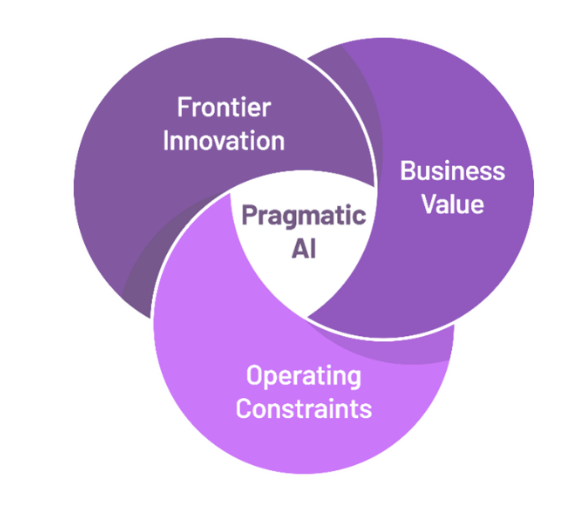
Pragmatic AI has three core elements:
- Frontier innovation is encouraged, but it is routed through responsible guardrails.
- Business value is predicated upon measurable outcomes such as uptime, throughput, quality and sustainability.
- Operating constraints are treated as first principles, not afterthoughts. These include safety, regulatory requirements, risk tolerance, data lineage and equipment physics.
Autonomy in industrial operations must be earned. Pragmatic AI follows a tiered approach aligned to risk and criticality, progressing from recommendation to assistance, from action with explicit approval to constrained autonomy within defined guardrails. Trust is not a baked-in feature of technology; it is built through controlled, real-world applications that are shown to be safe, reliable and responsible consistently over time.
With agents, AI is moving from advising to acting. Probabilistic models enter high-consequence deterministic environments. Decision cycles compress. Oversight becomes essential.
Importantly, rather than diminishing the role of engineers, pragmatic AI elevates human expertise in industry. It sees the role of the engineer shifting from operator to governor of intelligent systems. That shift does not happen organically, but must be designed into training, workflows and accountability. With pragmatic AI, the focus for organizations is on empowering the workforce, preserving institutional knowledge and cultivating skills in frontline teams to interrogate, challenge and direct AI in context.
The Business Case for Pragmatic AI
The industrial world is entering a new chapter. Autonomy will advance—and that’s good news.
AI agents will become more capable. Infrastructure will evolve to support constant reasoning, inference and action. Efficiency of token production will be a key driver of competitive advantage.
Yet the success of this transition will depend less on how fast technology moves and more on effective and responsible adoption. Pragmatic AI is the right model for industry at this moment. It finds equilibrium between frontier innovation, measurable business value and the constraints that keep people safe and assets reliable. It recognizes that autonomy requires structure, trust, context and economic clarity.
Companies that embrace pragmatic AI will avoid the risks of over correction, under planning and uncontrolled consumption. They will adopt agentic systems in ways that strengthen performance and resilience.
Being intentional about how and where AI is deployed in industry doesn’t mean dialing down ambition. It doesn’t mean we shouldn’t be bold in applying AI innovations to higher-order problems like decarbonization or circular business models. Rather, we need to work backwards—systematically and strategically—from an insistence on tangible business value and a recognition of the unique dynamics of industrial settings.
In the years ahead, AI will grow more powerful, more autonomous and more deeply embedded in operations. A pragmatic AI approach that considers both the opportunities and the risks will ensure it grows in the right direction.