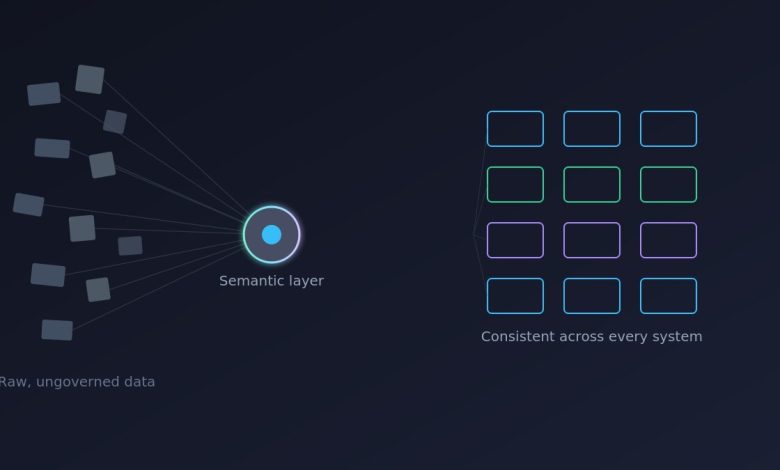
In most enterprise AI implementations, LLMs are trained on pattern recognition to generate outputs and predict what comes next. For analysis and decision-making, this practice could be hazardous because the model never asks what an organization actually means by terms like “revenue” or “churn.”
It infers, makes a statistically reasonable guess and returns a result that appears authoritative, but could be completely wrong for this business, in a specific context, under their rules. This is how AI agents make calls without human checkpoints to deliver a plausible-but-wrong answer. In 2026, the tolerance level for that kind of error is approaching zero.
For trustworthy AI analytics, semantic grounding is foundational. And semantic layer is emerging as the architecture enterprises are converging on, because it offers something the others cannot: a deterministic bridge between business language and complex data schemas.
What Semantic Grounding Actually Means for AI
Semantic grounding is the process of anchoring AI agents and tools to a universal layer that governs business context, logic, relationships and access policies. AI systems don’t ‘guess’ meanings dynamically from raw tables but are grounded in predefined semantics that the organization has already agreed on. They don’t decide what “active customer” means.
That definition already exists. AI simply reads from it and delivers exactly what the business was looking for.
Here are the ways in which semantic grounding can fix AI analytics:
-
Enforcing Consistent Business Context Across Every AI System
Models aren’t making things up when they produce different outputs from the same data. They don’t have a shared understanding of the business to draw on and thus infer it on their own.
Consider a CRM dataset being queried by three different AI systems. Without a grounding mechanism, the organization can easily get three different counts of “at-risk” accounts, because each model resolves it against its own assumption about how accounts, activity and risks relate.
Semantic grounding solves this architecturally. Business context is defined once and semantic layer operationalizes this at scale, centrally exposing this context in a form consumable across every AI system, analytics environment and business workflow.
-
Stopping AI Hallucinations from Reaching Decision-Makers
Hallucinations in analytics are hard to catch. When an LLM fabricates a historical fact, the error is usually obvious. When an AI analytics system derives a revenue forecast from a wrong metric definition, the number looks right.
It has a decimal place. It came from real data. The problem is in what that data was made to mean.
LLMs regularly overestimate the probability that their answers are correct by 20-60% (an Arxiv study), i.e., they are more “confident” in wrong answers than their accuracy justifies. To make matters worse, analytics environments bring in additional failure modes in the form of implicit business logic and context the model was never trained on.
AI has to decide what “engagement” means, and it will. Metrics such as product opens, support tickets, NPS, and login frequency are reasonable ways to measure customer engagement. But none of these are necessarily the organization’s definition.
Semantic grounding resolves this upstream. Before a query reaches the model, the semantic layer has already determined what “engagement” means in this context, for this business unit, against these data sources. The model operates from a context that has already been established. As a result, the space for hallucination shrinks dramatically because the room for misinterpretation was structurally removed.
-
Preventing Semantic Drift in Agentic AI Pipelines
Agentic workflows chain multiple AI systems together. One agent classifies, another aggregates, a third generates recommendations and a fourth acts on them. Every handoff is a continuation of the interpretation established in the step before.
AI drift happens when an ungoverned interpretation at step one compounds invisibly through every subsequent handoff.
Semantic grounding reduces this drift by ensuring that each agent in the pipeline interprets business concepts through a shared semantic foundation rather than locally derived assumptions. Delivering that consistency across an enterprise agentic pipeline requires a semantic layer that travels with the pipeline.
Enterprise semantic layers deliver governed context to BI tools and AI systems alike. However, sustaining this context across concurrent agents on massive scale data at speed that production demands is a much harder problem.
-
Making AI Governance Structural, Not Procedural
Governance without a semantic foundation becomes a tax on every AI initiative. Every new system is required to build its own governance scaffold from the ground up for every agent, tool and team.
Semantic grounding changes the underlying architecture of governance. Business context, entities, relationships and policies that govern them are encoded once. Every system served by the semantic layer inherits those properties. Auditability and explainability become built-in, as each result can be traced back to the semantics it was grounded in.
The Problem Was Never the Model
Models had reasoning capability long before enterprises governed what they reasoned over. The gap was always the business context, who owns it, where it lives, whether every system that needs it draws from the same place. As AI agents take on more autonomous decision-making, ungoverned semantics becomes a business risk.
Grounding AI at scale requires a semantic layer purpose-built to deliver a governed foundation that makes AI analytics trustworthy, consistent and operationally reliable across every system. The enterprises that recognize this earliest will be the ones whose AI produces insights worth acting on.