Motive Medical Intelligence study of more than 100 million U.S. insurance claims finds once-common use of codeine and hydrocodone for pediatric coughs has nearly disappeared
SAN FRANCISCO, Aug. 26, 2026 /PRNewswire/ — The once-common practice of prescribing opioid cough syrup for children has become exceedingly rare in the U.S., according to a new analysis of more than 100 million insurance claims conducted by Motive Medical Intelligence (Motive) using its Practicing Wisely clinical analytics system.
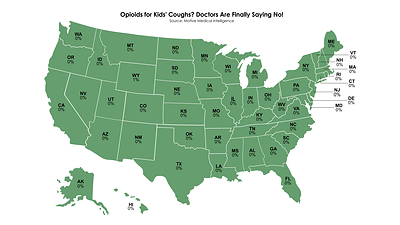
The analysis found that between October 2022 and September 2024, just four out of every 10,000 office visits for children with coughs or respiratory infections resulted in a prescription for opioid cough syrup.
The findings mark a dramatic shift in a prescribing practice that persisted for generations despite a lack of evidence that opioid cough medicines are effective in children, as well as mounting evidence of potentially serious harm.
“This is welcome news,” said Dr. Rich Klasco, Chief Medical Officer at Motive. “For decades, opioid cough medicines were prescribed to children despite limited evidence of benefit and very real safety concerns. These data show how dramatically clinical practice can change when physicians, medical societies, and regulators align around the evidence.”
From routine treatment to rarely prescribed
Opioids have a long history as cough suppressants. Bayer introduced heroin as a cough medicine in 1898, and opioid cough syrups later became widely prescribed for children, typically containing codeine or hydrocodone — the same opioid ingredients found in drugs such as Vicodin®, Norco®, and Lortab®. Over time, doctors came to regard these syrups as the cure for stubborn coughs, often prescribing them in response to parental requests for “something stronger.” By the 1990s, more than 1 million children annually were being prescribed codeine in the U.S.
Yet codeine and hydrocodone were never proven effective for treating children’s coughs in randomized controlled trials. More importantly, they have been shown to cause respiratory depression and death in children.
Concerns began to emerge in 2011 with a World Health Organization report. In 2015, the Food and Drug Administration began issuing warnings, and in 2016, the American Academy of Pediatrics (AAP) responded with its report, “Codeine: Time to Say ‘No.’” The AAP reviewed 50 years of FDA safety data and found 24 codeine-related deaths and 64 cases of severe breathing problems in children — most of them under 12 years of age.
Prescribing subsequently declined sharply. A University of Michigan study found that between 2014 and 2019, pediatric prescriptions for codeine and hydrocodone cough syrups fell 90.1% and 75.7%, respectively.
New data shows ongoing progress
Motive’s latest analysis suggests that progress has continued well beyond 2019. Across more than 100 million insurance claims analyzed from October 2022 through September 2024, prescriptions for codeine or hydrocodone were associated with only 0.04% of pediatric office visits for coughs or respiratory infections — equivalent to four prescriptions for every 10,000 visits.
The analysis also found encouraging results across states. Nevada and Vermont achieved the ultimate goal: no doctors prescribed these opioids to children for coughs. Rhode Island, Maine, New Jersey, and Massachusetts also had near-zero rates.
Even Wyoming, which recorded the highest rate in Motive’s analysis, was not statistically different from the national rate.
“The important story here isn’t just that prescribing declined,” Klasco said. “It’s that a deeply entrenched clinical practice can change when the evidence becomes clear, and the healthcare community acts on it.”
Study Methodology
The study was conducted using Motive’s Practicing Wisely data analytics system, which measures individual clinician performance across appropriateness of care, quality, and waste. By mapping closed-claims data to evidence-based standards of care, Motive’s expert team can measure individual clinician decisions at the point of care, share actionable insights back to the clinician, and help improve clinical performance to drive positive change across the U.S. health system. Practicing Wisely delivers unique insights into how individual clinicians perform against evidence-based standards, benchmarked against their peers, enabling health plans and systems to more accurately assess risk, reduce waste, move toward quality care, and drive high-value outcomes at scale. In the case of this good-news study, the results were positive with no follow-up or clinical change required.
About Motive Medical Intelligence
Motive Medical Intelligence is redefining healthcare performance analytics with an emphasis on transparency, physician trust, and real-world actionability. Motive is the partner of choice for organizations committed to eliminating low-value care and thriving in value-based care models. Through its proprietary Practicing Wisely solution, Motive is helping the industry eliminate the $400 billion in annual waste in the U.S. health system, advance the transition to high-value, patient-centered care, and achieve the quadruple aim. Learn more here.
Media: Supreme Communications for Motive Medical Intelligence, [email protected]

 View original content to download multimedia:https://www.prnewswire.com/news-releases/opioid-prescribing-for-childrens-coughs-falls-to-just-4-in-10-000-visits-new-analysis-finds-302860158.html
SOURCE Motive Medical Intelligence