

OceanBase Says the AI Bottleneck Is Data.The Architecture Backs It Up.
The vendor’s new lakebase platform rests on a point its chief executive hasnow made in print: that difficulty in enterprise AI has moved from the model tothe data.
Ask an agent for last quarter’s revenue and it answers in four seconds. Ask whether that is the number the finance team means by revenue, and the demonstration ends. That gap between a plausible figure and a governed one is the ground OceanBase chose to work on.
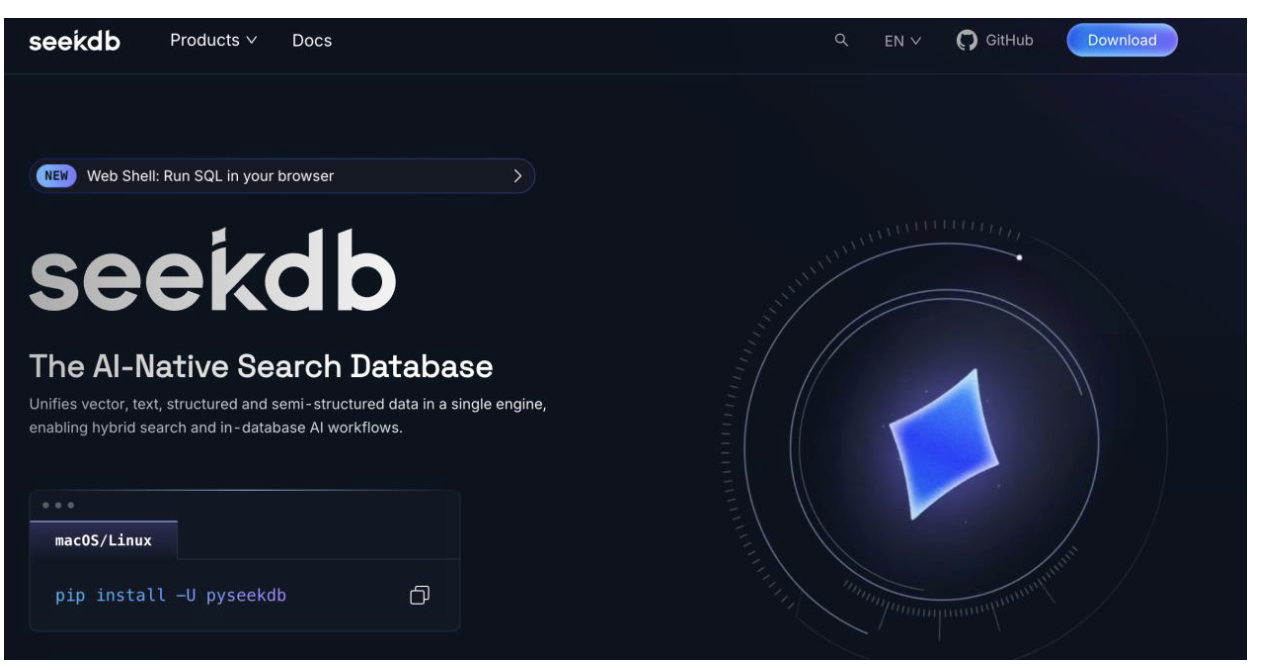
On 24 November, at its AI Data Conference in Beijing, the company launched OceanLake, which it calls an integrated lakebase AI data platform, and open–sourced its AI database as OceanSeek under Apache 2.0. For anyone building against this, the useful question is what the architecture does.
What Yang wrote
Chief executive Evan Yang set his position out in a guest column for ITTech Pulse on 25 November, under the headline “The Last Bottleneck in Enterprise AI Was Never the Model. It Is the Data.” It opens with Fred Brooks, whose 1986 essay “No Silver Bullet” separated the accidental complexity of software from the essential difficulty of real–world behaviour.
What a semantic layer buys
Under the branding, the first real component is a semantic layer: shared definitions, joins, hierarchies and entity identity encoded once, in the system, so an agent does not rediscover them on every prompt. That is why the definition has to live in the platform, where every agent inherits it.
Ping An Life is the disclosed proof point: ontology modelling over decades of insurance expertise, cutting typical data query delivery from days to about 15 minutes.
Where agent memory actually lives
The second component is an agent runtime that lets applications hold memory and context at production scale. A vector store is a retrieval index; an agent needs state — what it did four steps ago, what it ruled out, what it may touch — plus permission governance for short–lived, concurrent agents. Those are transactional primitives, which is why the runtime belongs inside the database.
Sandboxes are where agents get to practise
Hybrid retrieval — keyword, vector and structured predicates in one query — is table stakes. Data sandboxes are the more interesting piece: an isolated, production–shaped environment where an agent can read and write without touching live data, which buys reproducibility and bounds the blast radius. Haier’s deployment is the tell: ontology–driven agents there have moved from natural–language retrieval to executing business workflows, and execution writes.
One copy, two workloads
OceanBase is sixteen years old and was built for a specific job: Alipay’s core ledger on 11.11 peak traffic. Analytical scans and agent fleets have different resource shapes — short transactions are tail–latency sensitive, large scans are bandwidth hungry. Serving all three from one copy removes the CDC pipeline and the freshness gap between what an agent reads and what the ledger holds, and concentrates contention in one engine, which puts the emphasis on workload isolation.
What the deployments show
Ping An Life, Haier and Xiamen Airlines are external enterprises with specific mechanics; HSBC, SMBC and Hang Seng have begun choosing OceanBase to modernise core systems, which is how bank references always start. Inside Ant Group, the platform runs training pipelines and more than 30 million Flash Apps on LingGuang, which shows it runs at scale.
aYang’s points are clear: what limits an agent is how legible the data is to a machine that has to act on it. Brooks’s observation was that better tools move difficulty rather than delete it. OceanBase has located where the difficulty went.

More from AIJ Writing Staff
See all

Recommended for you
More stories Future of AI
Neural Concept Is Powering the Next Era of Engineering With AI Agents
 AI & Technology
Inside the eSIM Handshake: How a Backend Log Trace Unblocked One-Click Cellular handset Transfer for 9 Million MVNO Lines
 AI & Technology
IP is Becoming the Most Strategic Asset in the Era of AI Code Generation
 AI & Technology
Stop hunting an AI unicorn: SaaS is still the real goldmine
 AI & Technology
The next test for interview AI is whether its answers are yours
 AI & Technology