There is a pattern in enterprise AI that has become familiar enough to be predictable. A vendor demonstrates an autonomous capability, it performs convincingly against curated data, and it degrades the moment it meets a production environment. The failure is rarely in the model. It is almost always in what the model was asked to reason over.
Motadata has built its newest release around that observation. ObserveOps Infinity, now generally available, is positioned by the company not as an AI product but as the data layer an AI product would require. The agentic capabilities themselves have not shipped, and the company has declined to say when they will.
Why Autonomy Fails in an Observability Estate
The argument Motadata makes is specific. An autonomous system operating inside IT operations faces three problems that no amount of model capability resolves.
The first is structure. Telemetry in most estates arrives as unparsed strings across a mix of formats and vendors. Reasoning over it requires the reasoning system to do the parsing, which is expensive, fragile and non-deterministic.
The second is context. An event that carries no configuration item, no owner, no site and no service association describes a symptom without describing what is affected. An agent acting on that data is acting blind to consequence.
The third is governance. Autonomy in a production estate is only acceptable where the blast radius of an action is defined and where the actions taken can be audited afterwards. Without that, the question is not whether the system is capable but whether anyone will authorise it to run.
Motadata’s position is that these three problems are not solved at the AI layer. They are solved underneath it, and that is what the release addresses.
What Has Actually Shipped
Four things are available today, and the company is willing to have all four inspected.
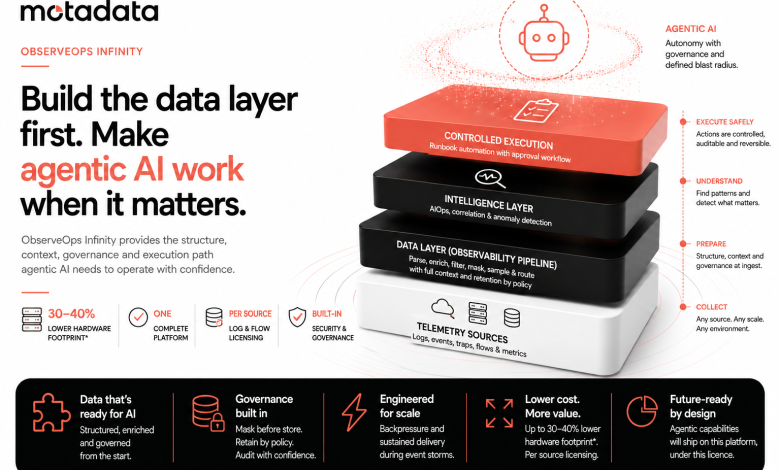
The first is structured, context-carrying telemetry. ObserveOps Infinity introduces an observability pipeline that sits between telemetry sources and storage. It parses logs, events, traps, flows and metrics into queryablefields at ingest. It attaches configuration item, site, owner, environment and service context before the data lands. Filtering, normalisation, reduction, redaction, masking, sampling and routing all happen while the telemetry is still in flight. The pipeline is included in the base platform rather than sold as an add-on, and Motadata describes it as an extensible control plane whose current capabilities are a starting point rather than a fixed set.
The second is a governed data lifecycle. Retention is applied by policy rather than by default, tiering data across full fidelity, aggregated and dropped. Sensitive fields are masked before they are written rather than after. Those are the guardrails that make an audit trail possible.
The third is AIOps in the base platform, covering event correlation and anomaly detection. This is pattern work rather than autonomous work, and the company positions it accordingly.
The fourth is runbook automation with an approval workflow. Motadata frames this as the controlled execution path, the mechanism through which an autonomous system would eventually act, with a human checkpoint already built into it.
What Has Not
The agentic layer above those four is not released. Motadata has said it will not give dates, feature names or demonstrations of unreleased capability, and has routed roadmap questions to its product management function rather than allowing its field teams to improvise answers.
The single commitment the company is prepared to make is a narrow one. Agentic capabilities, when they arrive, will release onto this same platform and this same licence. A customer deploying today would not re-platform, re-instrument or renegotiate to adopt them.
For an industry in which AI roadmap promises have become a routine part of enterprise software procurement, the restraint is itself a positioning decision.
The Commercial Structure Around It
Two further changes in the release matter to whether the data layer argument holds in practice.
Motadata has retired the four editions in which ObserveOps was previously sold. There is now one edition containing the complete platform: monitoring across network, server and virtualisation, topology, service level objectives, dashboards, AIOps, correlation, runbook automation, integrations, the pipeline and security controls including single sign-on, multi-factor authentication and role-based access control. The base is metered by monitored device, with optional modules for flow, log, network configuration management, application performance monitoring and real user monitoring, each metered by its own unit.
The consequence for the AI argument is direct. If the pipeline is what makes an estate ready for autonomy, then placing it behind a premium tier would mean readiness was a purchase decision rather than a property ofthe platform. Motadata has put it in the base.
The company has also reduced the hardware footprint of an equivalent deployment by an indicative 30 to 40 percent, a range it describes as workload-dependent and sizes per deployment against its own matrix. Part of that reduction is attributed to the pipeline, on the logic that telemetry never stored requires no disk. The headroom this creates is presented as part of the readiness argument, on the basis that autonomous processes have to run somewhere.
The Sequence Is the Claim
What Motadata is describing is an ordering rather than a feature set. The pipeline made the smaller footprint achievable. One edition put the pipeline into every customer’s hands. Together they produced telemetry that is structured, enriched and governed, which is the condition an autonomous system needs before it can be trusted to act.
Whether the agentic layer, when it arrives, justifies the groundwork is a question that cannot be answered yet. What can be assessed today is whether the groundwork is real, and that is the assessment the company appears to be inviting.
ObserveOps Infinity is generally available from August 2026.