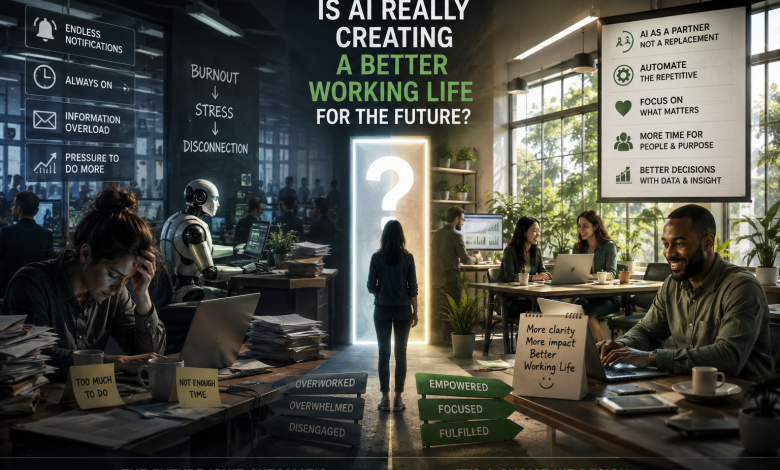
As artificial intelligence moves from experimentation into everyday business reality, organisations face a defining question: are we using AI simply to do more, or to create a better place to work?
For people leaders, this is no longer just a technology conversation; it’s a workforce conversation about productivity, wellbeing, trust and the kind of employee experience we want AI to enable.
Microsoft’s 2025 Work Trend Index describes Frontier Companies as organisations built around human-agent teams, where AI is embedded into everyday workflows while people remain responsible for judgement, creativity and oversight. With 82% of leaders saying this is a pivotal year to rethink strategy and operations, we need to show what responsible AI adoption looks like in practice by building confidence, developing new skills and putting robust governance around how people use AI every day.
What happens when productivity is no longer limited by time?
Much of the discussion around AI centres on productivity, and for good reason. AI offers a compelling response by reducing administrative effort, information gathering and automating repetitive tasks. Done well, it gives people more time for strategic thinking, creativity, innovation and customer engagement.
We have seen this first-hand through our Microsoft Copilot rollout, where employees across sales, project management, HR and support functions identified practical ways to remove friction from everyday work.
Copilot has been used to support creating a service proposal, pitch strategy and pricing model in minutes; supporting responses to a complex RFP; capturing meeting summaries, actions and decisions from recordings; and analysing scanned PDF documents that previously required significant manual effort.
These are just a few practical examples of AI solving real business challenges, yet they also raise another important question: if AI gives employees time back, what should organisations do with that capacity?
Could AI solve burnout or make it worse?
This is where the workforce conversation becomes more nuanced. Many advocates argue that AI will reduce workload and improve wellbeing, and there is evidence to support this.
Research from Workday found that 62% of employees reported lower stress or burnout risk after adopting AI, while 86% felt more productive.
If organisations use AI to remove unnecessary work and help people focus on what matters most, AI can create healthier and more sustainable ways of working. But if every hour saved becomes another hour filled with meetings, projects and additional demands, employees may simply find themselves running faster on the same treadmill.
The real opportunity isn’t to create more work. It’s to create better work.
What does AI mean for job security?
Alongside productivity and wellbeing, another question sits behind almost every AI discussion: what happens to jobs?
The technology sector has experienced significant restructuring in recent years, and it would be unrealistic to ignore the uncertainty many employees feel as AI capabilities advance. For some, AI represents exciting new opportunities. For others, it raises concerns about redundancy, changing skills requirements and long-term career prospects.
Much of this uncertainty stems not from the technology itself, but from a lack of clarity about how organisations intend to use it. People do not fear change as much as they fear ambiguity.
This places a responsibility on leaders to communicate openly about how roles may evolve, where new skills will be needed and how employees will be supported. HR/ People Management teams and Internal Communication professionals should be pushing leadership teams to back the implementation of AI tools with further investment into their current employees. Online learning portals and/ or external training should be made available to encourage employees to increase their knowledge and achieve technical certifications in networking, cybersecurity, data, cloud and AI.
The question should not be whether people or AI will do the work, but how people and AI can work together most effectively.
How do we ensure AI remains responsible?
That question makes governance critical. The productivity benefits of AI can only be realised if employees trust the systems they use, and organisations trust how those systems are used.
Through building secure data foundations, governance, security and responsible deployment, innovation and governance can move forward together. This matters because the risks are real. Confidential data, intellectual property, shadow AI and unsanctioned use of external platforms can all undermine trust. The Logicalis 2026 CIO Report found that only 37% of CIOs have full visibility of AI tools in use across their organisation, while 57% say employees jeopardise data security through AI use.
Responsible AI is therefore not a barrier to innovation. It is what enables innovation to scale safely and sustainably.
The future of work is still human
Ultimately, the most important question is not what can AI do; it is what kind of workplace do we want to create?
Do we use AI to help people focus on more meaningful, creative and impactful work? Do we create capacity for learning, innovation and growth? Do we reduce stress and improve wellbeing? Do we equip people with the skills and confidence they need to thrive?
Or do we simply expect more output from less headcount?
Success will not be measured solely by productivity gains. It will be determined by how effectively organisations balance innovation with trust, governance, wellbeing and human potential.
Technology will increasingly shape how we work, but leadership will determine whether AI strengthens performance, trust and opportunity for everyone.