Replicating 15,000 years of lunar exposure in just four hours, this first-of-a-kind commercial capability lets Interlune and the global space resources industry test hardware using material analogous to what it will encounter on the Moon
SEATTLE, Aug. 26, 2026 /PRNewswire/ — Interlune, a space infrastructure and resources company, today announced that it has successfully implanted and then extracted helium-4 in simulated Moon dirt with the same results as actual samples collected during the Apollo missions. The helium was implanted into ilmenite, the primary helium-bearing mineral in Moon dirt, or regolith, and it will be used to create the first commercially available lunar regolith simulant that replicates the effects of solar-wind implantation.
“This demonstration is a force multiplier not only for Interlune’s broader technology development, but for others building hardware for the Moon,” said Rob Meyerson, Interlune co-founder and CEO. “It gives the industry a practical way to validate core processing technology on Earth, learn faster and accelerate progress toward Moon readiness.”
The company recreated the solar-wind process that naturally implants helium and other volatile gases and delivered the equivalent helium-ion exposure approximately 32 million times faster, replicating nearly 15,000 years of exposure on the Moon in about four hours on Earth.
“One of the biggest hurdles to demonstrating mechanical processing technology is having a test material that is sufficiently representative of real lunar regolith,” said Dr. Elizabeth Frank, Interlune chief scientist. “We first demonstrated a way to implant helium into the ilmenite as it is implanted in lunar regolith by the solar wind. We then heated the material and found that it released helium at the same temperatures observed in Apollo samples, validating our approach. This gives us confidence that hardware tested with the Interlune-created simulant on Earth will perform as expected on the Moon.”
Interlune will use the helium-bearing simulant to test extraction hardware for its proprietary Harvesting System. The system uses mechanical methods to release volatile gases from lunar regolith at industrial scale, reducing the need to heat large quantities of material.
Most proposed methods for extracting solar-wind volatiles involve heating regolith to nearly 1,000 degrees Celsius, requiring substantial power. Interlune’s mechanical approach is designed to use up to 10 times less power than thermal extraction methods, an important advantage when operating on the Moon, where every kilogram of equipment and unit of power matters.
A New Level of Lunar Testing
Lunar regolith simulants are essential for testing instruments, landers, rovers, and resource-processing equipment on Earth. Commercially available simulants approximate characteristics such as mineral composition and particle-size distribution, but they typically do not contain the helium, hydrogen, and other volatiles implanted in real lunar regolith by the solar wind.
With this demonstration, Interlune can now produce gas-bearing simulant in quantities ranging from grams to kilograms, enabling testing with larger prototypes and integrated hardware. The company plans to offer the material and related testing services to commercial companies, research institutions, and government customers.
Interlune is centralizing its regolith-simulant research and development at the Houston-based Interlune Research Lab (IRL), which is funded in part by a grant of up to $4.84 million from the Texas Space Commission. IRL’s Texas-based team includes engineers and scientists with expertise in soil geochemistry and physics, nuclear and plasma engineering, and industrial engineering.
Implant, Release, Measure
To determine whether they could create a realistic simulant, the Interlune team needed to implant helium into the ilmenite, release it by heating, and then compare the released helium with that from real lunar regolith.
They began with ilmenite, informed by 1970s studies of Apollo mission samples showing that ilmenite is the primary helium-bearing mineral in lunar regolith. In a mineral, atoms form a regular crystal lattice structure. However, microscopic analyses of Apollo ilmenite grains show the outer edges of these crystals have been damaged by the solar wind. When the solar wind bombards ilmenite grains, it damages the crystal structure and creates tiny defects. These defects provide spaces where helium and other gases can become trapped.
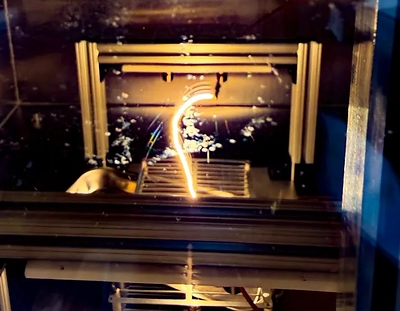
To recreate this process in the lab, the team filled a vacuum chamber with helium gas and heated a filament to temperatures high enough to emit electrons. The electrons interacted with the helium, producing a “soup” of ions and free particles called plasma. The helium ions were then accelerated toward the simulant at energies designed to mimic helium’s behavior in the solar wind and disrupt the lattice rim.
To confirm that the helium had been implanted in the simulant as it would be in lunar regolith, the team gradually heated the ilmenite in a vacuum chamber while measuring the chemical makeup of the released gas using a mass spectrometer. The measurements show that the helium released was between approximately 300 and 800 degrees Celsius, consistent with the broad temperature range observed in the 1970s Apollo sample studies.
The final step of making the helium-bearing simulant is to mix the ilmenite with other Moon-like minerals or rocks that replicate the composition of specific locations on the Moon. Producing this simulant on Earth allows engineers to develop and test extraction equipment without consuming scarce lunar samples or waiting to operate on the Moon.
Next Up: Hydrogen
Building on the helium demonstration, Interlune plans to include hydrogen in its simulant implantation process. Hydrogen plays a critical role in modifying the ilmenite crystal structure to capture and retain solar-wind gases. Notably, hydrogen-bearing simulants could support the development of resource-extraction systems and other technologies needed for sustained lunar operations. It is not currently available commercially in the quantities needed for many hardware-testing programs.
Interlune’s longer-term goal is to adjust the simulant’s mineralogical composition and implanted-gas concentrations to represent conditions at different locations on the lunar surface. Other minerals that can also capture helium could be implanted to further improve fidelity. Beyond engineering applications, this new capability will enable scientists to better understand how eons of solar wind exposure alter lunar materials at an atomic level.
About Interlune
Interlune is a privately funded space infrastructure and resources company building the industrial backbone of the space economy. Founded in 2021 by a team of public- and private-sector experts, the company is developing and testing industrial systems that will operate autonomously in extreme environments. These technologies will create the fundamental infrastructure to support a permanent human presence on the Moon and an in-space economy. Central to the mission is harvesting natural resources in space, starting with helium-3 and also including hydrogen, oxygen, metals, rare earth elements, and water. Interlune has secured nearly $500 million in binding helium-3 purchase agreements from government and commercial customers. The company has also raised $23 million in venture capital and secured more than $18 million in non-dilutive U.S. government research funding. Follow Interlune on LinkedIn, X, Bluesky, Facebook, and Instagram.

 View original content to download multimedia:https://www.prnewswire.com/news-releases/interlune-implants-helium-into-simulated-moon-dirt-advancing-the-ability-to-test-moon-bound-hardware-on-earth-302860080.html
SOURCE Interlune