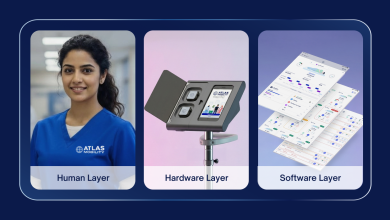
Safety is foundational to effective healthcare delivery. Organizations must protect patients, provide staff with immediate access to help during workplace violence situations, behavioral escalations, or medical emergencies, and ensure critical equipment is available when and where it’s needed. Meeting these demands depends on timely, actionable insights that enable healthcare teams to make informed decisions, respond quickly, and operate with greater confidence. Real-Time Location Systems (RTLS) are playing an increasingly important role in advancing these priorities by delivering visibility into the location, status, and movement of people and assets, along with the contextual intelligence needed to improve safety, efficiency, and care delivery across the healthcare ecosystem.
What is the Role of RTLS in Healthcare Safety?
What was once viewed as an isolated issue has evolved into a systemic challenge affecting healthcare delivery globally. As incidents involving patients and visitors become more frequent, healthcare organizations and government agencies across the Americas, Europe, and Oceania have increasingly recognized workplace violence as an epidemic and, in some regions, a national crisis.
These pressures are particularly pronounced in high-acuity environments such as emergency departments, where caregivers must deliver around-the-clock care while navigating emotionally charged situations, complex patient needs, and unpredictable circumstances. Protecting both patients and staff requires more than policies and training alone. Healthcare leaders need greater awareness of what is happening across their facilities, where resources are located, and how quickly assistance can be mobilized when needed.
This growing need for operational awareness is driving increased adoption of Real-Time Location Systems (RTLS). Leveraging technologies such as Bluetooth Low Energy (BLE), Wi-Fi, RFID, and infrared, RTLS provides healthcare organizations with continuous insight into the location and status of caregivers, patients, infants, and critical medical equipment, including infusion pumps, wheelchairs, beds, and other essential resources.
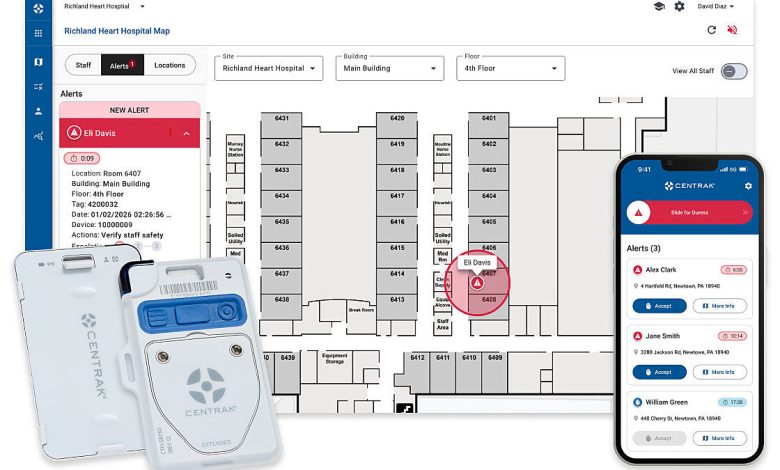
One of the most impactful applications of RTLS is staff safety. Through purpose-built wearable badges and mobile duress technology, caregivers can discreetly request assistance wherever they are working, whether in patient care areas, parking facilities, community settings, or other remote locations. When an alert is activated, designated responders receive immediate location information, enabling them to quickly assess the situation and coordinate assistance. By improving situational awareness and reducing the time required to deliver help, these solutions strengthen workplace violence prevention strategies, support emergency response efforts, and provide staff with greater confidence that assistance is readily available during critical events.
While staff safety is one of the most impactful applications of RTLS, the technology also delivers significant operational and financial value. By providing real-time visibility into mobile medical equipment and resources, healthcare organizations can reduce unnecessary spending, improve equipment utilization, support preventive maintenance compliance, and ensure critical assets are available when and where they are needed. Without visibility, clinicians frequently spend valuable time searching for equipment, while hospitals often compensate for the uncertainty through excess inventory, rentals, or duplicate purchases. RTLS replaces guesswork with actionable data, helping teams proactively manage Periodic Automatic Replacement (PAR) levels, reduce loss and shrinkage, prevent patient delays caused by unavailable equipment, and optimize existing resources.
How RTLS is Closing the Gap Internationally
Globally, healthcare systems operate under different funding models, regulations, and care delivery structures, but many are confronting remarkably similar challenges. Workforce shortages, increasing demand for care, workplace violence, equipment availability, patient flow constraints, and rising expectations for quality and efficiency continue to place pressure on healthcare leaders across every region.
As a result, healthcare organizations are increasingly looking beyond standalone technologies and adopting more connected, data-driven approaches to operational management. RTLS has emerged as a key enabler of this shift, providing healthcare leaders with the information needed to better understand how people, assets, and workflows move throughout the care environment. Across the United Kingdom, United States, Canada, Australia, and New Zealand, healthcare providers are using location intelligence to strengthen staff safety programs, improve asset utilization, support patient care initiatives, and enhance operational performance.
While workplace violence remains one of the most urgent concerns globally, regulatory responses and organizational strategies vary by region. In the United States, workplace violence prevention has become a growing area of focus for accrediting bodies and health systems. Similar conversations are taking place across the UK, Canada, Australia, and New Zealand, where healthcare organizations and industry groups continue to advocate for stronger protections for frontline caregivers, particularly in high-risk settings such as emergency departments, behavioral health units, and community care environments.
Although implementation approaches differ, the underlying objective remains consistent: enabling staff to quickly access assistance, improving situational awareness, and ensuring organizations can respond more effectively when critical events occur. Increasingly, healthcare leaders view RTLS not simply as a tracking technology, but as operational infrastructure that supports safer workplaces, more efficient resource management, and better-informed decision-making.
How Are Different Countries Leveraging RTLS?
The National Health Service (NHS) and other UK providers are leveraging RTLS offerings to support staff duress response, monitor patients who may be at risk of wandering, and improve visibility into the location and status of critical equipment. As the UK has expanded its utilization of this technology over the last decade, research has shown that RTLS is an accurate method for monitoring bedside contact time, which supports healthcare facilities in knowing if staffing and care delivery match patient needs. These insights may not seem crucial for each challenge hitting healthcare, but patient safety, staff safety, operational efficiency, and cost control are deeply connected.
Hospitals across the United States initially adopted RTLS to improve asset management and equipment availability. As health systems realized the operational and clinical value of location intelligence, deployments expanded to support patient safety initiatives, workflow optimization, infection prevention efforts, and staff duress response. Today, many organizations view RTLS as a strategic tool for improving quality outcomes, increasing operational efficiency, and enhancing the overall care experience.
Meanwhile, healthcare organizations across Australia are exploring new ways to leverage location-aware technologies to support mobile worker safety, accelerate emergency response, and strengthen caregiver protection programs. This growing interest builds upon years of successful technology adoption throughout the region. In parallel, Australia and New Zealand are evaluating a proposed joint standard for mobile duress and personal alarm systems, including requirements for alarm delivery times and location transmission, reflecting a broader commitment to protecting healthcare workers and establishing consistent emergency response expectations.
Canadian healthcare organizations have similarly expanded their use of RTLS, driven in part by the success of the country’s first smart hospital. There, location intelligence was incorporated as a foundational component of the facility’s digital infrastructure, enabling a more connected approach to care delivery. The organization’s deployment illustrates how healthcare providers can move beyond standalone tracking applications toward a more integrated operational ecosystem. By connecting medical devices, caregivers, patients, and critical systems, the platform helps create a unified view of hospital operations. Integrations with electronic health records, mobile communications, patient engagement platforms, access control systems, and security technologies enable information to flow seamlessly across the organization, supporting faster decision-making, improved coordination, and more proactive interventions. The result is a smarter, more connected care environment that enhances both operational performance and patient outcomes.
A Common Thread Across the Globe
From London to Sydney and everywhere in between, healthcare organizations are facing many of the same challenges. Despite being separated by thousands of kilometers, hospitals around the world are grappling with workforce shortages, rising workplace violence, increasing patient demand, and growing pressure to improve operational efficiency and care quality. It’s striking how similar the patterns are internationally. Whether it’s a Joint Commission standard in the US, an NHS mandate in the UK, provincial reporting requirements in Canada, or Australian state-level initiatives in safety, healthcare systems are beginning to leverage real-time visibility as foundational infrastructure and reduce the potential for siloed approaches to facility visibility.
As workforce shortages, staff violence, and patient expectations continue to rise, the health systems investing in scalable RTLS are the ones best positioned to ongoingly provide their teams with safety, efficiency, retention, and the tools they need to succeed.
Mohsen Hekmatyar is Vice President of International & Specialty Markets at CenTrak, bringing over 20 years of leadership experience in RTLS, security, and safety solutions. Based in Dallas, Texas, he leads global sales initiatives and international market growth for CenTrak, helping healthcare organizations worldwide improve safety, security, and operational performance.