Artificial intelligence has moved from science fiction to an increasingly familiar part of everyday life. A few decades ago, the idea that computers could understand language, analyze enormous amounts of information, or make predictions based on patterns would have seemed almost impossible. Today, those capabilities are becoming part of how we work, communicate, and deliver care.
Healthcare is now entering a similar period of transformation, particularly with the growing role of AI in nursing. AI leverages the computing power of technology to sift through large amounts of data and automate routine operational tasks, giving nurses better visibility and actionable insights. The result is greater capacity to focus on what has always defined exceptional nursing care: clinical judgment, hands-on treatment, and human connection.
The evolution of patient mobility provides a useful example. Over the past 17 years, Atlas Mobility has progressively added layers of human expertise, hardware, software, and automation to address challenges hospitals face every day. Each layer has built on what came before, creating a technology-enabled approach designed to make safe mobility more consistent and more accessible.
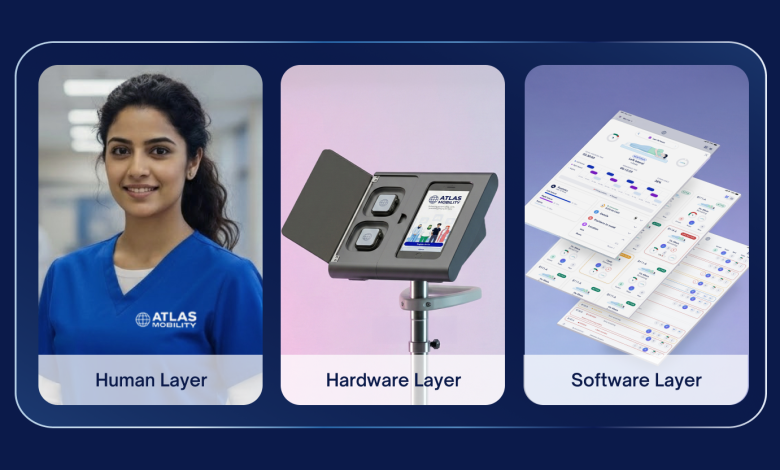
The Human Layer: Bringing Mobility Expertise to the Bedside
When Atlas began, the challenge was straightforward: caregivers were getting hurt while moving patients.
Hospitals had lift equipment and safe patient handling policies, yet equipment alone could not solve the problem. Care teams needed people who understood how to assess a patient’s mobility needs, select the appropriate equipment, and help execute safe mobility practices at the bedside.
That led to the development of the Mobility Technician model.
Mobility Technicians became an embedded resource for care teams, bringing specialized mobility expertise directly into patient care. They could help nurses and other clinicians determine how to safely move a patient, identify the appropriate equipment, and reinforce safe patient handling practices during actual patient care.
The model addressed a fundamental reality of healthcare: successful implementation depends on people. The technology and equipment can provide capabilities, but experienced professionals help translate those capabilities into practice.
This bedside experience also gave Atlas something that would become increasingly valuable as technology evolved: a detailed understanding of what mobility looks like in the real world.
The Hardware Layer: Seeing What Happens After the Patient Is Moved
The next question was about the patient.
A successful transfer tells us that a patient was moved. It tells us far less about what happened afterward.
For patients at risk of pressure injuries, positioning and offloading are critical. A nurse can complete a turn, yet the quality and duration of that offloading can vary. Care teams need visibility into whether patients are being repositioned according to their care plan and whether those practices are sustained over time.
That led Atlas to mobility monitoring.
The Mobility Monitoring System introduced technology that could provide visibility into patient positioning and mobility activity. Sensors and monitoring devices could capture information at the bedside and give care teams and leaders a clearer picture of what was happening with patient mobility.
This created a new layer of accountability and insight. Care teams could use technology to reinforce appropriate mobility practices, while leaders could see trends across patients, units, and programs.
The combination of Mobility Technicians and monitoring technology brought together human expertise and objective data. One helped care teams execute mobility. The other helped organizations see and measure what was happening.
The Software Layer: Connecting Mobility Across the Organization
Once hospitals could capture mobility information, another question emerged: How can that information be used to improve the entire program?
Software created the connection.
The Atlas Mobility platform brings mobility information together so organizations can monitor activity, identify trends, and use data to guide improvement. Rather than relying on isolated observations, leaders can see how mobility practices are performing over time and identify areas that may require additional support or intervention.
A mobility program lives across an organization. Nurses, therapists, mobility specialists, educators, quality teams, and leaders all interact with different parts of the process.
Software provides a way to connect those activities and create greater visibility into program performance.
The evolution had now moved through three layers: people providing expertise at the bedside, hardware capturing what happens during care, and software turning that information into insight.
The Automation Layer: Putting Years of Expertise Into a Toolkit
The next step is making all of that expertise accessible to more hospitals.
For nursing leaders, the value extends beyond efficiency. Automation creates a more reliable way to manage equipment, staff readiness, and mobility performance across an organization, allowing care teams to spend less time maintaining processes and more time optimizing patient care and outcomes.
Every hospital has different resources. Some have dedicated mobility teams, educators, quality staff, and extensive technology infrastructure. Others operate with much smaller teams that manage multiple priorities simultaneously.
The need for safe, consistent mobility exists across all of them.
Atlas Mobility is bringing its years of experience into a toolkit that helps hospitals operationalize mobility without requiring a complete institutional overhaul. Automation handles many of the processes that historically required significant manual effort.
Equipment inventory management can be automated, giving teams visibility into the equipment available across their program. SPHM training tracking can be automated, helping leaders see staff readiness and identify gaps. Mobility data can be automatically collected and trended, giving organizations a continuous view of program performance and creating a foundation for improvement.
This is where AI and automation can extend the reach of human expertise.
The knowledge gained through years of working alongside care teams becomes embedded in the technology and processes that hospitals can deploy. Instead of asking each organization to build its own mobility infrastructure from the ground up, the toolkit provides a foundation that can be adapted to the hospital’s environment and resources.
AI can further enhance that foundation by helping organizations analyze data, identify patterns, and surface insights that can inform decisions.
The result is a progression that mirrors the broader evolution of technology in healthcare: human expertise supported by hardware, connected through software, and increasingly enhanced through automation and AI.
The Future: Technology Extends What People Can Do
Looking back at the evolution of AI, the technology has advanced dramatically. The more interesting question for healthcare is how that technology can expand the capabilities of the people already doing the work.
Nursing will always depend on clinical judgment, experience, observation, communication, and human connection. Nurses are the heart of patient care, providing hands-on treatment and emotional support alongside their clinical expertise. Those qualities are central to caring for a patient and understanding the individual behind the clinical data.
Technology can take on repetitive operational work, organize information, provide visibility, and surface patterns. That gives clinicians and leaders more capacity to focus their expertise where it has the greatest impact.
Atlas Mobility’s evolution reflects that philosophy. Mobility Technicians brought expertise to the bedside. Mobility monitoring added visibility into patient care. Software connected mobility data across the organization. Automation now packages years of operational learning into a toolkit that can help hospitals of different sizes and resources put a mobility program into practice.
AI represents the next layer of that evolution.
The goal is a healthcare environment where technology expands the reach of the people providing care, helping more teams apply proven practices, see what is happening, and continuously improve.
The future of AI in healthcare will ultimately be measured by what it enables people to accomplish. When technology carries more of the operational load, nurses and other healthcare professionals have greater capacity to bring their knowledge, judgment, and compassion to the patient. That is where AI can have its most lasting impact: helping human expertise reach further.