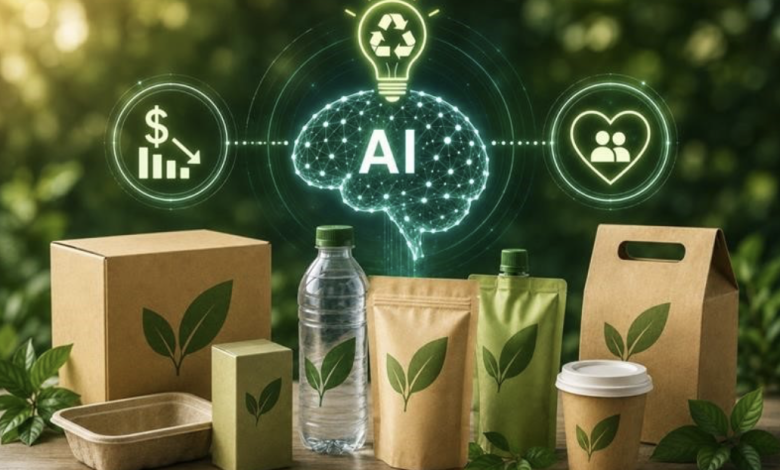
Every packaging brief I have received in the last five years asks for the same three things: make it more sustainable, make it cheaper, and make consumers notice. For most of my career, those three demands pulled against each other. Recycled resin cost more than virgin and performed worse. Lightweighting saved money but risked failures in transit. Engagement features added cost without adding function.
The honest position among packaging engineers was that you could pick two. Consumer behaviour reinforced the problem: shoppers still rank price, quality, and convenience well above environmental impact when deciding what to buy. Sustainability that arrives with a price premium gets left on the shelf.
AI is the first set of tools that act as a lever across the entire packaging value chain, from material discovery to the moment a consumer picks the pack up, attacking all three constraints at once rather than trading one against another. It does this in specific, unglamorous places: formulation screening, structural simulation, waste sorting, and the data carried on the pack itself.
Why the trade-off exists
The root cause is iteration cost. Developing a new pack means cutting tools, moulding samples, filling them, and putting them through drop, top-load, and transit testing. Each loop takes weeks and real money, so teams can only afford to test a handful of design candidates. The safest candidate wins, and the safest candidate is usually virgin material at proven wall thickness.
Recycled content makes this worse because recyclate is inconsistent. Melt flow, colour, and contamination vary from batch to batch, which forces engineers to over-specify and erodes the cost case. Globally, 2022 figures show that only 9% of plastic waste is recycled and that packaging accounts for 40% of it. Poor supply quality and high iteration cost feed each other.
Regulation has now removed the option of waiting. Under the EU’s Packaging and Packaging Waste Regulation, which applies from mid-2026, all packaging must be recyclable by 2030 and plastic packaging must contain minimum recycled content, with targets rising through 2040. The trade-off can no longer be dodged. It has to be engineered out.
Material discovery at machine speed
The slowest part of materials work has always been the search. When a deep learning system recently predicted 2.2 million new crystal structures, including 380,000 stable candidates, it demonstrated something packaging scientists should take personally: the screening of candidate materials no longer has to happen one lab experiment at a time.
The packaging applications are narrower but follow the same logic. Machine learning models trained on polymer property data can predict how a blend of virgin and recycled resin will behave before anyone runs an extruder. The same applies to barrier coatings for mono-material laminates, which are the structures most likely to pass recyclability grading. AI does not replace the lab. It decides which ten experiments out of a thousand are worth running.
Simulation as the new development loop
Structural simulation has existed for decades, but it was expensive enough that teams reserved it for final validation. AI surrogate models change the economics: once trained on simulation and physical test data, they evaluate a design candidate in seconds, which means hundreds of geometry and material combinations can be screened before a single tool is cut.
I saw this firsthand when leading a multi-market programme across developing markets focused on introducing more sustainable materials while keeping the broader innovation pipeline on track. One of the key challenges wasn’t ambition, but validation capacity—each new material or design change needed to be tested to ensure it would perform reliably in manufacturing and across the supply chain. To address that, we shifted more of the early-stage screening into simulation, which allowed us to evaluate options more quickly and reduce dependence on physical testing. That helped shorten development timelines while maintaining the same performance standards as existing designs.
To address that, more of the early-stage screening was shifted into simulation, allowing options to be evaluated more quickly and reducing dependence on physical testing. As a result, development timelines were shortened while maintaining the same performance standards as existing designs.
That is the quiet answer to the cost question. The cheapest pack is the one you got right before tooling, and AI-assisted simulation is currently the most reliable way to get there.
Smarter sorting feeds better recyclate
The recycled content problem is also a supply problem, and AI is changing the sorting end of it. In recent industrial trials, imperceptible digital watermarks on packs were detected on high-speed sorting lines at roughly 90% sorting efficiency, with granularity down to individual SKU level on real post-household waste.
SKU-level sorting matters because it creates recycled streams that do not exist today, such as food-grade material separated from non-food. Cleaner streams mean more consistent recyclate, which collapses the over-specification penalty I described earlier and narrows the price gap with virgin resin. Designers and waste sorters have historically worked in isolation from one another. Intelligent sorting connects them, because the data printed into the pack at design time is what the sorting line reads at end of life.
The pack becomes a data carrier
The same shift serves the consumer side. Retail is in a global transition from the 50-year-old linear barcode to 2D codes such as QR, targeted for 2027 and readable both at the till and by any smartphone. The pack stops being a static label and becomes a live channel: usage guidance, refill prompts, local recycling instructions, and verifiable provenance behind every sustainability claim.
Credibility is the commercial point. An analysis of five years of US sales data found products carrying environmental and social claims grew 28% cumulatively against 20% for products without them. Shoppers reward claims they can trust, and a scannable pack backed by real supply chain data is far harder to dismiss as greenwash than a printed leaf icon. AI sits behind the scan, personalising what each consumer sees and keeping the underlying product data accurate at scale.
Where packaging leaders should start
Start with your data, not with a model. Most packaging organisations hold decades of test reports, material certificates, and specification sheets trapped in PDFs and spreadsheets. None of the approaches above works without that history in structured form, and assembling it is unglamorous work that pays off across every later use case.
Then pick one high-volume SKU and run a bounded pilot: AI-assisted lightweighting or recycled content qualification, measured in weeks saved against your normal loop. Treat the 2D code migration as a single programme serving regulatory labelling and consumer engagement together, because building them separately doubles the cost of each. The trade-off between sustainable, cheap, and engaging was real for twenty years. It is now an engineering problem with a closing window, and the teams that move first will set the cost curve everyone else has to chase.