A second-quarter surge, major mortgage-tech financing and renewed foreign interest signal a more selective phase for Canada’s fintech market as AI and regulatory reform spur competition
TORONTO, Aug. 25, 2026 /CNW/ — Investment in Canadian fintechs neared US$1 billion in the first half of 2026, as a sharp second-quarter rebound and several large transactions highlighted a market where investors focused on companies with scale, specialized artificial intelligence capabilities and competitive advantage as new financial infrastructure comes online.
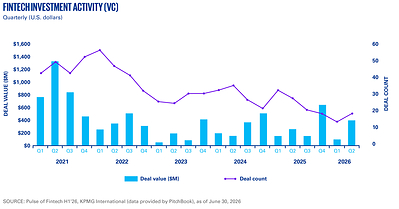
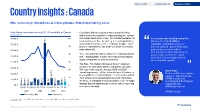
According to KPMG International’s H1’26 Pulse of Fintech report, investment in Canadian fintechs was broadly stable compared with the previous six months, with US$996.7 million invested across 47 deals versus US$1 billion invested across 56 deals in the second half of 2025, according to data compiled by PitchBook. On a year-over-year basis, the drop in investment was more pronounced, with H1’26 deal activity down more than 40 per cent from the US$1.7B invested across 82 deals in the first half of 2025.
Dubie Cunningham, a Partner in KPMG Canada’s Banking and Capital Markets practice, says investors are not retreating from Canadian fintechs. Rather, they are placing fewer, more deliberate bets.
“Canadian fintech has entered a selective maturation phase, with investors going after fewer deals but applying more scrutiny to their investments. They are being more discerning and going after fintechs that have scale, specialized AI capabilities and that are competitively positioned to take advantage of upcoming reforms to Canada’s financial services industry,” she says.
Pulse of Fintech H1’26 Highlights
- US$996.7M total invested across 47 deals in H1’26
- US$375M invested across 24 deals in Q1
- US$621.7M invested across 23 deals in Q2
- Venture capital funding totalled $492.9M across 33 deals in H1’26
- US$94.6M invested across 14 deals in Q1
- US$398.2M invested across 19 deals in Q2
- Corporate venture capital investment totalled $25M across 8 deals
- Merger and acquisition activity totalled US$37M across 12 deals
- Private equity/growth investments totalled US$130.6M across two deals
Investment activity rose substantially in the second quarter to US$621.7 million from US$375 million in Q1, despite virtually unchanged volume. The largest deal was a US$218.6M Series E investment in online mortgage lender Nesto, valuing the company at US$1B. The funding round included new investors such as La Caisse (formerly CDPQ), Fidelity Investments Canada ULC, PICTON Investments and Endeavor Catalyst, and renewed investment from existing investors such as Portage, Diagram, NAventures, National Bank of Canada’s corporate venture capital arm, Fonds de solidarité FTQ and Fondaction.
Nesto’s financing helped boost total venture capital investment to US$398.2 million across 19 deals in the second quarter, up from US$94.6 million across 14 deals in Q1. Ms. Cunningham notes transactions such as Nesto’s illustrate Canada’s maturing fintech investment climate.
“Canadian fintechs are attracting capital not simply because they are innovative, but because they provide technology, customers, licences or regulated platforms that can accelerate expansion. While previous waves of fintech investment rewarded digital access and growth, this current wave is rewarding specialized intelligence and demonstrable economics,” Ms. Cunningham says.
|
DEALS BY VERTICAL |
DEAL TYPE |
|
19 AI/machine learning |
12 Early Stage VC |
|
8 Digital assets/cryptoassets |
11 M&A deals |
|
6 PropTech |
10 Late Stage VC |
|
4 Payments |
8 Seed Round |
|
2 InsurTech |
3 Angel Investments |
|
2 Cybersecurity |
2 PE Growth/Expansion |
|
1 RegTech |
1 Buyout/LBO |
AI DEALS DOMINATE
AI and machine learning-oriented fintechs continued to attract significant investor interest, with 19 investments in the first half – more than any other vertical.
Ms. Cunningham notes that while AI has been the most active vertical over the past year – and will likely remain one of the most active sectors – fintech investment is moving from broad experimentation to more specialized AI applications.
“Fintech investors aren’t investing in AI for AI’s sake – they’re being strategic. Capital is flowing to fintechs that are using AI to solve a specific problem. The fintechs that are leveraging AI to make deposit-taking, lending and payment processing faster and more efficient are creating significant value; those are the types of fintechs where we see investment dollars going over the next year to 18 months,” she says.
Regulatory changes: the next investment catalyst
Investors continued to deploy capital into digital asset-based fintechs, the second most active vertical in the first half of the year. Robinhood Markets Inc.’s US$168.4M acquisition of Toronto-based WonderFi Technologies was the second-largest fintech deal in Canada in H1. The deal marked Robinhood’s entry into Canada through WonderFi’s regulated cryptoasset platforms Bitbuy and Coinsquare.
Andrew Mathias, a Partner in KPMG’s Deal Advisory practice, says regulated platforms with scale will continue to draw foreign and domestic capital, as Canada’s financial services sector enters a new era of financial innovation through the Consumer-Driven Banking Act and implementation of the Real-Time Rail.
“Consumer-Driven Banking and the Real-Time Rail are opening up the infrastructure that fintechs need to compete, and these regulatory reforms could materially alter fintech economics and create conditions for a new period of competition in financial services,” Mr. Mathias says.
Consumer-driven banking will allow consumers to securely share their financial information with accredited fintechs, while the Real-Time Rail will modernize Canada’s payments system by enabling real-time money movement and improved payment data. Together, these reforms are expected to accelerate competition across Canada’s financial services sector.
“While regulation is often seen as a constraint, it might finally become a catalyst for fintech investment,” says Mr. Mathias. “Access to secure data-sharing systems and modern payment infrastructure will lower the cost of new services, enable new payment and account-aggregation products, reduce fintech dependence on incumbent institutions, increase partnership and acquisition opportunities and put pressure on established banks and larger software providers to differentiate. We expect the result will be more competition and consolidation for Canadian fintechs over the next year to 18 months,” he adds.
Global investment
On a global scale, US$103B was invested across 2,098 deals, with a majority (US$81B) of investment concentrated in the U.S. across 933 deals.
About KPMG Canada
KPMG LLP, a limited liability partnership, is a full-service Audit, Tax and Advisory firm owned and operated by Canadians. For over 150 years, our professionals have provided consulting, accounting, auditing, and tax services to Canadians, inspiring confidence, empowering change, and driving innovation. Guided by our core values of Integrity, Excellence, Courage, Together, For Better, KPMG employs more than 10,000 people in over 40 locations across Canada, serving private- and public-sector clients. KPMG is consistently ranked one of Canada’s top employers and one of the best places to work in the country.
The firm is established under the laws of Ontario and is a member of KPMG’s global organization of independent member firms affiliated with KPMG International, a private English company limited by guarantee. Each KPMG firm is a legally distinct and separate entity and describes itself as such. For more information, see kpmg.com/ca
For media inquiries:
Roula Meditskos
National Communications and Media Relations
KPMG Canada
416-549-7982
[email protected]
SOURCE KPMG LLP