-
AI is becoming more useful because we’re starting to trust its answers. What happens when those answers also have to make money?
“AI works because the user increasingly believes that the answer is based on relevance, evidence and context. The moment the user starts wondering whether the answer is also influenced by who paid for placement, the relationship changes.
“That does not mean AI cannot be commercial, but it means the commercial layer must be clearly separated from the trusted answer.
“If the model says, “Here is what I think is best, and here is a sponsored alternative,” trust can survive. If the sponsored alternative becomes “what I think is best”, trust starts to collapse.”
-
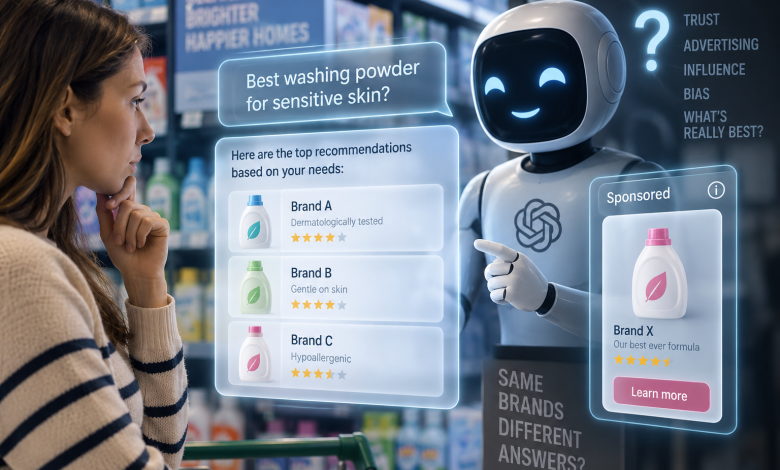
If I ask an AI, “What’s the best washing powder for sensitive skin?”, should the answer be based on evidence, or could the brand with the biggest advertising budget eventually influence what I’m told?
“It should be based on evidence and on the information the individual has given it, but the danger is that AI recommendations may become enormously valuable commercially precisely because they feel more authoritative than advertising. After all, the rate at which customers decide to buy from AI is considerably higher than normal website browsing.
“If a consumer believes an AI has researched ingredients, reviews, price, product claims and their own preferences, then “I recommend Brand X” carries far more weight than a banner advert. That makes the temptation to monetise that recommendation enormous.
“For FMCG brands, that creates a new battleground. They may no longer just be fighting to be seen, but to be recommended.”
-
Google taught consumers to distinguish between sponsored results and organic results. Will AI assistants have to make the same distinction to retain our trust?
“Yes, and arguably the distinction will need to be even stronger. With Google, we can see a page of alternatives, and we can scroll down and ignore the sponsored result, but AI often gives us a single, confident answer. That makes commercial influence much harder to detect.
“AI platforms may ultimately have to establish a very clear rule: the answer is the answer, and advertising sits separately from it.
“Otherwise, users will eventually develop exactly the behaviour they developed with search engines: “That’s probably sponsored, so I’ll ignore it.”
“And once people start applying that suspicion to the AI’s main answer, the product has a much bigger problem.”
- Could the biggest threat to AI adoption actually be advertising?
“Potentially, yes. Not because people dislike advertising, but because AI is fundamentally selling trust.
“We tolerated advertising in search because search gave us choices, but AI is different. We are increasingly asking it to do the research and make sense of those choices for us.
“If the commercial model damages our confidence that it is doing that impartially, it undermines the reason we delegated the decision in the first place.
“The irony is that the more trusted AI becomes, the more valuable its recommendation becomes commercially and therefore the greater the temptation to monetise it.”
-
Are FMCG brands moving from competing for shelf space and search results to competing for space inside an AI’s answer?
“I think they are, yes.
“For decades FMCG has been about availability and visibility: get on the supermarket shelf. Get good shelf position. Get into the retailer search results. Get onto Google. Get into the Amazon results. Win on social.
“But AI potentially changes the problem again. If somebody asks: “What’s a good high-protein breakfast for under £2?” the AI might not present twenty products, it might recommend just three, and eventually it might only recommend one.
“Being the brand that the AI understands, trusts and associates with that consumer need could become enormously valuable.”
-
What happens to smaller FMCG brands? Does AI democratise discovery or favour the biggest budgets?
“It could do either, and the optimistic view is fascinating.
“Today, a small brand can have an objectively brilliant product but struggle to compete with companies spending millions on advertising and distribution. A genuinely independent AI could discover that product because it is better suited to the consumer’s needs.
“That could democratise FMCG discovery. But if AI recommendation becomes another paid media channel, we recreate the existing system, only potentially with even fewer brands getting through.
“So one of the big questions becomes: does AI become the great leveller, or simply the next advertising platform?”
-
What happens if I ask, “What are those curved crisps that come stacked in a tube?”
“You expect the answer to be Pringles because that is almost certainly what you mean, and that is a useful test of AI trust.
“Imagine asking that question and getting: “You might be thinking of Walkers.” You would immediately think the AI had misunderstood you.
“Now imagine discovering that Walkers had paid for that response. That is far worse because the AI didn’t misunderstand you. It understood perfectly and deliberately gave you a less useful answer. That distinction is important.
“An AI being wrong is something we can forgive as the technology improves, but an AI knowingly giving us a worse answer because somebody paid it to is a breach of trust.”
-
Will consumers learn to recognise sponsored AI recommendations just as they learned to scroll past sponsored Google results?
“Almost certainly, if platforms go down that route. Consumers are remarkably good at developing defences against advertising.
“Banner blindness is a good example, and sponsored search is another. If AI recommendations become obviously commercial, users will develop similar behaviour.
“They might say: “Give me your answer excluding sponsored recommendations.”
“And that raises an interesting question for AI companies. If the user can simply ask the AI to remove the advertising influence, what is the advertising product actually worth?
“That may force the commercial model to evolve beyond simply buying recommendations.”
-
Does AI make brand distinctiveness even more important?
“I think it makes it considerably more important. We normally think of distinctive brand assets as being designed for humans: colours, shapes, packaging structures, logos, characters, sounds and language. But increasingly those assets may also help machines understand brands.
“The Pringles example is perfect. We didn’t need to say the brand name, we simply described it as curved + crisp + stacked + tube.
“Those characteristics are so distinctive that they effectively identify the brand. For FMCG companies, that suggests a fascinating new dimension to brand building.
“Could distinctive brand assets become important not only because humans recognise them, but because AI recognises them too?”
-
Will brands need to optimise themselves for AI in the same way they optimised for search engines?
“I think some version of this is inevitable. SEO became important because Google became an intermediary between businesses and customers. If AI becomes an even more important intermediary, businesses will naturally want to understand how they are represented within it.
“But I don’t think it will simply be “AI SEO”, because the AI potentially understands much more than keywords. It can potentially understand product data, imagery, consumer reviews, availability, ingredients, claims, packaging, sustainability information, price and consumer sentiment.
“So FMCG brands may need much better structured product information and much greater consistency across everything they publish.”
-
Who should decide which brand an AI recommends?
“Ideally, the consumer. Not explicitly every time, but through the preferences and requirements they give the AI.
“If I say: “Find me a washing powder for sensitive skin, under £10, from a company with strong environmental credentials” the AI should optimise against those requirements.
“The winning brand should be the brand that best meets them, and that creates a potentially healthier form of competition.
“Instead of asking: “Who can spend the most to reach this consumer?” brands start asking: “How do we genuinely become the best answer to this consumer’s requirement?”
“For FMCG, that could have profound implications.”
-
If trust becomes the most valuable asset an AI company owns, can it afford to sell influence over its answers?
“This may be the fundamental question. The short-term commercial value of influencing recommendations could be enormous.
“But the long-term value of being the system that hundreds of millions of people trust to give them an impartial answer could be far greater, so the AI companies have a strategic choice.
“They can either monetise attention, as much of the internet has done, or they can monetise trust without corrupting it.
“Exactly the same problem exists in every interaction with the AI, whether it is politics or anything with an emotional angle. But that’s a discussion for another time. I will be interested to see which way things go.”