AI translation has quietly moved from novelty to infrastructure. It sits in browsers, office suites, messaging apps, and customer support tools, converting text across languages in a single click. For low-stakes communication, quick emails, social posts, casual chat, that convenience is transformative. But once the stakes rise, generic machine translation starts to look fragile.
When a cross-border SME meeting hinges on nuance, or a clinic must explain a procedure to a patient in their own language, “good enough” isn’t good enough. In those moments, the gap between instant MT and professional human translation becomes obvious. The real question isn’t whether AI can help. It’s how to design translation systems that are genuinely safer than generic tools, by putting humans and workflows, not just models, at the center.
Translation vs. Communication: Why Context Matters
Most AI translation tools are built around isolated text. Paste words, pick languages, click translate, and receive an output that sounds fluent and plausible. The hidden assumption is that translation can be lifted out of the real-world interaction it’s meant to serve. It can’t.
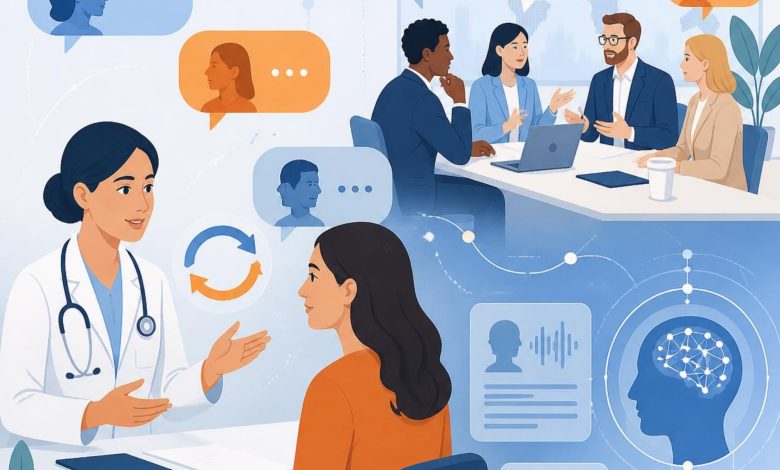
Translation lives inside negotiations, consultations, support calls, and everyday exchanges. In a cross-border SME meeting, a subtle shift in tone can derail trust or stall a deal. In a clinic, a slightly wrong nuance can change how a patient understands risk or gives consent. Accuracy isn’t only about each sentence; it’s about the decisions that follow.
Healthcare research bears this out. One evaluation of AI-translated emergency department discharge instructions found sentence-level accuracy above 90 percent for Spanish and Chinese, yet still flagged clinically meaningful errors and urged caution outside low-stakes communication (PubMed, 2025). A related analysis in npj Digital Medicine reached a similar conclusion: large-language-model translation can match human translators for widely spoken languages, but implementation still needs clear safeguards and professional oversight.
If translation sits inside a workflow with varying levels of risk, the technology needs to reflect that variation. That’s where multi-step pipelines and human-in-the-loop design stop being optional and become core requirements.
Multi-Engine, Multi-Step Workflows: Beyond One-Click MT
The dominant pattern in off-the-shelf tools is simple: one model, one call, one output. It’s easy to integrate and scale, but it asks a single engine to do everything: parse context, choose terminology, resist hallucinations, preserve tone, and catch edge cases. It also makes errors harder to catch, because there’s no built-in checkpoint where quality gets verified.
A safer pattern treats translation as a pipeline with distinct roles. One engine produces an initial draft focused on coverage and fluency. A second validates and refines it, checking for meaning preservation and obvious hallucinations. A glossary and style layer enforces terminology, register, and tone, flagging deviations for the user.
The engines behind each step can be neural MT systems, large language models, or a hybrid of both; the stack matters less than the principle. Don’t ask one engine to do everything, design for complementary strengths and explicit checks instead. One example of this pattern in production is Hermes Translator, which combines multiple AI engines with several layers of validation rather than a single call, and lets users route sensitive content to human review.
The point isn’t novelty for its own sake. In hands-on tests, systems built this way can match leading single-engine tools on quality, and sometimes exceed them on specialized content. But beating a particular engine was never the real goal; reducing risk by building error-catching into the design is.
Human-in-the-Loop as a First-Class Feature
Translators and interpreters bring domain knowledge, cultural insight, and ethical judgment that no AI system currently has. Accept that, and AI’s role becomes clear: amplify human expertise and connect users to it, rather than replace it. That means treating human oversight as a built-in feature, not an external service bolted on afterward.
Three modes are worth building into any serious platform. The first lets users send an AI draft to a professional translator for review before anything ships. The second lets users call in a live human interpreter the moment stakes or complexity rise, instead of leaning indefinitely on automated output. The third embeds a directory of translators and interpreters, profiles, language pairs, specializations, reviews, so users can find the right expert directly.
This works best when AI is positioned as infrastructure and workflow, and humans are positioned as the actual service. Platforms such as Hermes Translator and Hermes Medica follow this model: AI handles routine translation and intake, and anything critical routes to a human professional on request.
The architecture is safer than generic MT precisely because it accepts the limits of automation instead of pretending they don’t exist. It assumes some content will always need a human, and it builds that path in rather than leaving it as an afterthought.
Live Interpreting and Real-Time Constraints
Text is only part of the picture. In SME meetings, medical consultations, tourism, and hospitality, much of the communication is live: people interrupt, pivot mid-sentence, and switch topics on the fly. Tone and emotional register can matter as much as the words themselves. Live interpreting is a different problem from static text translation.
Latency, turn-taking, background noise, accents, and idiom aren’t side issues. They decide whether people actually understand each other. An AI interpreter that lags or stumbles on an idiom in a cross-border meeting can quietly fray rapport; missing a patient’s hesitation in a clinic can mean missing the moment to clarify consent.
A layered approach is the safer path. Real-time AI interpreting can carry the lower-stakes parts of a conversation, while segments tied to decisions, consent, or high-stakes content escalate to a human interpreter, either by user choice or by preset rule. The interface should always make clear which mode, AI or human, is doing the work at any given moment.
Domain Separation, Privacy, and Quality Assurance
Not all content carries the same risk. Everyday business notes, tourism help, and informal messages sit in one category; medical, legal, and regulatory content sit in another. Treating them identically is a design flaw.
Domain separation is the practical fix: distinct workflows, glossaries, and escalation rules for general versus medical content, with medical workflows deliberately narrower and more conservative about raw machine output. Sensitive elements, names, IDs, other identifiers, can also be masked before content reaches an AI engine, cutting exposure of protected information. Guidance from the American Translators Association makes a similar point: AI translation can be a useful first pass, but professional review remains essential wherever content carries legal, medical, or reputational weight.
Where appropriate, and with consent, platforms can keep structured logs of translation and interpreting sessions to support error analysis and governance. The goal is learning from mistakes, not surveilling users. Systems that separate by domain and build in these safeguards are meaningfully safer than tools that treat every text the same way.
A Practical Checklist for Adopting AI Translation
For teams weighing AI translation, in clinics, SMEs, hospitality, or software products, the useful questions are about design, not raw engine choice:
- Does the platform rely on a single model and a single pass, or a multi-step workflow with explicit validation?
- Is human review, interpreter access, or an expert directory built into the core product, or bolted on later?
- Are live interpreting features treated as their own workflow, with a clear path to escalate to a human?
- Does the system separate everyday, business, and medical content, with safeguards that scale to the risk?
- How is privacy and logging handled, and is that visible to users?
Framing evaluation this way shifts the conversation from “which tool is fastest” to “which system is safest and best matched to how people actually communicate.”
Conclusion: AI Translation as Infrastructure, Not Idols
It’s tempting to picture translation engines as a magic button that handles any text, in any domain, at any level of risk. The reality is more nuanced. AI translation has come a long way and is genuinely useful across a wide range of contexts, but its limits sharpen exactly where the stakes are highest.
The systems that last will be the ones built to accept those limits: multi-step workflows, several engines working together, domains kept separate, human experts built into the loop by design. They treat AI as infrastructure for multilingual communication, not a replacement for the people who do it professionally.
The best outcomes come from workflows where AI and humans work together, and where safety and context matter as much as speed. That principle, more than any single model release, is what should guide how translation platforms get built from here.