



A US company today can hire a designer in Lisbon and an engineer in Bangalore before it signs an office lease. That shift, US-headquartered teams spreading across borders, has turned global HR software from a large-enterprise luxury into a core system for any business with people in more than one country. The best global HR software for US companies has to do more than store records: it needs to run people operations, coordinate pay across currencies, and keep the business compliant everywhere it employs someone.
This guide ranks eight platforms US buyers reach for when they manage a distributed workforce, from modern core HR suites to employer-of-record services and global payroll specialists. Each entry names what the tool costs in 2026, so you can weigh price against fit before you book a demo.
What global HR software means for a US-headquartered team
For a US company, global HR software is any platform that can run people operations for employees who sit outside the United States, not track them from a distance. The gap between paying a domestic W-2 team and employing staff across borders is wide, and four capabilities close it:
- Multi-country payroll, whether the platform runs it in-house or connects local providers
- Jurisdiction-aware compliance that keeps each hire legal where they work
- Multi-currency handling for salaries, taxes, and statutory benefits
- Localization, from language to regional workflows and pay rules
Two more decide fit for a distributed team. Employee experience matters when your people seldom share an office: self-service and mobile access, plus onboarding that feels the same in every country, carry the culture that a headquarters can’t enforce in person. Data residency and privacy matter the moment you hold records on EU staff, where GDPR sets how you store and move personal data. A tool that handles US payroll well but stops at the border isn’t global HR software, and buying the wrong category is the expensive mistake US teams make most. The category skews to US and Western multinational buyers: North America led the global HR software market in 2025 with $11.2 billion in revenue, near a 40 percent share, per Dataintelo.
The categories US buyers mix up
“Global HR software” covers a few product types, and picking the wrong one is the expensive error. A global HRIS or HCM is the system of record for people data and processes across countries; it assumes you hold a legal entity in each place or connect one that employs on your behalf. An employer of record removes that assumption by acting as the legal employer where you have no entity, which is what lets a US company hire abroad without a subsidiary. A global payroll platform runs pay and filings across currencies, sometimes in-house in big markets and sometimes through local partners. The lines blur, since Deel and Rippling fold several of these into one product, yet the split that matters for a US buyer is core HR versus EOR: one runs your people operations, the other employs people for you where you can’t. Decide which sits at the center of your stack before you compare features.
Global HR software compared
The table below lines up the eight platforms on category, 2026 starting price, coverage, G2 score, and the buyer each suits. Employer-of-record fees are per employee per month and often fall with volume; the modern and enterprise suites price by quote.
| Platform | Category | Starting price (2026) | Coverage | G2 score | Best-fit buyer
|
|---|---|---|---|---|---|
| HiBob | Modern core HR + connected payroll | Quote-based (demo) | Global; native US and UK payroll | 4.5/5 | US-HQ’d distributed teams wanting modern core HR |
| Deel | EOR, global payroll, HRIS | EOR from $599/mo per person; HRIS free to 200 | 150+ countries | 4.7/5 | Hiring staff and contractors abroad from one tool |
| Remote | EOR, global payroll | EOR from ~$699/mo per person | 180+ countries | 4.5/5 | Owned-entity EOR with payroll reliability |
| Rippling | HR, IT, global payroll | ~$8/employee/mo + modules; EOR by quote | 185+ countries | 4.8/5 | Consolidating HR, IT, and payroll |
| Papaya Global | Global payroll, EOR | Payroll from ~$29/mo; EOR from ~$499/mo | 160+ countries | 4.5/5 | Finance-led multi-country payroll |
| Oyster | EOR, global payroll | Payroll $29/mo; EOR $699/mo per person | Global | 4.7/5 | Distributed teams hiring without entities |
| Workday | Enterprise HCM suite | Quote-based (enterprise) | Global | 4.1/5 | Large enterprises on one global HCM |
| ADP | Global payroll, HCM | Quote-based (custom) | 140+ countries | 4.2/5 | Established multinationals standardizing payroll |
Prices were checked against vendor pages in 2026. EOR rates are per employee per month and drop with volume; the enterprise suites are quote-only. Country counts come from the vendors. Confirm current terms before you commit, since global HR and EOR pricing shifts and carries hidden costs like currency markups, deposits, and setup fees.
How we compared the platforms
This ranking weighs what a US buyer with a distributed team feels after go-live, not the feature grid alone. Four inputs shaped the order. Coverage came first: real support for multi-country employment and payroll. Then fit, how well each tool’s model suits a US-headquartered team, sat beside published 2026 pricing so cost meets capability. Verified G2 feedback, ratings and review counts from thousands of practitioners, settled close calls, and every downside noted below traces to those reviews rather than opinion.
The best global HR software for US companies
1. HiBob
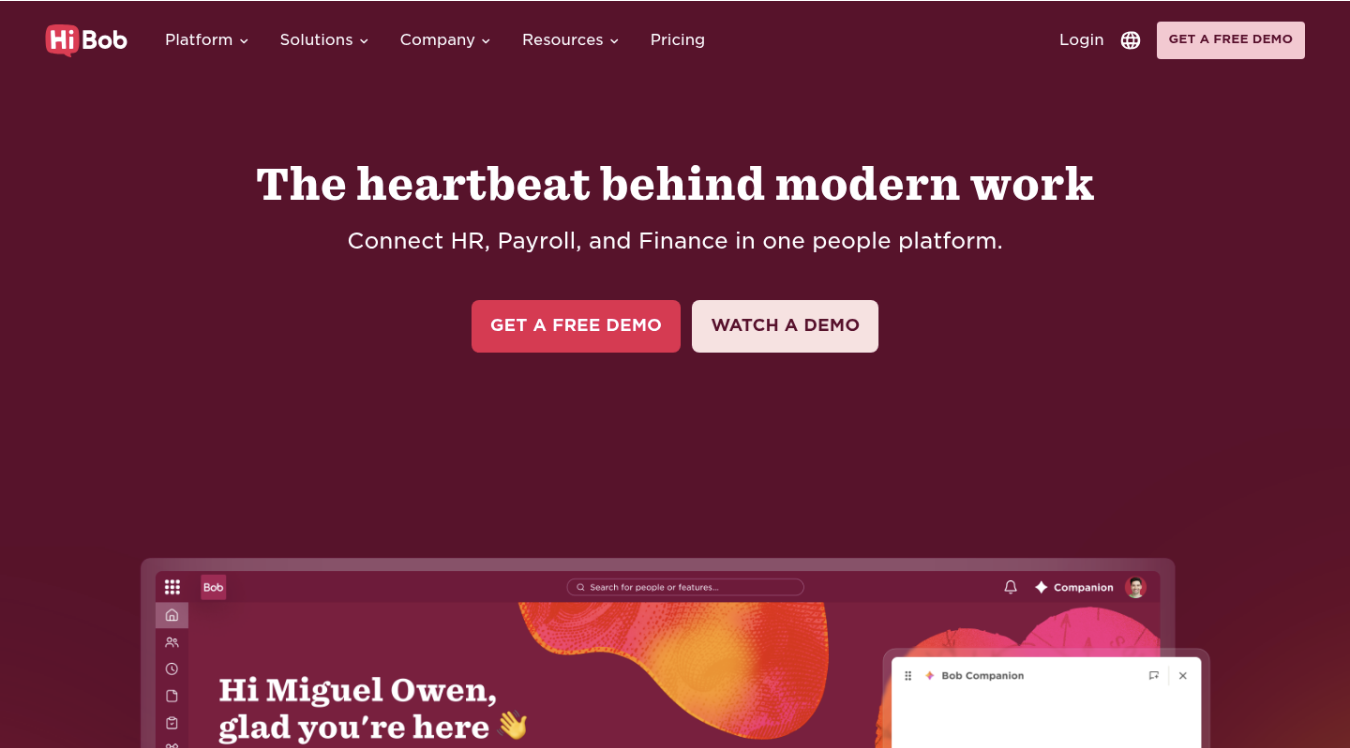
Bob treats a US company’s global workforce as one connected system of record. Every hire, promotion, and exit across countries lives in Bob Core, the required foundation that holds unified people data, org structure, and audit-ready workflows, so a team in Austin and a team in Berlin work from the same numbers. For pay, Bob runs native US and UK payroll and links every other country through its Payroll Hub, a no-code layer that connects local providers into one dashboard rather than forcing a rip-and-replace. The experience is built for distributed work: mobile-first self-service, role-based access, and multi-language environments that suit a workforce in many time zones. HiBob is GDPR-compliant, with the access controls and data-residency handling a cross-border employer needs. The honest catch is pricing: HiBob keeps rates off its public site, so a scoped figure only lands after a sales walkthrough. Bob earns the top spot for US-headquartered teams that want modern core HR with connected global payroll, not an EOR.
2. Deel
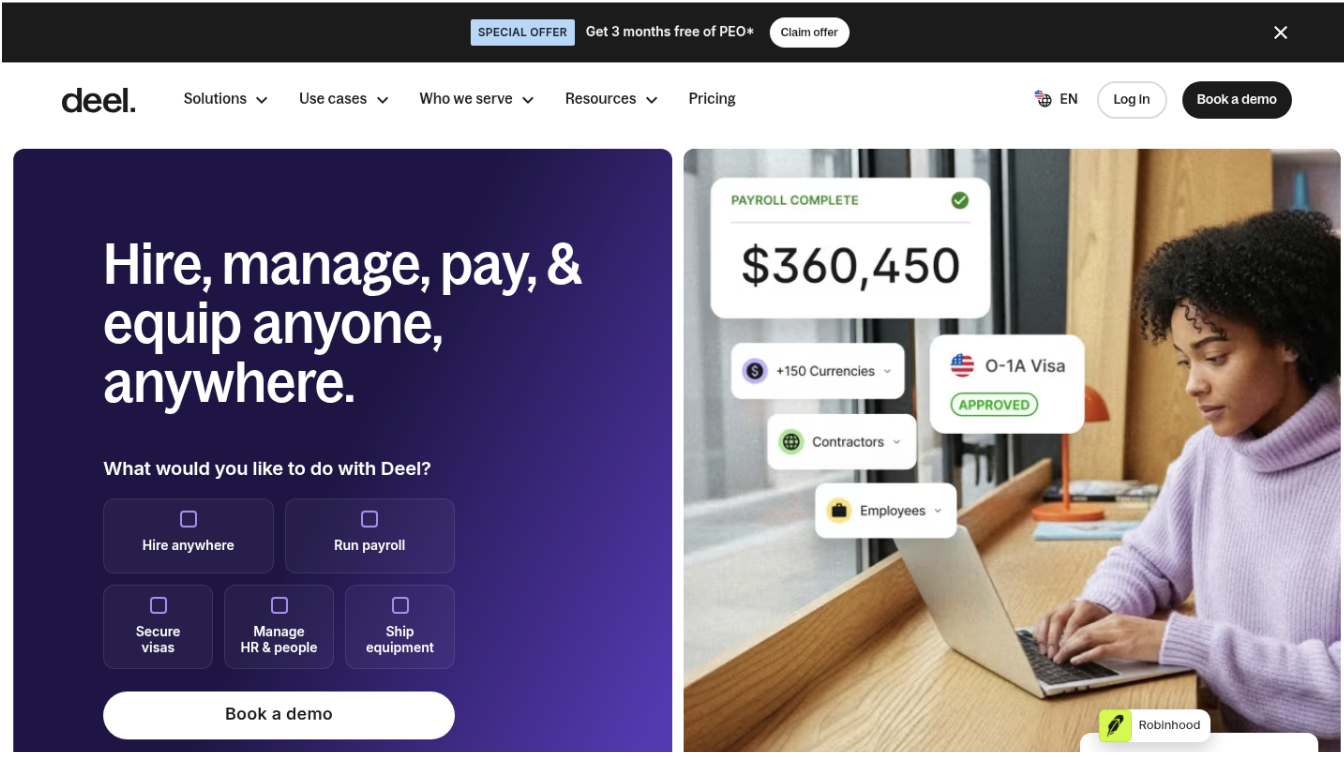
Deel is the default first stop for US companies going cross-border, and the most-used platform in this category. It bundles a free HRIS for up to 200 employees, contractor management, employer-of-record hiring in more than 150 countries, and global payroll in one place. Pricing is more transparent than most of the field: EOR runs from $599 per employee per month, contractors cost $49 per month, and the US PEO tier is $125 per person, though the EOR figure is a floor that climbs with a one-month salary deposit and currency markups. Onboarding for an EOR hire takes a few business days. Reviewers give Deel a 4.7/5 on G2 from over 6,500 reviews, the highest count here, yet those same reviews flag payment issues and payout delays, and some teams find it expensive once volume grows. For breadth and clear list pricing, it remains the benchmark rivals get measured against.
3. Remote
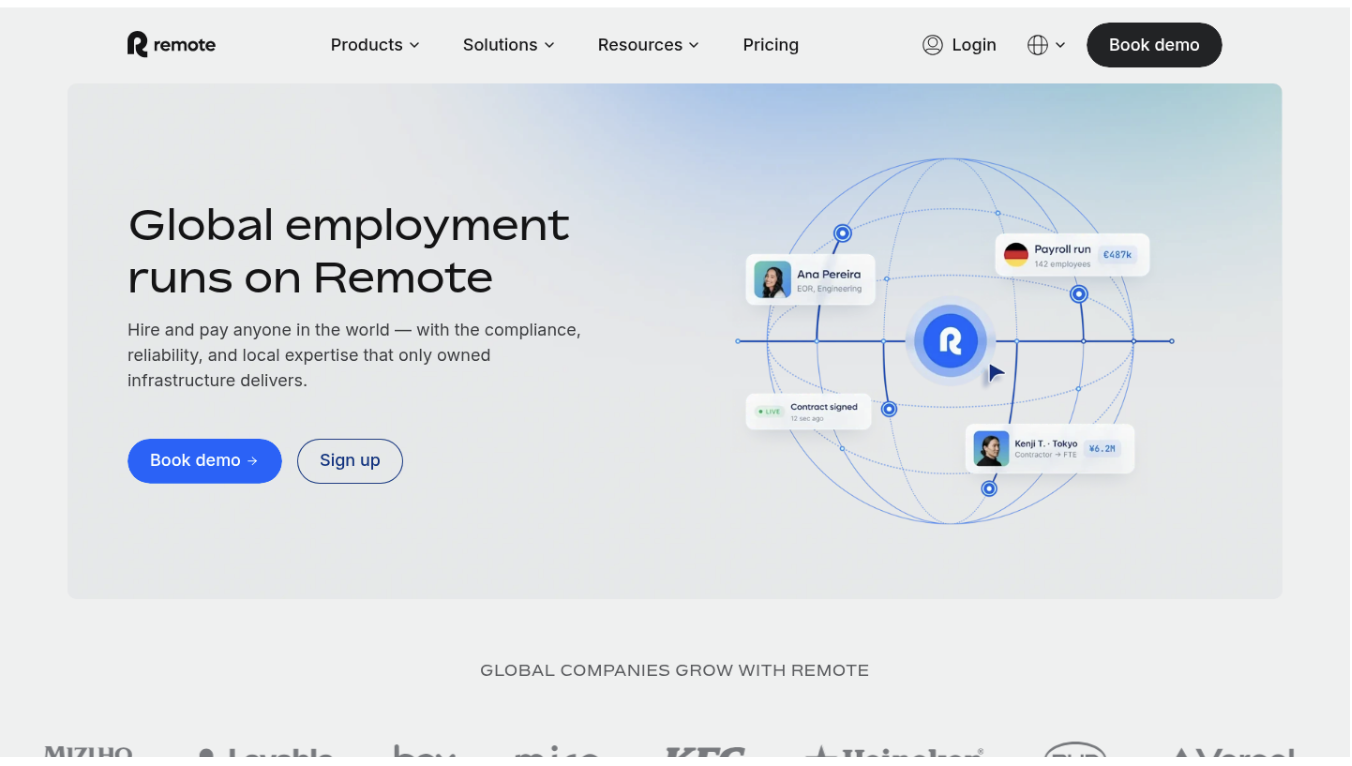
Remote built its service around legal entities it owns in the countries it covers, which lets it fund and run payroll cycles direct instead of routing through third parties. That owned-entity model is the draw for US buyers who care about payroll reliability and want to avoid the window where money has left the company account but hasn’t reached the employee. Coverage for EOR is in the 80–90+ country range via owned entities (contractor/payroll reach is broader), and EOR pricing is $699 per employee per month, in line with Deel rather than under it.
Remote holds a 4.5/5 on G2 (review counts vary by product page; recent figures are in the 4k–8k range depending on the specific listing). The weak spots reviewers name are support gaps and processing delays, so response times can lag when an issue crosses time zones. Remote fits a distributed US team that puts payroll accuracy and entity control first and doesn’t need Deel’s wider contractor catalog.
4. Rippling
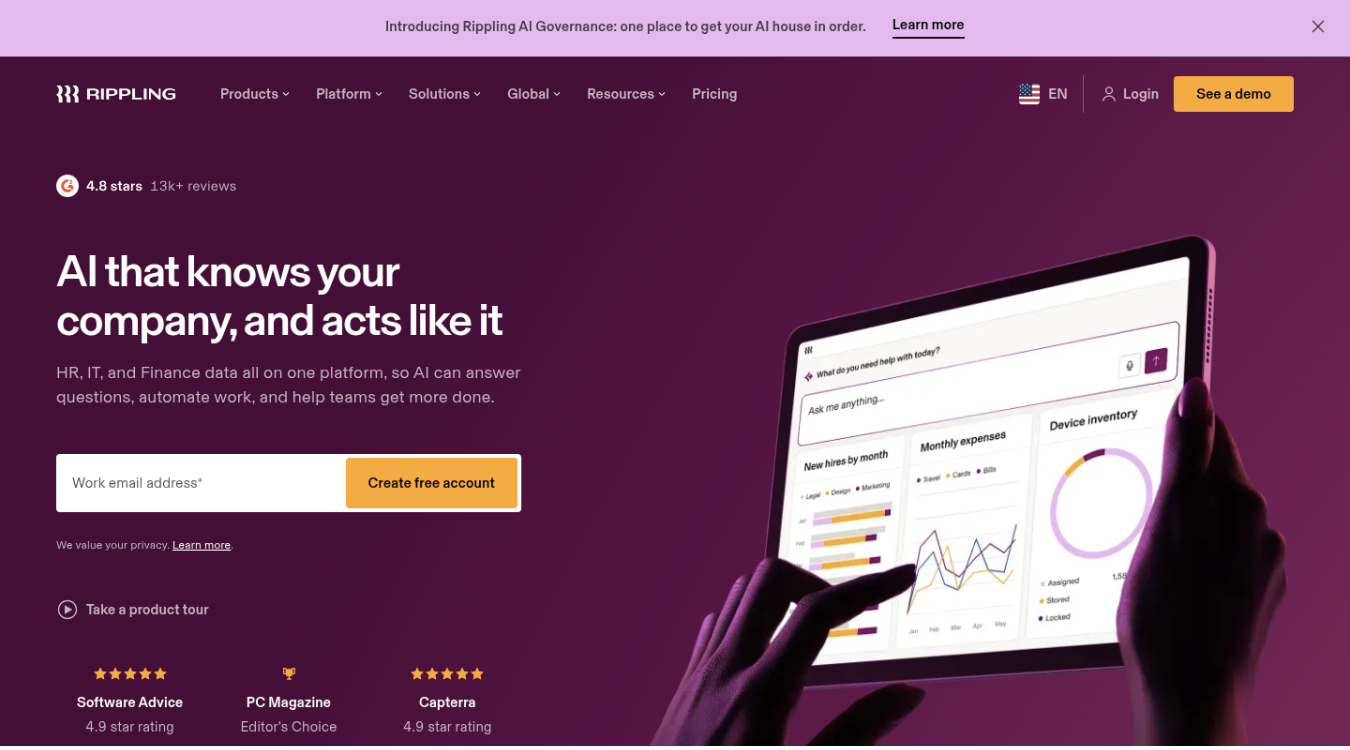
Rippling comes at global HR from a different direction, tying HR, IT, and finance into one operating system so a new hire in London gets a payroll record, app access, and a laptop from a single workflow. It handles hiring across more than 185 countries, with global payroll in a smaller set of markets, and carries the strongest core automation in this group. Pricing starts near $8 per employee per month for the base, then climbs as you add modules, and the EOR sits behind a custom quote, so the true cost is a full-stack commitment rather than a line item. Rippling scores a 4.8/5 on G2, the highest rating here, from over 12,000 reviews. The recurring complaint is a steep learning curve: reviewers describe a heavy setup and note missing features in spots. For a US company that wants to fold global hiring into a broader IT-and-HR system, it’s a strong fit; for a plain EOR need, it’s more platform than the job asks for.
5. Papaya Global
Papaya Global started as payment infrastructure and layered workforce management on top, which shows in its strength: consolidated multi-country payroll with real-time cost and tax visibility across more than 160 countries. For a US finance team watching spend in a dozen jurisdictions, that finance-grade reporting is the reason to look. Global payroll starts near $29 per employee per month, contractor management from as little as $5 per person, and its EOR from about $499 per employee per month, with cross-border payments billed near $3.50 per transaction. Papaya holds a 4.5/5 on G2. The downsides reviewers raise center on invoicing problems and delays, plus support that can run thin, so the billing side needs watching. Papaya suits a finance-led US company that treats payroll depth and multi-entity payments as the core problem, less so a small team that needs basic hiring cover.
6. Oyster
Oyster is built for distributed teams that want to hire across borders without standing up local entities, and it leans into a clean onboarding flow for international staff. Its pricing is among the more legible: global payroll runs $29 per team member per month, contractor management the same $29, the employer-of-record plan is $699 per person per month, and the US PEO tier is $144 per person. Oyster earns a 4.7/5 on G2. Reviewers do note friction, since small changes can take several steps to complete, and some flag limited flexibility when customizing contracts along with errors in documentation. For a US company that wants EOR coverage with predictable per-seat rates, Oyster is a fair pick, though its remit stays close to employment and payroll rather than full core HR.
7. Workday
Workday is the enterprise end of this list, a full human capital management suite covering core HR, talent, planning, and analytics for large global organizations, often paired with its finance product. It’s a deep system of record for a company running one platform across the whole employee lifecycle worldwide. That depth carries an enterprise price: Workday is quote-only with a high total cost of ownership and an implementation measured in months, and it assumes a dedicated HR and IT function to run it. On G2 it sits at 4.1/5, the lowest score in this group, and reviewers point to a complex interface and a steep learning curve, with navigation many find hard to follow. For a US multinational standardizing thousands of employees on one global HCM, Workday is a category leader; for a scaling mid-market team, it’s heavier and pricier than the work needs.
8. ADP
ADP anchors the list on reputation, with decades of payroll and compliance infrastructure that large US employers lean on to standardize pay across regions. Its global payroll and HCM tools cover core HR, payroll, and reporting in more than 140 countries, which is the appeal for an established multinational that values a proven backbone over a modern interface. Pricing is custom and quote-based, oriented to bigger headcounts, so it’s not a self-serve option for a small distributed team. ADP holds a 4.2/5 on G2. The complaints reviewers repeat are difficult navigation and inconsistent customer support, on an interface that feels dated next to newer suites. ADP makes sense for a large, compliance-heavy US company that wants a long-standing payroll engine at global scale, less so for a lean team that would rather move fast on a modern platform.
How to choose global HR software for a distributed US team
Start with a blunt question: do you employ people abroad, or do you pay a few contractors overseas? The answer sets the category. If most of your headcount is US W-2 with a handful of international contractors, an EOR or contractor service bolted onto a domestic HR tool costs far less than full multi-country infrastructure. If you employ full-time staff in several countries, you need a real global platform, and the choice narrows to what you want at the center.
Decide whether your core problem is people or payments. A US company that wants one modern system of record for its distributed workforce, with pay connected rather than outsourced, lands on a core HR platform like Bob. A company whose hardest problem is running compliant payroll in a dozen countries leans toward a payroll-first provider such as Papaya. A team whose main need is to employ people where it has no entity wants an EOR like Deel or Remote.
Then weigh three practical filters. Total cost, once deposits, currency markups, and statutory benefits land, runs well above the headline per-seat fee, so compare the full cost of employment rather than the sticker. Implementation time separates the modern suites, live in weeks, from enterprise systems that take months. Data residency and GDPR handling decide whether you can hold EU employee records without extra tooling. Map your current workflows against those three before a demo, since that step surfaces gaps a sales walkthrough tends to skip.
Which global HR software wins for US companies
For a US company running a distributed team, the best global HR software is the one that keeps people operations modern while pay and compliance stay connected across borders. That’s why Bob takes the top spot: it gives a US-headquartered team one system of record in Bob Core, native US and UK payroll with a Payroll Hub that links the rest, and an employee experience built for people who work far from any office, all under GDPR-grade data handling. The EOR specialists like Deel and Remote solve a narrower problem, employing people where you have no entity. The payroll bureaus like Papaya go deep on payments. The enterprise suites, Workday and ADP, fit organizations with thousands of staff and the teams to run them. For a scaling US business that wants global core HR without the enterprise weight, Bob is the platform to shortlist first.
Global HR software FAQ
What is the best global HR software for US companies?
No single platform wins for every US company, since the right fit turns on whether your core need is people operations or payments. A US-headquartered business running a distributed workforce that wants modern people operations with connected pay tends to shortlist a core HR suite first, then compares it against EOR specialists like Deel and Remote. A finance-led team managing pay in many countries may rank a payroll-first provider such as Papaya higher. Match the tool to the problem before you weigh the brand.
What is the difference between global HR software and an EOR?
Global HR software is the system of record that runs hiring, people data, and HR processes across countries, and it assumes you either hold a legal entity in each place or connect a service that does. An employer of record is that service: it becomes the legal employer on your behalf where you have no entity, handling local payroll and benefits so you can hire abroad without a subsidiary. Many US companies use both, a core HR platform such as Bob at the center and an EOR like Deel to employ people in countries where they lack an entity.
How does global payroll work for a distributed team?
Global payroll pays employees in different countries in their own currency while meeting each country’s tax and statutory rules. Two models dominate. A platform can run payroll in-house where it holds the capability, as some do for major markets, or it can connect local payroll providers into one dashboard so a US HR team sees every country in a single view. The connected model lets a company keep the payroll partners it already trusts instead of ripping them out. Either way, budget for currency markups and statutory benefits, which push the real cost above gross salary.
How much does global HR software cost in 2026?
Cost depends on the model. Employer-of-record hiring starts near $599 per employee per month with Deel and Remote, and runs to $699 with Oyster, dropping as volume grows. Global payroll runs closer to $29 per employee per month with Papaya and Oyster. Core HR platforms range from about $8 per employee for a base tier up to quote-only pricing for modern and enterprise suites; Bob and Workday both price on application, so the figure comes from a demo rather than a public page. Beyond the sticker, plan for salary deposits and statutory benefits, which can add well over a tenth on top of gross pay, plus currency markups on cross-border transfers.
Do US companies need global HR software for a few international hires?
Often not. Full global HR software earns its cost when you employ staff across several countries. If most of your team sits in the US with one to five international contractors, a simpler stack works better: a domestic HR platform for your main team plus a contractor or EOR service for the overseas hires. That avoids paying for multi-country payroll and compliance you seldom touch. Revisit the decision when international headcount grows into a genuine cross-border workforce that needs one system of record.