Here’s something worth paying attention to. Most teams are spending real money on AI tools and seeing almost nothing change about how work actually gets done.
That’s not a model problem. The models are good. It’s not a skills problem either. It’s simpler than that — and more frustrating.
The AI tools most teams use don’t know what the team is working on.
Think about that for a second. Your AI assistant can draft, summarise, translate, explain. But ask it what’s blocking the Henderson project, which tasks are overdue this week, or what got decided in last Tuesday’s brief — and it has nothing. Not because it isn’t capable. Because it lives in a tab, not in the workspace.
The gap nobody’s talking about
There’s a lot of conversation about the GenAI productivity paradox — AI investment is high but output impact is hard to find. Most explanations focus on adoption, change management, skills. Those are real factors. But they’re not the root cause.
The root cause is that most AI tools are designed to answer questions in isolation. They process what you give them. They don’t see what you haven’t shown them. And the thing that would actually make AI useful — the full picture of who’s working on what, what’s blocked, what was decided, what’s due — lives somewhere the AI never looks.
This is fundamentally a knowledge management problem. Teams generate enormous amounts of context every day — decisions, updates, briefs, changes — and almost none of it is visible to the AI tools sitting on top of that work. It’s why most AI assistants feel impressive in a demo and underwhelming in daily use.
What changes when AI knows the workspace
Most teams think of their project tools as task trackers. But what they are really managing is knowledge — decisions made, context built up, history that explains why things work the way they do. That is the problem that knowledge management software is supposed to solve. Vaiz approaches it differently: instead of storing knowledge separately from the work, it keeps both in the same place and puts AI across all of it.
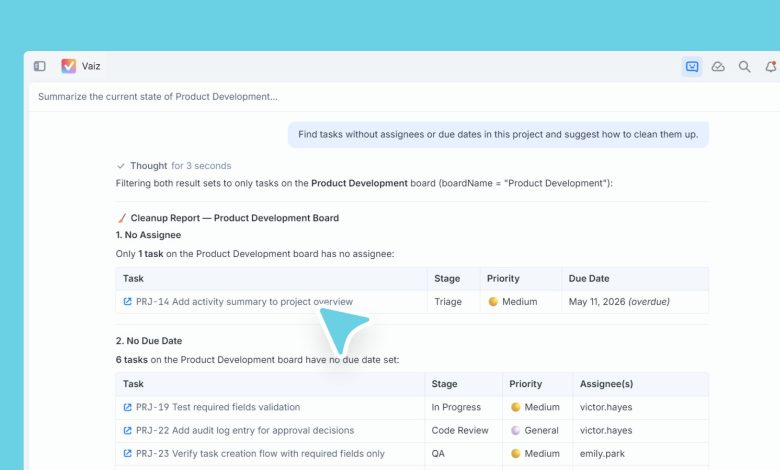
The AI assistant operates inside the workspace — tasks, documents, project history, team activity — not just the item currently in focus. Ask it what’s overdue, what’s blocked, or what the team should prioritise today, and the answer is grounded in what’s actually happening rather than what you chose to paste into a prompt.
That’s the difference between AI knowledge management that works and one that doesn’t. The knowledge has to be live, connected, and visible to the AI — not sitting in a separate wiki that nobody updates.
It also supports MCP — the Model Context Protocol — which means if your team already uses another AI tool, that tool can connect to the workspace and operate with the same context. Less about replacing what you have, more about making it actually useful.
Where this is heading
The reason this matters beyond today is agentic AI. Everyone’s talking about agents, but most conversations skip the basic requirement: agents need context to act. An agent that can’t see the workspace can’t update task status, flag risks, or run a process autonomously — because it doesn’t know what’s happening.
This is where managing knowledge with AI becomes infrastructure, not a nice-to-have. Agents need a living record of what the team knows — not a static wiki, but a connected workspace where knowledge updates as work happens. The teams that get real value from agentic AI won’t necessarily be the ones with the most sophisticated models. They’ll be the ones whose AI can already see the work.
“The value of AI at work depends entirely on what it can see.”
The thing most teams are sitting on
Workspace context is the unlock. It’s not a new concept — it’s just that most tools were built before anyone took it seriously. The right approach doesn’t ask teams to change how they work. It sits where the work already happens and makes everything the team knows accessible to the AI in real time.
The AI that knows your projects, your documents, your team, and your history isn’t a future thing. It exists now. Most teams just haven’t connected the two yet.
About Vaiz
Vaiz is a work management platform that combines tasks, docs, and automation in one workspace. Built for small and mid-sized teams. Free to start, from $5/user. Learn more at vaiz.com