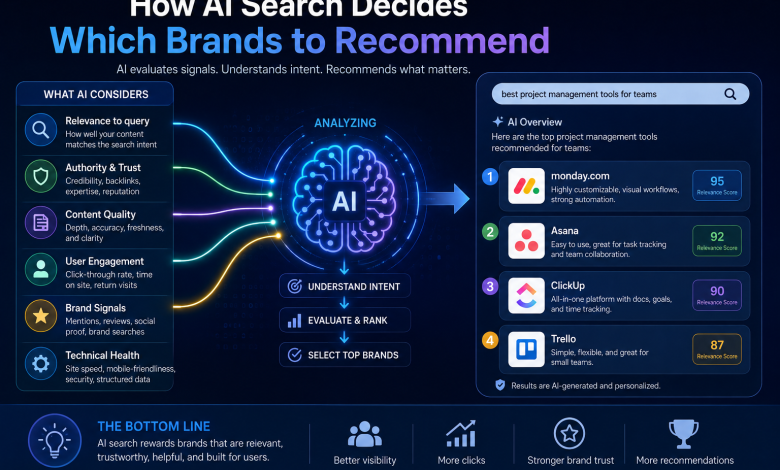
The algorithm you never hired is now shaping your brand’s reputation, whether you like it or not. With 900 million weekly active ChatGPT users and Google’s AI Overviews appearing in roughly half of all searches, the stakes have shifted.
Brands invisible to these systems are losing ground they may never reclaim. Understanding how AI search decides which brands to recommend isn’t optional anymore. It’s survival. And Prox Digital Agency guides global brands by providing the best digital solutions in their survival period.
The Old Playbook Just Burned
For decades, digital marketing followed a predictable script. Rank high on Google. Run targeted ads. Measure everything. Know exactly where your traffic came from and what it cost to acquire.
That playbook now covers maybe half the battlefield.
Today’s AI search engines return results, craft answers, and recommend brands directly. When someone asks ChatGPT for a marketing agency, a financial planner, or a project management tool, the response lands with authority. A short list appears. Some names get rich descriptions. Others get a passing nod. Most get nothing at all.
Here’s what should concern you: The way AI platforms choose which brands to surface doesn’t mirror traditional Google rankings nearly as closely as you’d think.
In mid-2025, an Ahrefs study found that 76% of URLs cited in Google’s AI Overviews also ranked in the top 10 organic results. Fast forward to today, and that overlap has plummeted to roughly 38%.
The rules changed. Most people just haven’t noticed yet.
The Two-Stage Process: How AI Actually Chooses
Semrush’s AI Visibility Index 2025 reveals that AI models rely on a two-stage decision process. Understanding this machinery is your first step toward getting named.
Stage 1: Discovery
At this stage, the AI asks: “What are the best running shoes?” or “Which CRM do experts actually recommend?”
To answer, it scans what the broader internet says about each brand. Key sources include:
- Reddit, Quora, and niche forums where real people debate and recommend
- Review platforms like G2, Capterra, and Yelp
- Listicles, rankings, and comparison articles
- Social media chatter and YouTube comments
What matters less here is what your brand claims about itself. What matters far more is what others say about you. The model aggregates collective sentiment and favors brands with stronger community presence and social proof.
Critical data point: Brands with significant Reddit and Quora mentions get cited by ChatGPT roughly four times more often. AI isn’t just reading your website—it’s reading what people say about you in the wild.
Stage 2: Authority
Once the user wants deeper information—say, “Is Garmin’s Forerunner 965 actually waterproof?” or “What does Zoho CRM cost per user?”—the AI pivots to validation.
At this stage, it prioritizes:
- Your official website and product pages
- Wikipedia and other established reference sources
- Pages with structured data like pricing, specs, and availability
If your site lacks clear, well-organized, machine-readable information, the AI may skip you entirely even if you passed the discovery phase.
What AI Actually Cares About (And What It Ignores)
The Keyword Trap
Here’s where most companies get it wrong: they assume traditional keyword optimization works in AI search.
Research from Princeton and the Indian Institute of Technology Delhi (November 2023) found something surprising. Keyword stuffing actually performed about 10% worse than no optimization at all.
What actually helped? Adding verifiable statistics. Citing authoritative sources directly within your content. Writing in a tone researchers described as “authoritative and persuasive.”
The old SEO tricks don’t translate. You need a different approach.
Structure Is Underrated
SE Ranking analyzed 129,000 domains and 216,524 pages across 20 industries. The findings were striking:
- Pages with content sections between 120–180 words earned 70% more citations than pages with shorter blocks
- Content updated within the past three months got cited twice as often as older material
For service businesses specifically: Squarespace sites in the service sector were about 12% more likely to receive at least one AI-driven visit per month compared to physical product sellers.
The lesson? Structure matters. Freshness matters. Depth matters.
Platform Differences You Can’t Ignore
Treating all AI search as one channel is a strategic mistake.
An Ahrefs study revealed only 13.7% citation overlap between Google’s AI Overviews and Google’s own AI Mode and they’re from the same company. ChatGPT, Perplexity, and Google’s AI features share just 14% of their top-cited sources.
Each platform has its own personality:
- ChatGPT leans heavily on Wikipedia, it’s the number-one cited domain by a wide margin
- Google AI Mode pulls disproportionately from social media; over 90% of Instagram citations came through this channel
- Perplexity favors listicle-style content; in professional services, one in three citations came from a “best of” article
- Editorial roundups dominated across all categories; more than 20% of all citations came from these articles
If you’re optimizing for one platform, you’re probably missing the others.
The Domain Authority Reality Check
Here’s a factor most content strategies overlook entirely. Referring domain diversity emerged as the single strongest predictor of ChatGPT citation probability. Sites with over 32,000 referring domains received 3.5 times more citations than those with under 200. Let that sink in.
You can’t just optimize your way into AI visibility through content alone. Domain authority earned through backlinks, media coverage, community mentions, and genuine brand presence acts as the baseline filter. AI platforms evaluate whether you’re a legitimate player before they even consider your content quality. It’s not about gaming the system. It’s about actually being the kind of brand that belongs in the conversation.
How B2B Brands Are Winning Right Now
The new B2B marketing metric is simple: Does your brand get cited when a buyer asks an AI assistant a question? The brands showing up inside ChatGPT, Claude, and Google’s AI Overviews are, with very few exceptions, the same ones ranking well on Google. AI visibility correlates with search rank, it doesn’t replace it.
Real example: One enterprise B2B SaaS client now receives roughly 174 referred sessions per month from AI assistants across 26 articles up from just 23 a month earlier. Their content has earned 794 LLM citations across the site. During that same period, those citations drove 29 commercial conversion events, free-trial requests, demo completions, the works.
Another example: A venture capital firm had 27 articles go from effectively unranked to compounding organic traffic. The same work lifted them to the second-highest AI assistant visibility in their competitive set, with LLM referral traffic up 183% month over month.
The common thread? Every piece of content went through editorial infrastructure with primary-data substance, human review, and named author authority surfaced in structured schema.
And here’s where it gets interesting: We have been quietly applying this exact framework for our clients, helping them move from invisible to cited across ChatGPT, Perplexity, and Google’s AI Overviews. By combining editorial rigor with structured schema and primary-data content, we’re making sure clients don’t just rank and get recommended.
What About “Generative Engine Optimization (GEO)”?
Since you might be wondering, what is GEO (Generative Engine Optimization)? It’s simply the practice of getting your brand named inside AI-generated answers, rather than just ranked in traditional search results.
It’s the discipline that turns everything we’ve discussed into actionable strategy. And right now, very few businesses are doing it well.
Practical Steps to Get Recommended by AI
1. Build for Extraction and Ranking
AI platforms pull from self-contained passages of content. Make it easy for them.
- Open every section with a direct, declarative answer to the implied question
- Use lists and tables for comparisons, features, and multi-point answers
- Implement schema markup (Article, FAQ, Organisation, Product) for machine readability
- Keep paragraphs short- two to four sentences- with one clear idea each
2. Find and Close Citation Gaps
Start by identifying topics where AI assistants cite your competitors but not you. A citation gap is a demand signal. It tells you the topic already matters in your category; you just haven’t earned a place in the conversation yet.
Create content that offers something AI can’t find elsewhere. Original research. Firsthand experiments. Unique perspectives. AI can quote a statistic, but it still needs to credit the source.
3. Optimize Both Discovery and Authority
Most brands optimize one stage and neglect the other.
Common problems:
- Brands with strong social buzz but weak official documentation
- Companies with excellent technical SEO that generate little conversation
- Sites with great content but hidden pricing or ambiguous information
AI doesn’t choose based on authority alone or conversation alone. It needs both.
4. Balance On-Site and Off-Site Actions
On your site:
- Create dedicated pages that clearly explain your products, materials, and practices
- Build certifications and standards pages AI can reference directly
- Develop product attribute hubs covering key topics
- Write clear, non-promotional summaries and FAQs
Beyond your site:
- Appear on the sources that already shape AI answers; this often matters more than publishing additional content on your own domain
- Pursue editorial coverage in reputable publications
- Maintain consistent review sentiment across G2, Capterra, Trustpilot, and similar platforms
- Ensure your business listings are accurate with correct categories, hours, and locations
5. Make Your Site Crawlable
AI platforms read code, not visuals. JavaScript-heavy pages that block crawlers are a frequent culprit. If the AI agent can’t extract your price, availability, and product attributes within its crawl timeout window, it skips your site and recommends a competitor instead.
Test your site. If a bot can’t read it, neither can AI.
AI Is Already Deciding
Here’s a number worth remembering: 75% of our AI-optimized clients are capturing direct, documented e-commerce sales or transaction revenue specifically from ChatGPT recommendations.
The businesses vary wildly by category, size, and stage. The common denominator? They structured themselves in ways AI systems could read, cite, and recommend, and their competitors didn’t.
Why this matters right now:
- 50% of consumers actively use AI-powered search during buying decisions
- ChatGPT hit 800 million weekly active users by late 2025
- 75% of brands are now getting sales from ChatGPT
- AI platforms cite different sources differently; treating them as one channel is a losing strategy
The businesses treating AI visibility as optional are the ones who’ll wake up to the problem only after competitors have built an unassailable lead.
A new mindset: A brand through AI’s eyes depends on three things: whether AI can find you, whether it trusts you, and whether it can understand and cite your content.
The good news? Content that earns AI citations- original research, firsthand experiments, unique perspectives, exclusive data- is also the kind of content people share, journalists quote, podcasts discuss, and sales teams actually use.
The algorithm you never hired is already shaping your brand’s reputation. It’s time to make sure you’re part of the conversation, not just a footnote in someone else’s.