



Every year, tens of millions of checked bags never make it to the carousel on time. According to SITA, the global aviation technology body that tracks baggage performance across airlines worldwide, 24 million bags were mishandled globally in 2025 alone. Anyone who’s stood at an empty carousel watching the belt shut down knows exactly what that number feels like in real life. It’s not just an inconvenience. It’s your clothes, your chargers, sometimes your work laptop, sitting somewhere you can’t see and nobody can quite explain.
Airlines will tell you they’re “looking into it.” What they usually mean is they’re waiting for a scanner somewhere in the system to pick up your bag’s barcode again. Until then, you’re guessing. That gap between “my bag is missing” and “my bag is found” is exactly where a luggage tracker tag earns its place in your carry-on.
Luggage Tracker Tag Horror Stories: What Happens When Your Bag Disappears
Picture a connecting flight through a major European hub. You land, your bag doesn’t. The airline desk takes your claim, prints a reference number, and tells you to check an app that updates once every few hours, if it updates at all.
Three days have passed. No call. No bag. You’re reduced to refreshing a tracking page that hasn’t changed since check-in, hoping someone at the transfer hall notices the tag before it gets rerouted to the wrong continent.
This isn’t a rare story. It’s the default experience for a mishandled bag, because standard airline tracking only knows what a scanner tells it, and scanners only fire when someone physically routes your bag past one. Between those checkpoints, your suitcase is a black box. You have no visibility, and neither does the airline, no matter how many times the desk agent says “let me check the system.”
How Bag Tracking Actually Changes the Outcome at the Airport
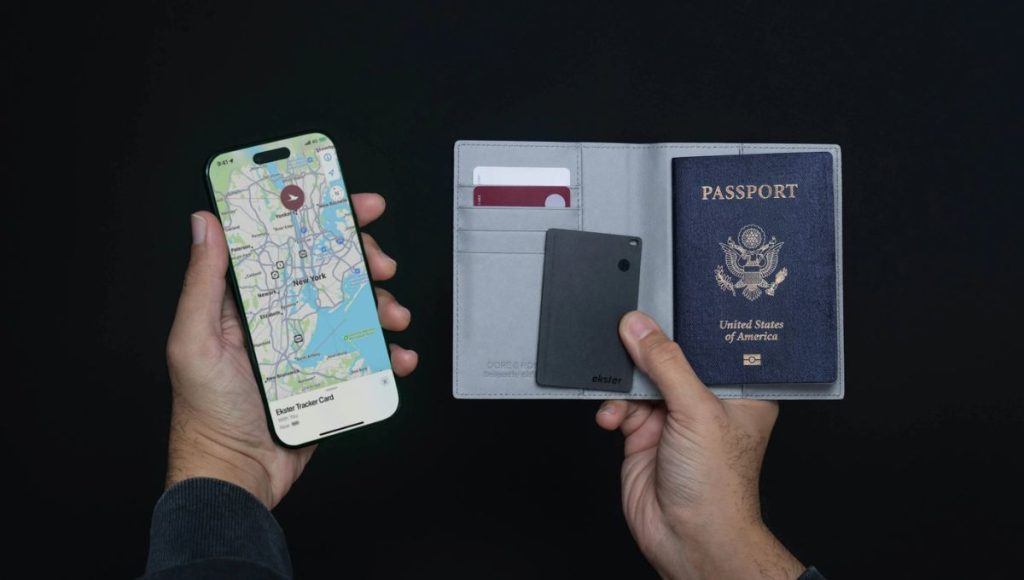
Now run that same layover with a small tracker clipped inside the bag. The moment your suitcase moves near another phone on the Apple or Google network, whether that’s a fellow passenger or an airline worker walking past with their own device, your app updates. You’re not waiting on a barcode scan. You’re watching an actual location on a map.
This is where the Ekster Tracker Tag does something most travelers don’t expect: it works whether you carry an iPhone or an Android phone. Here’s what that actually gets you at the airport:
- Real-time crowd-sourced updates — your app pings the moment your bag moves near another phone on the network, not just when a scanner catches it
- True cross-platform tracking — pairs with Apple Find My (over a billion iPhones) or Google’s Find Hub (over three billion Android phones), so it doesn’t matter which one you or your travel companion carries
- Zero ongoing cost — no separate app, no account setup, no subscription fee either way
- Proof you can act on — see the last known location, ring it if it’s nearby, or hand airline staff a screenshot showing exactly where their scanners lost track of it
That cross-platform part matters more than it sounds. A lot of trackers lock you into one ecosystem. If your travel companion has a different phone than you, or if you switch phones down the line, a single-platform tracker becomes dead weight. This one doesn’t care which pocket your phone lives in — and that’s the difference between filing a claim and actually pointing someone toward your bag.
What Every Missing Suitcase Has in Common Without One
Look back at enough of these stories and a pattern shows up. It’s rarely the airline being careless on purpose. It’s a system built entirely around scheduled scans, with zero visibility in between. SITA’s baggage data backs this up at an industry level too: transfers between flights remain the single biggest driver of mishandling worldwide, accounting for close to 40% of all cases. That matches the connecting-flight scenario most horror stories start with.
Bags that get found fastest usually have:
- Independent location data the owner controls, separate from the airline’s own scanner system
- A tracker on a network with enough device density to pick up a signal quickly
- No dependency on someone at the transfer hall noticing the tag by chance
Bags that stay lost the longest usually have:
- Nothing but the airline’s barcode-scan system to rely on
- A tracker that only works with half the population’s phones, cutting the odds of detection in half
- A subscription-based GPS tracker with a dead battery, since these need charging schedules travelers forget mid-trip
A single-platform Bluetooth tag is better than nothing, but it only helps if enough compatible devices happen to pass near your bag. A dual-network tag doubles your odds simply by doubling the pool of phones that can detect it. Subscription-based GPS trackers solve the network problem differently, using cellular data instead of Bluetooth crowd-sourcing, but for the average traveler checking a bag a few times a year, a monthly bill is a lot of ongoing cost for a problem a one-time purchase already solves.
How to Choose the Best Luggage Tracker for Your Next Trip
Before you clip anything to your suitcase, run it against a short checklist:
- Phone compatibility. Confirm it works with your actual phone, not just “smartphones” in general. Some tags are iOS-only and simply won’t report a location to an Android device.
- Battery type. Rechargeable trackers or ones with replaceable batteries that last 10 months to a year are best.
- Subscription cost. Bluetooth trackers using Find My or Find Hub don’t need a monthly plan. Cellular GPS trackers do. Know which one you’re buying.
- Size and attachment. A tracker with a built-in attachment hole saves you from buying a separate loop or case just to clip it inside your bag.
- TSA rules. Trackers running on the Apple or Google finding networks are allowed in both checked and carry-on luggage, so this shouldn’t be a deciding factor either way.
Weighed against those points, the best luggage tracker for most travelers is the one that works no matter whose phone is nearby, costs nothing after the initial purchase, and doesn’t ask you to remember a charger. That combination is rarer than it should be, and it’s exactly what makes a dual-network, subscription-free tag worth packing before your next flight.
Lost luggage isn’t going away. Airlines mishandle bags every day, and no amount of hoping fixes that. A luggage tracker tag won’t stop a bag from getting misrouted, but it decides whether you’re the traveler staring at an unchanged tracking page, or the one who already knows exactly where your bag is sitting.