For the past several years, AI discussions have largely revolved around training. Headlines have focused on massive GPU clusters, multibillion-dollar infrastructure investments, and the race to build increasingly powerful models. Scale became the symbol of AI leadership, and organizations capable of training larger models often dominated the conversation.
Training is undoubtedly important. It is the process through which models learn patterns from vast amounts of data and develop the capabilities that make AI possible. However, training represents only one stage of the AI lifecycle. It is the build phase, not the usage phase.
As AI adoption expands across industries, attention is beginning to shift toward a different question: Where is value actually created?
What AI Inferencing Actually Means
The simplest way to understand inferencing is to compare it to a newly trained employee.
Training involves months of learning, examples, coaching, and preparation. Inferencing is what happens when that employee begins applying that knowledge to real-world situations. The training matters, but the value comes from execution.
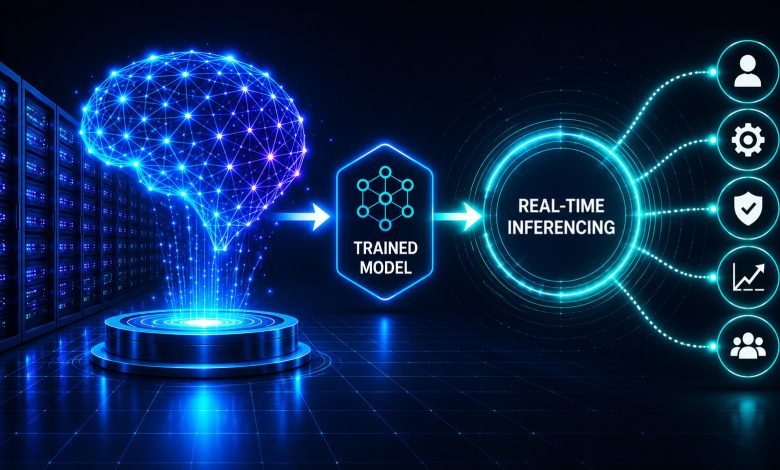
AI operates in much the same way. Training teaches a model how to recognize patterns and relationships within data. Inferencing occurs when the trained model applies that knowledge to generate recommendations, predictions, responses, or decisions.
Consumers interact with inferencing every day. When Amazon recommends products based on browsing behavior, inferencing is at work. When Google Search ranks results based on user intent, inferencing is taking place. When a payments platform identifies a potentially fraudulent transaction in real time or a navigation application recommends a faster route, those decisions are being driven by inferencing.
Training teaches the system. Inferencing is the moment the system becomes useful.
Why Inferencing Is Where the Real Scale Begins
One reason inferencing receives less attention is that it lacks the spectacle associated with training. Massive training runs generate headlines. Inferencing happens quietly in the background.
Yet inferencing is where AI begins to operate at scale.
Training may occur once, periodically, or on scheduled cycles. Inferencing happens continuously. Every chatbot response, search query, recommendation, fraud check, personalization engine, and automated decision creates an inference event.
As AI becomes embedded within products, workflows, and customer experiences, those events multiply rapidly. A successful AI application may generate millions or even billions of inference requests every day.
Increasingly, inference will not only occur when humans ask AI systems questions. Autonomous AI agents will continuously interact with applications, APIs, databases, and other agents. These machine-driven interactions dramatically increase the number of connections, transactions, and security decisions organizations must manage.
This changes the economics of AI. A foundation model may require a major training cycle, but inference occurs continuously throughout the life of the application. The more successful an AI system becomes, the more inferencing it requires.
Why Infrastructure Now Matters More Than Ever
Training and inferencing place very different demands on infrastructure.
Training prioritizes large-scale computational power. Inferencing prioritizes responsiveness, consistency, geographic proximity, secure connectivity, and efficient movement of data between users, AI services, applications, and data sources. Users rarely see the training process, but they immediately notice inferencing performance.
Unlike training environments where data pipelines can often be planned in advance, inference frequently requires real-time access to distributed enterprise data. AI agents need secure, governed connectivity to information wherever it resides — SaaS platforms, private applications, cloud environments, and data centers.
A delayed chatbot response, a lagging AI assistant, or a recommendation engine that struggles to keep pace can quickly undermine confidence in an application. In many cases, users judge AI not by the sophistication of the model but by the quality of the experience it delivers.
This reality is pushing infrastructure closer to the center of AI strategy. Organizations must increasingly consider how AI services perform under real-world conditions, across regions, and under growing demand.
A brilliant model with poor inferencing performance can still fail to create meaningful value.
The Market Shift From Bigger Models to Better Delivery
Many emerging technologies follow a familiar pattern. Early competition rewards invention and technical breakthroughs. Over time, operational excellence becomes the deciding factor.
AI appears to be entering that transition.
The first phase of the market rewarded organizations capable of building increasingly advanced models. The next phase is likely to reward organizations capable of delivering those models efficiently, reliably, and at scale.
Questions around inferencing costs, response times, performance consistency, and operational efficiency are becoming just as important as questions about model quality. As AI adoption accelerates, organizations will increasingly evaluate whether AI systems can scale economically while maintaining a high-quality user experience.
The focus is gradually shifting from who built the model to who can operate it most effectively.
What Business Leaders Should Be Watching Now
For business leaders, AI strategy can no longer end with model selection. Operational readiness is becoming equally important.
Leaders should understand how inference costs scale with usage, how performance changes during periods of peak demand, and how user experience varies across geographic regions. Security becomes more challenging during inference because AI is no longer isolated inside development environments. AI systems begin interacting with users, applications, APIs, and sensitive business data. Organizations must control not only who can access AI, but what AI agents themselves are allowed to access.
Organizations that focus exclusively on training breakthroughs risk overlooking where recurring value and recurring costs actually emerge.
Training remains essential. Without training, there is no model. But training alone does not create business outcomes.
Inferencing is where AI interacts with customers, supports employees, automates decisions, and generates measurable results. As AI adoption continues to expand, inferencing increasingly serves as the bridge between technical capability and commercial value.
The next phase of AI competition may not be defined by who trained first. It may be defined by who delivers best.