Abstract
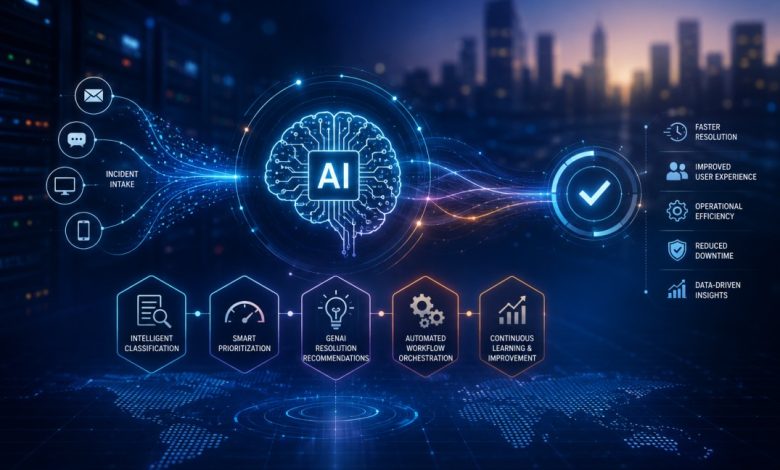
Modern IT operations environments face increasing pressure to resolve incidents quickly while maintaining service reliability and user satisfaction. Traditional incident management processes rely heavily on manual triage, delayed decision-making, and reactive workflows. This article introduces a vendor-neutral framework for AI-Powered Incident Management using Generative AI simulation, enabling intelligent incident classification, automated prioritization, contextual resolution recommendations, and workflow orchestration. The framework demonstrates how organizations can simulate AI-driven operations to improve response times, reduce operational overhead, and move toward autonomous IT service management.
1. Introduction
Incident management is a core function in IT service delivery, ensuring that disruptions are identified, prioritized, and resolved efficiently. However, traditional incident management models often depend on manual processes, requiring service desk agents to interpret incident details, categorize issues, and determine resolution paths.
As IT environments grow more complex, these manual approaches introduce delays, inconsistencies, and increased operational costs. Organizations are now exploring AI-driven solutions to enhance incident management, but full-scale AI adoption often requires significant investment in infrastructure and data readiness.
Generative AI simulation offers a practical alternative by mimicking intelligent decision-making through structured workflows. This approach enables organizations to experience the benefits of AI without requiring advanced machine learning models.
2. Challenges in Traditional Incident Management
Despite advancements in IT service management tools, organizations continue to face several challenges:
- high volume of incoming incidents
- inconsistent categorization and prioritization
- delayed response and resolution times
- lack of contextual insights during triage
- repetitive manual tasks for service desk agents
These challenges result in increased downtime, reduced productivity, and lower user satisfaction. Without intelligent automation, IT teams struggle to scale operations effectively.
3. Framework Overview
The AI-powered incident management framework consists of four key layers:
- Incident Intake and Context Enrichment
- GenAI-Simulated Classification and Prioritization
- Resolution Recommendation Engine
- Automated Workflow Orchestration and Monitoring
These layers work together to simulate intelligent IT operations and enable proactive incident handling.
4. Incident Intake and Context Enrichment
The process begins with incident intake from multiple channels, including service portals, email, monitoring systems, and chat interfaces. Each incident is captured and structured with key attributes such as:
- incident description
- affected services or systems
- user or business impact
- timestamps and metadata
Context enrichment enhances this data by incorporating historical incident patterns, configuration details, and known issue correlations. This ensures that downstream processes operate with accurate and meaningful inputs.
5. GenAI-Simulated Classification and Prioritization
At the core of the framework is a GenAI-simulated engine that mimics intelligent decision-making. Instead of relying on trained models, this layer uses structured logic to simulate AI behavior.
The classification process evaluates:
- keywords and patterns in incident descriptions
- service impact and urgency indicators
- historical categorization trends
- predefined classification rules
Similarly, prioritization is determined based on:
- business impact
- service criticality
- urgency levels
- dependency relationships
This simulation approach enables consistent and explainable decision-making, ensuring that incidents are categorized and prioritized accurately.
6. Resolution Recommendation Engine
One of the most valuable capabilities of AI-powered incident management is the ability to suggest resolution steps.
The recommendation engine analyzes:
- historical incident resolutions
- knowledge base articles
- known error databases
- troubleshooting workflows
Based on this analysis, the system provides contextual recommendations to service desk agents or end users. These suggestions may include:
- step-by-step resolution guidance
- relevant documentation
- automated fixes or scripts
By enabling guided resolution, organizations can significantly reduce mean time to resolution (MTTR).
7. Automated Workflow Orchestration
Once incidents are classified and recommendations are generated, workflow automation ensures that the appropriate actions are executed.
Key automation capabilities include:
- assigning incidents to the correct support teams
- triggering escalation workflows for critical issues
- notifying stakeholders and affected users
- initiating automated remediation processes
Workflow orchestration ensures that incidents move through a structured lifecycle, reducing delays and improving accountability.
8. Continuous Monitoring and Feedback Loop
The framework incorporates continuous monitoring to track:
- incident resolution times
- effectiveness of recommendations
- recurring incident patterns
- system performance trends
Feedback loops allow the system to refine classification logic and improve recommendation accuracy over time. This creates a self-improving environment that enhances operational efficiency.
9. Benefits of AI-Powered Incident Management
9.1 Faster Incident Resolution
Automated classification and recommendations reduce response time and accelerate issue resolution.
9.2 Consistent Decision-Making
Standardized logic ensures uniform handling of incidents across teams.
9.3 Reduced Operational Overhead
Automation minimizes manual effort and repetitive tasks for service desk agents.
9.4 Improved User Experience
Faster resolution and proactive communication enhance user satisfaction.
9.5 Scalable IT Operations
The framework supports high incident volumes without requiring proportional increases in staffing.
10. Responsible AI and Automation
While AI simulation offers significant benefits, organizations must implement it responsibly. Key considerations include:
- maintaining transparency in decision logic
- ensuring fairness in prioritization
- providing human oversight for critical incidents
- maintaining audit trails for all automated actions
Responsible implementation ensures trust and reliability in automated systems.
11. Conclusion
AI-powered incident management represents a significant advancement in IT service delivery. By simulating generative AI capabilities through structured workflows, organizations can improve efficiency, reduce downtime, and enhance user experience.
This framework provides a practical pathway for organizations to adopt intelligent IT operations without requiring complex AI infrastructure. As organizations mature, these simulated capabilities can evolve into fully autonomous systems, enabling the next generation of IT service management.
References
- Deloitte Insights (2023): https://www2.deloitte.com
- McKinsey & Company (2022): https://www.mckinsey.com
- Harvard Business Review (2021): https://hbr.org