Over the past several months, headlines have been dominated by record-breaking investments in expanding AI infrastructure. Around the world, hyperscalers and major players are betting big on strengthening the backbone of AI.
This all shows that AI is not just about models. It’s about having the right infrastructure, data management, and governance safeguards in place to make the models both useful and safe for enterprises.
Infrastructure is More Than Power and Compute
AI demands enormous storage and compute capacity. But building more data centers alone is not enough. We really need to think about how to gain the right data to fuel these systems, and how to protect, govern, and contextualize it.
A recent study from OpenText and the Ponemon Institute found enterprises are prioritizing AI without but lacking the foundations to support it. AI adoption is a top priority, yet most organizations lack confidence in measuring ROI or aligning IT and security goals with AI strategy. The challenge is fragmented, ungoverned enterprise information.
Without trusted, well-governed data, even the most powerful AI models will produce inconsistent, biased, or risky outputs.
Why Secure Information Management is the Foundation for AI
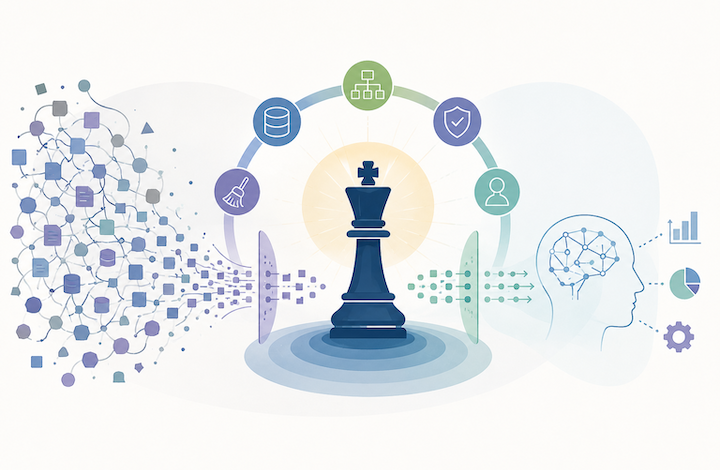
The phrase “data is king” no longer tells the full story. Today, context is king. To make AI accurate and reliable, enterprises must know what data they have, where it lives, who has access to it, and how it’s being used. That means data classification, cleaning, lineage, and consistent governance. It also means stripping out sensitive information, like PII, before training or inference.
Beyond cleaning data, enterprises must invest in context engineering. This is the process of defining the business meaning of information so AI can generate accurate, relevant results.
These practices may sound operational, but they are what elevate AI from eye-catching demos to scalable, business-critical use cases, especially in highly regulated industries.
Security and Governance Safeguards Build Trust
As AI becomes embedded in core workflows, security risks grow more complex. New threats like the challenge of auditing autonomous AI agents make it essential to build governance into AI environments from the start.
This requires building safeguards that can also scale. For example, having access controls that extend to AI agents, audit trails that track who (or what) did what work, and taking a zero-trust mindset for every workflow. Without that foundation, even the most advanced models will struggle to earn enterprise trust.
Where Enterprises Can Start
For leaders wondering how to move from vision to execution, I propose using four practical strategies:
- Map and Classify Data: Know what you have, where it resides, and who has access, and which data sets are actually a fit for AI. This is the foundation for both AI readiness and compliance. For example, a bank looking to deploy an AI assistant for customer service cannot simply connect a model to years of customer records and hope for the best. It needs to know which data is current, which data contains PII, which records are governed by retention rules, and which employees or AI agents are entitled to use that information.
- Strengthen Governance at Scale: Apply policies that strip out sensitive data, enforce access controls, and maintain lineage across workflows. Governance cannot be a manual review process once AI is operating across thousands of documents, tickets, transactions, and business processes. Enterprises need automated policy enforcement so that AI systems understand not only what information exists, but what information they are allowed to use, summarize, share, or act upon.
- Embed Security into AI Workflows: Extend zero-trust principles to AI agents and design with resilience against emerging threats. This means treating AI agents like any other identity. They should have defined roles, limited permissions, observable behavior, and audit trails. If an agent is resolving an IT ticket, reviewing a contract, or approving a workflow, the organization should be able to trace what data it accessed, what action it took, and whether that action complied with policy, just like it would a human employee.
- Bring AI to the Data: Instead of moving sensitive or high-volume data into centralized models, deploy AI where the data lives. This is especially important for regulated industries and global enterprises navigating data sovereignty, privacy, and latency requirements. A healthcare organization, manufacturer, or government agency, for example, cannot freely move sensitive data across environments. AI must be architected to operate within the enterprise’s existing cloud, hybrid, or private environments while preserving control. In my own work, this has meant designing AI systems that sit inside the operational workflows people already use, like helping development teams automate parts of DevSecOps. The goal is not to pull all that information into a separate AI environment, but to bring AI to the enterprise data, policies, permissions, and context that already exist.
Taken together, these steps help enterprises avoid one of the most common mistakes in AI adoption: treating the model as the strategy. The real strategy is building an information environment where AI can operate with context, permission, security, and trust.
Building for the Future
The global AI race is moving from who has the biggest models or fastest chips to who builds the strongest foundations. Enterprises that get this right will scale AI responsibly and profitably.
I often tell customers, if you want AI that delivers real value, don’t just ask how powerful your models can become. Ask whether your information is ready to support them.
That is the true measure of AI readiness.